

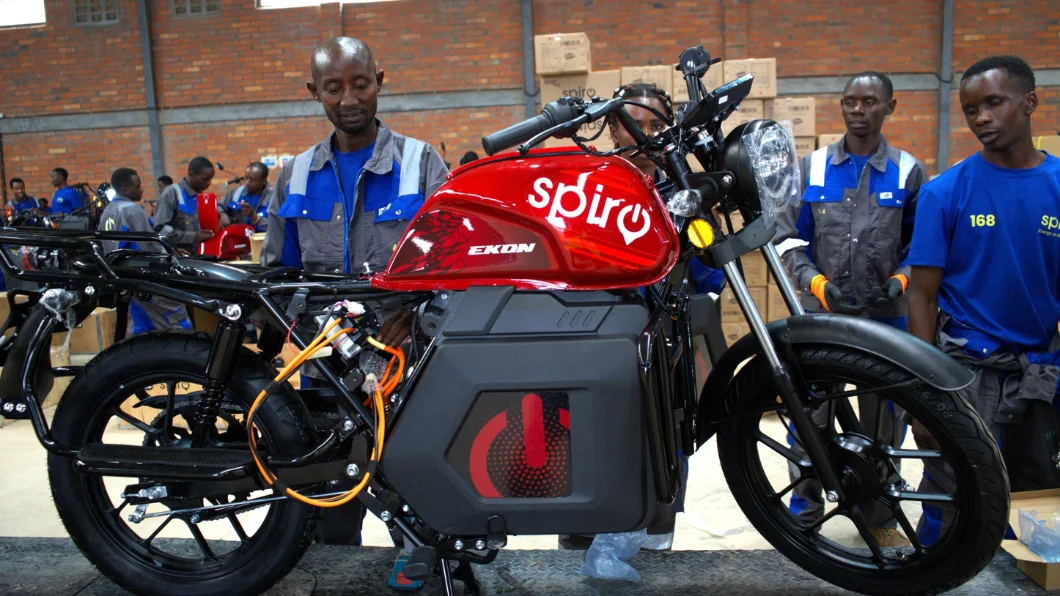
Pull into one of Spiro’s swap stations anywhere in Nairobi, Kigali, or Lagos, and within sixty seconds you’re back on the road with a fully charged battery. No waiting. No downtime. No fuel queue.
That one-minute exchange, now repeated more than 30 million times across seven African countries, is what just attracted $215 million in fresh equity.
Spiro has closed a $215 million round backed by Impact Fund Denmark, Denmark’s state development finance institution, and Equitane, the long-term investment platform founded by Spiro chairman Gagan Gupta. The raise brings the company’s total funding to more than $343 million across seven rounds, cementing its position as the most heavily capitalised electric mobility company on the continent.
Why this round is different
The timing and structure of this raise matter. It follows a $100 million equity round led by Afreximbank’s FEDA in October 2025 and a $50 million debt facility secured just three months ago. Three significant capital events in under a year, from development finance institutions and long-term investment platforms, not growth-stage VCs looking for a quick exit. The investors writing these cheques are not betting on a startup. They are building infrastructure.
Impact Fund Denmark’s CEO, Lars Bo Bertram, framed it plainly: “We see potential for significant commercial growth in Spiro and electric mobility across Africa, as well as measurable climate impact. That is exactly the type of investment we want to make.”
Danish pension capital flowing into an African electric motorcycle company is not something that would have seemed plausible five years ago. It is a signal of how quickly the market has matured.
What Spiro has actually built
The numbers Spiro brings to this conversation are hard to argue with. The company currently operates 100,000 electric motorcycles and 2,500 battery swap stations across Kenya, Rwanda, Uganda, Nigeria, Togo, Benin, and Cameroon. It also runs manufacturing plants in Kenya, Rwanda, and Uganda, and a battery recycling facility in Nigeria, meaning it controls the supply chain from production to end-of-life.
For riders, the economics are tangible. Spiro says its customers spend up to 40% less on daily transport costs compared to petrol bikes, roughly $2 saved per day. A lifecycle assessment of its Kenya operations found its motorcycles produce 72% lower emissions than petrol alternatives, preventing approximately 19 tonnes of CO2 per vehicle over its lifetime.
These are not projections. They are operational metrics from a business running at real scale.
The market is moving fast
Spiro is not building into a small opportunity. Electric two-wheeler sales across Africa grew by nearly 40% in 2024. In Kenya specifically, electric motorcycles went from 0.5% of new registrations in 2021 to 15.3% in 2025. The African electric two-wheeler market is projected to grow from $441 million in 2023 to over $2.6 billion by 2031.
There is also a structural gap that Spiro is explicitly targeting. Africa has roughly 25 million motorcycles in use today. India, with a comparable population, has 320 million. That gap is not just an absence. It is a market waiting to be built, and Spiro intends to build it on electricity.
What happens next
The new funding will go towards expanding Spiro’s battery swap station network, developing next-generation vehicle technology, and entering Ethiopia and the Democratic Republic of Congo, two of the continent’s largest and most untapped markets.
Bloomberg also reported that Spiro is nearing unicorn status, with founder Gagan Gupta disclosing the company is approaching a $1 billion valuation.
For now, Spiro’s expansion into the DRC and Ethiopia will be the clearest test of whether the infrastructure model it has built across seven markets can travel. If it can, Africa’s electric mobility story just got a lot bigger.