
Almost everything Africans do online, banking apps, video calls, government services, business transactions, depends on a handful of fiber optic cables lying on the bottom of the ocean. Most people never think about them until they break, and when they break, entire regions go dark at once.
Submarine cables carry roughly 90% of Africa’s internet traffic. There are over 570 of these cables crisscrossing the world’s oceans, and a relatively small number of them serve the entire African continent. When even one gets cut, the consequences ripple across multiple countries simultaneously, because several nations often share the same physical cable route.
What These Cables Actually Are
Picture a cable roughly the width of a garden hose, packed with hair-thin strands of glass fiber that carry data as pulses of light, laid along the ocean floor connecting one continent to another. That’s a submarine cable. Data that feels instantaneous, a video call, a bank transfer, a Google search, is physically travelling through one of these cables at some point in its journey, often crossing thousands of kilometers of open ocean.
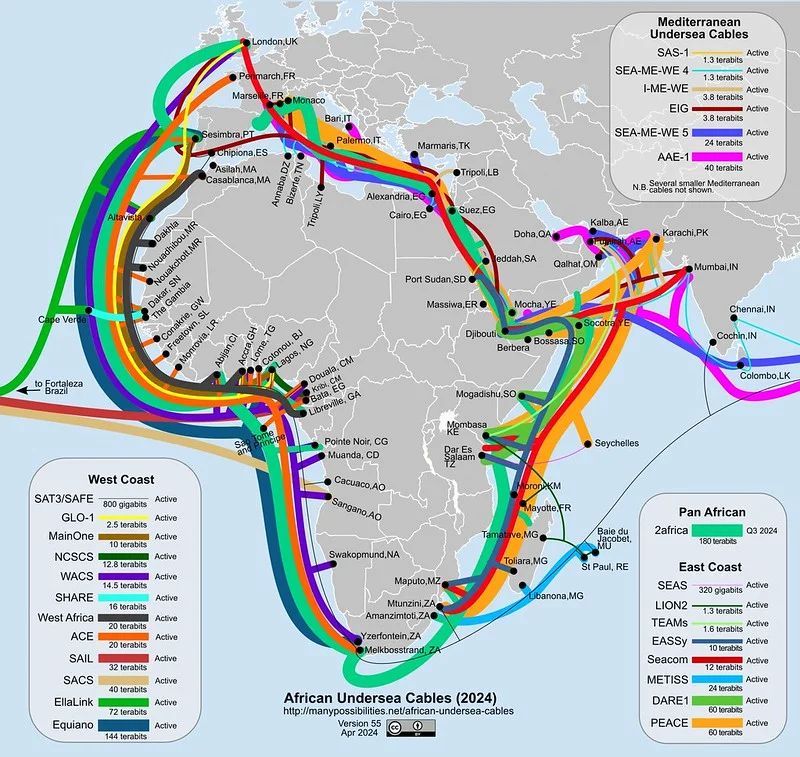
Africa is connected to the rest of the world, and to itself, through systems with names like WACS, ACE, SEACOM, EASSy, and Meta’s 2Africa. Each one is really a consortium, a group of telecom companies and increasingly big tech firms, that pooled money to build and now share ownership of a single cable.
Who Actually Owns Them
Here’s the part that surprises a lot of people: most of these cables aren’t owned by African governments or even African telecom companies alone. They’re owned by consortiums of investors, and increasingly, the biggest owners are the same handful of global tech giants everyone already knows. Google, Meta, Microsoft, and Amazon have poured billions of dollars into building and co-owning subsea cables that serve Africa, because their businesses depend on fast, reliable data flow just as much as any bank or telecom does.
Google’s Equiano cable and Meta’s massive 2Africa project, designed to be one of the largest submarine cable systems ever built, are both partly aimed at wiring up African connectivity, alongside connecting other regions. That’s not charity. It’s these companies securing the infrastructure their own services, search, cloud computing, social media, need to function reliably on the continent. But it does mean that a meaningful share of the infrastructure carrying Africa’s internet is owned by companies headquartered in California, not Lagos, Nairobi, or Cape Town.
Why Outages Happen More Than You’d Think
Cable breaks aren’t rare, freak accidents. They happen with some regularity, usually from ship anchors dragging across the seabed, occasionally from underwater seismic activity, and in one troubling recent stretch, from deliberate attacks. Since early 2024, Africa has experienced multiple major cable-related outages within the same year, hitting East and West Africa in separate incidents.
One of the worst runs of disruption traced back to the Red Sea, a critical chokepoint carrying around 17% of all global internet traffic. Cables running through those waters suffered repeated damage, which international cable industry groups linked to shipping traffic disrupted by regional conflict, including attacks attributed to Houthi rebels in Yemen. Those Red Sea cables remained unrepaired for extended periods because the security situation made it too dangerous for repair ships to safely reach the damaged sections.
Separately, cable breaks off the coast of Côte d’Ivoire and further faults along the East African coast knocked out or degraded internet service for countries including Kenya, Uganda, Tanzania, Rwanda, Madagascar, South Africa, Liberia, Ghana, and Benin, sometimes all within the same week.
Fixing a Broken Cable Isn’t Quick
When a submarine cable breaks, you can’t just patch it from shore. Specialized repair ships have to sail to the exact location, often taking several days just to arrive, then physically retrieve the damaged section from the seabed, splice it back together, and lower it again. Industry estimates put the average repair time at around 40 days, and that’s assuming weather, sea conditions, and, increasingly, regional security situations all cooperate.
During these repair windows, telecom operators scramble to reroute traffic through whichever alternative cables remain intact, which is why some countries recover within hours while others stay degraded for weeks. It depends entirely on how many alternative routes exist for that specific stretch of coastline, and in parts of Africa, the honest answer is not many.
The Resilience Problem Nobody’s Solved
The deeper issue researchers keep flagging is that Africa’s internet resilience hasn’t kept pace with how dependent the continent has become on connectivity. Multiple disruptions within a single year, hitting overlapping regions each time, exposed just how few backup routes exist for large stretches of the coastline. Experts have pointed out that unlike some other regions, Africa hasn’t built a coordinated regional framework for handling these emergencies collectively, leaving individual telecom operators to improvise cross-border workarounds each time a cable fails.
With Africa’s internet economy already valued in the hundreds of billions of dollars and growing, the stakes of these outages keep rising. More cables are being planned and built, but new construction takes years, while the underlying vulnerability, a small number of physical cables serving an enormous, connectivity-hungry continent, remains largely unchanged in the meantime.