

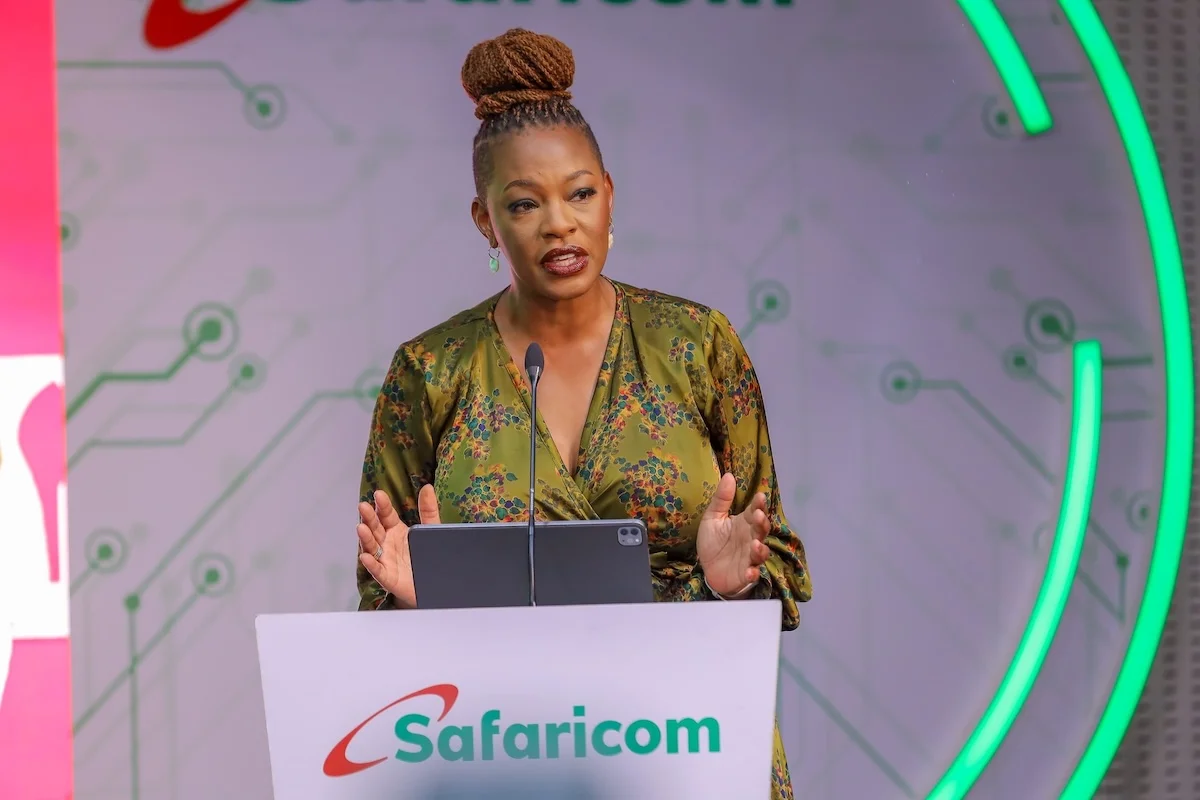
Safaricom has lost a third senior executive in five months, and this one leaves on a date that’s hard to read as coincidence.
Esther Masese Waititu, Safaricom’s Chief Financial Services Officer, has resigned and will exit on July 31, 2026, ending a tenure that began in February 2023. CEO Peter Ndegwa told staff in an internal memo that she was leaving “to pursue other opportunities,” at her own request. Boniface Mungania, the company’s Director of Public Sector Digital Transformation, steps in as interim Chief Financial Services Officer while Safaricom searches for a permanent replacement.
The Job That Actually Matters Here
The title sounds like a back-office finance role. It isn’t. Chief Financial Services Officer is the executive who runs Safaricom’s financial services arm, which means M-PESA and everything built on top of it: payments, savings, credit, the Fuliza overdraft product, and insurance. It’s arguably the most consequential business unit inside the entire company, generating a huge share of Safaricom’s profit.
Waititu’s specific legacy inside that unit is substantial. Ndegwa credited her with spearheading M-PESA’s migration to what the company calls Fintech 2.0, a cloud-native architecture meant to make the platform more reliable and easier for outside developers to build on through its Daraja ecosystem. She also oversaw the launch of Ziidi Trader in February 2026, an M-PESA mini-app that lets Kenyans buy and sell shares on the Nairobi Securities Exchange directly from their phones, built in partnership with the NSE, the Capital Markets Authority, and the Central Depository and Settlement Corporation.
She’s the Third, Not the First
Waititu’s exit doesn’t happen in isolation. Sitoyo Lopokoiyit, who ran M-PESA Africa for five years and had briefly served as acting Chief Financial Services Officer himself, left Safaricom on March 31, 2026, to become Chief Executive of Personal and Private Banking at Absa Group in Johannesburg. Then came Michael Mutiga, Safaricom’s Chief Strategy Officer, who is departing to become CEO of Stanbic Bank Kenya and South Sudan starting August 1, pending central bank approval.
That’s three senior executives connected to Safaricom’s financial services business, all gone within roughly five months, and all three moving into senior banking roles rather than staying in telecoms. One departure is routine. Three, in the same function, within the same short window, is a pattern.
The Date Nobody’s Officially Connecting
Here’s the detail that makes this exit different from the other two. Waititu’s last working day, July 31, falls on the same day Safaricom holds its Annual General Meeting that formally hands Vodacom fuller control of the company, following Vodacom’s completion of its 55% majority stake acquisition on June 30, 2026.
Neither Safaricom nor Vodacom has said the departures are connected to the ownership change, and there’s no public evidence tying any of the three exits directly to the takeover. Waititu is leaving at her own request, and her two predecessors both moved into chief executive roles elsewhere, which is a natural, ambitious career move regardless of who owns Safaricom. It would be a stretch to call this proof of anything. But it would also be strange not to notice that Safaricom’s financial services leadership has emptied out at almost exactly the moment a foreign parent company took majority control of the business those executives were running.
Why This Matters Beyond One Résumé
Leadership continuity matters most exactly when a company is navigating major change, and Safaricom is navigating quite a lot of it at once: a new majority owner in Vodacom, continued scaling of M-PESA, an expanding but still loss-making Ethiopian business, and rising competition at home from PesaLink’s cheaper bank-to-bank transfers cutting into M-Pesa’s pricing advantage.
Losing three senior leaders from the exact division steering that fight, without a permanent replacement named for any of them yet, isn’t necessarily a crisis. But it does raise a real question about succession planning at a company entering a genuinely pivotal stretch under new ownership. Whether these exits turn out to be ordinary career progression or the start of a deeper leadership reset should become clearer over the next few months, once Safaricom actually names who’s stepping into these roles for good.