
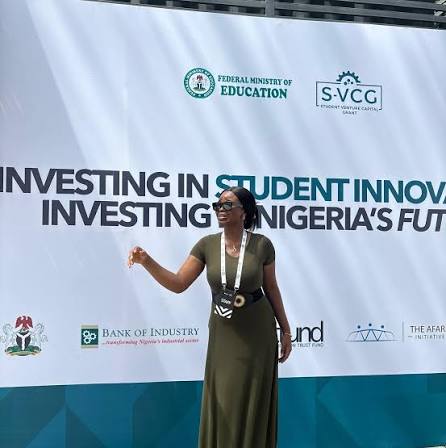
Nigeria’s Federal Government has opened the application portal for the Student Venture Capital Grant (S-VCG), a ₦50 million equity-free grant programme designed to turn student-led innovations into commercially viable businesses. The portal is now accepting applications from eligible students in accredited tertiary institutions across the country.
The initiative forms part of the government’s broader “Next Moonshot” agenda. It targets a specific gap in Nigeria’s innovation ecosystem: the absence of early-stage capital for founders who are still in school and cannot access traditional venture funding.
The Grant Targets a Specific Kind of Student
The S-VCG is not open to every student with an idea. The programme restricts eligibility to full-time undergraduate students in their 300-level and above. Applicants must be enrolled in accredited Nigerian universities, polytechnics, or colleges of education. The venture itself must sit within the Science, Technology, Engineering, Mathematics, and Medical Sciences (STEMM) fields.
The requirement for a working proof-of-concept matters. The grant does not fund ideas that exist only on paper. It funds ventures that have demonstrated some level of market validation. This distinction separates the S-VCG from pitch competitions that reward presentation skills over execution.
The Minister of Education, Dr Tunji Alausa, framed the programme’s purpose directly. He said the government is searching for future Nigerian unicorns whose roots will be planted in the country’s universities and colleges. The language borrows from venture capital’s obsession with outsized returns. The structure, however, is closer to a development programme than a fund.
READ ALSO:
Startup Founders Who Can’t Sell Won’t Survive: The Hard Truth About Early-Stage Success
Why African Startups Can No Longer Afford to Ignore Compliance
Founder Dependency: Why Your Startup Needs to Survive Without You
The Startup Automation Playbook: What, How, and When to Automate
Equity-Free Funding Changes the Relationship Between Founder and Funder
The most significant feature of the S-VCG is that it does not take equity. Student founders retain 100 percent ownership of their intellectual property and their businesses. This structure matters because early-stage founders in Nigeria often face a difficult choice. They can bootstrap and grow slowly, or they can give away large chunks of their company to the first investor willing to write a cheque.
The S-VCG removes that trade-off. A student who receives ₦50 million does not surrender control. They do not owe returns to an investor. They do not face pressure to exit. They keep building.
This model mirrors the logic behind the Askya AI Growth Platform, which we covered recently. Both programmes recognise that Africa’s earliest-stage founders need capital that does not come with strings attached. The difference is that Askya invests in AI-native startups with paying customers. The S-VCG invests in student ventures that may be years away from revenue.
The Support Ecosystem Goes Beyond the Money
The grant comes with more than cash. Successful applicants enter a structured incubation programme. They receive mentorship from experienced entrepreneurs and industry leaders. They gain access to tools and platforms needed to scale their ventures.
The most concrete addition is a partnership with Google. Every applicant who completes a valid submission receives a one-year free Google Gemini Pro licence and access to premium learning resources. Google’s Gemini AI also powers the customised evaluation system embedded in the application portal, handling initial assessments of submitted proposals.
This detail signals something important about the programme’s design. The government is not just writing cheques and hoping for the best. It is using technology to manage the evaluation process at scale. If thousands of students apply, human reviewers cannot assess every proposal fairly and efficiently. An AI-powered system can handle the first pass, flagging promising submissions for deeper review.
The Ministry is implementing the programme in partnership with the Bank of Industry. This collaboration ensures that disbursement follows a transparent, milestone-based structure. Funds are not released all at once. Student teams unlock tranches as they meet specific targets.
The Programme Addresses a Structural Gap in Nigeria’s Innovation Pipeline
Nigeria has no shortage of young people with ideas. The country’s universities graduate hundreds of thousands of students every year. Many of them have technical skills and entrepreneurial ambition. What they lack is access to the first layer of capital that would allow them to test their ideas in the market.
Traditional venture capital does not serve this segment. VC funds need to deploy large amounts of capital into companies that can absorb it and generate returns quickly. A student with a prototype and no revenue does not fit that model. Angel investors exist, but they are concentrated in Lagos and Abuja and tend to invest in founders with track records.
The S-VCG fills a gap that has remained empty. It provides capital to founders who have none of the credentials that investors require. It gives them a runway to build, test, and iterate without the pressure of immediate returns.
The programme also creates a visible pipeline. If it succeeds, the ventures it funds will become the deal flow for later-stage investors. A student who receives a S-VCG grant and builds a working business becomes a credible target for angel investment or seed funding. The grant does not replace venture capital. It feeds it.
For students who apply and succeed, the path forward looks like this. They receive the grant in milestone-based tranches. They enter an incubation programme. They gain access to Google’s tools. They build.
For the rest of the ecosystem, the S-VCG represents a test. Nigeria’s government has committed to a model that treats student innovation as a national asset. The programme’s success will depend on whether the funded ventures produce real businesses with real customers and real revenue.
If they do, the S-VCG will become a template that other African countries can adopt. If they do not, it will join the long list of well-intentioned programmes that confuse funding with progress.