
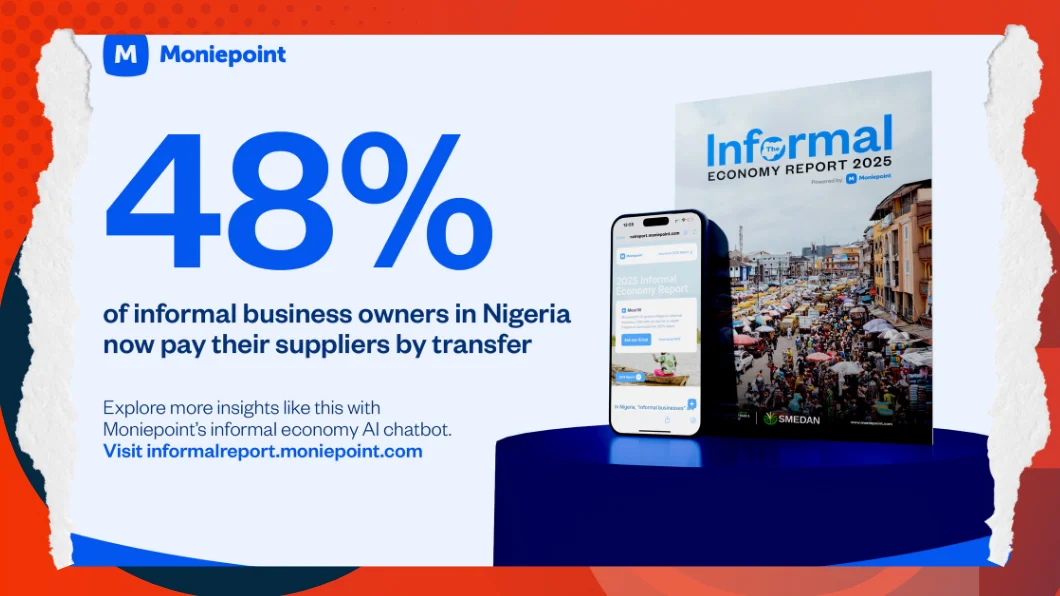
Moniepoint Inc. has launched an AI-powered chatbot named “M”, designed to make information about Nigeria’s informal economy easier to access and understand. The tool debuted alongside the company’s 2025 Informal Economy Report, which examined how millions of small traders and self-employed Nigerians keep the country’s cash-based economy moving. The company described it as “a first step toward open-source economic insight.”
For years, the informal economy has powered most of Nigeria’s growth while remaining largely invisible in official data. By turning that data into conversation, Moniepoint is extending its role beyond payments and point-of-sale machines into an AI-driven insight platform. In simple terms, the fintech wants anyone, from a kiosk owner in Kano to a policymaker in Abuja, to be able to ask questions about business activity and get answers instantly.
The Scale of Nigeria’s Informal Economy
Nigeria’s informal economy isn’t small in any way. The National Bureau of Statistics (NBS) estimates that over nine in ten employed Nigerians work informally, according to its 2023 labour-force data. Independent analyses also suggest that informal activity contributes more than half of national GDP, making it one of the largest unrecorded sectors in Africa.
Yet despite its scale, reliable, real-time data on this part of the economy remains scarce. Traditional surveys capture only fragments of what happens daily in markets, transport hubs, and small workshops. Moniepoint, which processes billions of naira in merchant transactions every month, sits on a live stream of economic behaviour, a dataset far richer and timelier than most public reports. Turning that into a searchable, conversational format could reshape how analysts, lenders, and even small traders understand the country’s pulse.
The idea is simple: if people can chat with their banks, they should also be able to chat with their economy.
The Technology Behind “M”
Moniepoint’s chatbot, simply named “M”, runs on a large language model trained to interpret data from Nigeria’s informal economy and turn it into everyday insight. The company hasn’t disclosed which AI framework it’s using, but the tool is being described as a “natural-language interface” built to simplify access to Moniepoint’s own analytics, field research, and merchant transaction records.
Through M, users can type or speak questions like “Which states have the highest informal business activity this year?” or “How has POS usage changed since 2023?” and get an instant data-backed answer. The chatbot’s core idea is not just convenience but translation. The ability to turn complex datasets into understandable language that traders, journalists, or small agencies can act on.
For now, M is accessible through Moniepoint’s website and business app. There’s no information yet about multilingual or offline versions, but Moniepoint says local-language support is “under consideration.”

In a market where data is usually locked behind paywalls or technical reports, the introduction of a conversational AI tool represents a quiet but meaningful shift. It makes information feel local, responsive, and alive.
Why It Matters for Nigeria’s Fintech and Policy Landscape
M has brought about a change in Nigeria’s fintech ecosystem, from processing payments to processing intelligence . Moniepoint already powers millions of small transactions daily, but this looks like an effort to democratise access to data that shapes business and policy decisions.
Most small traders don’t read policy briefs or market research, but they live the data those reports describe. By giving them a chatbot that explains trends in plain language, Moniepoint is bridging a long-standing divide between financial inclusion and information inclusion.
The implications are significant for policymakers. Access to consistent, real-time informal-economy data could help the Central Bank of Nigeria and other agencies refine credit programmes, tax planning, and digital literacy drives. Accurate data is what turns inclusion goals into measurable outcomes.
Strategically, Moniepoint is also repositioning itself. The company is following a global trend where payment firms evolve into insight engines, layering analytics, AI, and open-access tools onto their transaction networks. Internationally, companies like Stripe and Adyen have done this for formal commerce. Moniepoint’s approach is distinct because it focuses on the informal economy, a segment often invisible to structured financial systems.
It’s an ambitious shift. But if it works, Moniepoint could become not just one of Africa’s biggest payment processors, but also its most valuable economic observatory.
The Gaps and Opportunities Ahead
For all its promise, M is still a work in progress. The chatbot’s reach and reliability will depend on how transparent Moniepoint is about the data behind it, and how accessible it becomes to everyday Nigerians.
At present, the company hasn’t explained how frequently the chatbot’s datasets will update or whether its responses will cite official sources. Without those safeguards, there’s a risk of building an AI tool that simplifies information but occasionally misreads it.
Language and access are also hurdles. Nigeria’s informal economy is multilingual, spanning traders who speak English, Hausa, Yoruba, Igbo, and Pidgin. Unless M supports those languages or a voice-based interface, many of the people it aims to empower may never use it.
Still, the opportunities are clear.
- Localisation: A multilingual model could make the chatbot truly national.
- Partnerships: Collaborating with universities, think tanks, or the NBS could strengthen data accuracy.
- Expansion: Moniepoint already operates across several African markets; adapting M for Ghana, Kenya, or Uganda would position it as a continental intelligence tool, not just a Nigerian one.
If Moniepoint can balance openness with rigour, M could become a foundation for an Africa-wide network of AI-driven economic insight tools that make invisible markets visible.
Forward Look
Moniepoint’s chatbot may not transform Nigeria’s informal economy overnight, but it signals an important turn in how African fintechs think about value. Payments alone no longer define success. Information does.
The launch of M shows that data accessibility can be as transformative as credit or connectivity. It’s also a reminder that AI doesn’t have to feel distant or futuristic. In this case, it lives inside a conversation; answering questions, simplifying numbers, and opening up knowledge once buried in reports.
The next phase will be about trust and scale: ensuring that people not only use M but rely on it. Because when technology starts reflecting the realities of the street market, it stops being innovation for innovation’s sake. It becomes part of everyday life.