


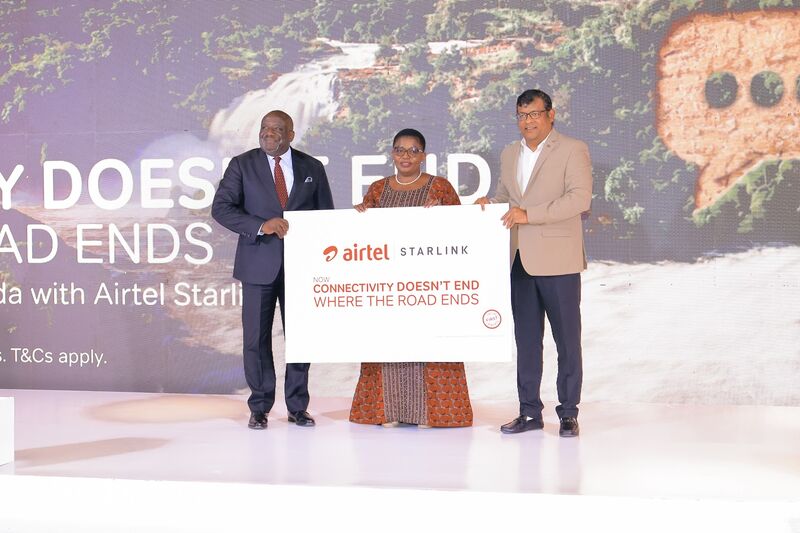
Airtel Uganda customers can now send messages from places where there is no mobile signal at all.
The operator launched Airtel Starlink on 24 September, making Uganda the second African market where the satellite-to-mobile service is commercially available, after the Democratic Republic of Congo went live on 14 August.
How It Works
The idea is simpler than it sounds. Instead of a phone searching for a terrestrial mobile tower, Starlink’s satellites act as cell towers in space.
When a customer moves outside Airtel’s ground coverage, the phone connects to the satellite constellation instead, then switches back to the normal network once it returns to range. No satellite dish, no additional hardware, and no separate device. What it does require is a supported smartphone, currently Android only, and a clear view of the sky.
Customers opt in through the MyAirtel app and get a free 30-day trial running until 23 October, after which access comes through eligible Airtel Uganda data bundles.
What It Actually Does, and Doesn’t
This is where the branding runs ahead of the product.
The service supports SMS and light-data applications such as WhatsApp messaging, carried by a constellation of 650 satellites. It does not carry ordinary voice calls. Airtel Africa chief executive Sunil Taldar told investors in July that the first generation of the service handles text messages and calling on certain apps, and that regular voice arrives with the second generation, which he placed at 2028 and beyond.
So the honest description is not “everyone gets satellite internet.” It is closer to: your phone might still send a message when the nearest tower is out of reach.
Who It Is Aimed At
Airtel is pitching it at transport and logistics operators, humanitarian organisations, farmers and mining operations, along with keeping people reachable during emergencies and network outages.
That last use case has become less theoretical. Network outages tied to infrastructure failures and conflict have repeatedly cut off entire regions across the continent, and a service that works when the ground network does not has obvious appeal to anyone whose work depends on being reachable.
The Bigger Rollout
Uganda is one step in a much larger plan. Airtel Africa and SpaceX announced a partnership in December 2025 to roll out Starlink Direct-to-Cell across all 14 of Airtel Africa’s markets, covering more than 174 million customers. Kenya served as the pilot in March 2026, the DRC was the first commercial launch, and Uganda is the second.
Airtel says the rollout continues as individual countries grant regulatory approval, which is the real constraint. Uganda is a useful example: as recently as January, Starlink was not licensed in the country at all.
There is also a detail in the commercial arrangement worth noting. “The satellite operator relies on our spectrum,” Taldar said, with Airtel handling the customer relationship from sign-up onwards. In other words, the telecom keeps the customer. Starlink provides the coverage.