

Roughly 300,000 children in Kenya have a hearing impairment, according to the Kenya Society for Deaf Children. Just 20,000 of them were enrolled in schools as of 2024. That gap between need and access sits at the centre of what a Nairobi startup is trying to solve.
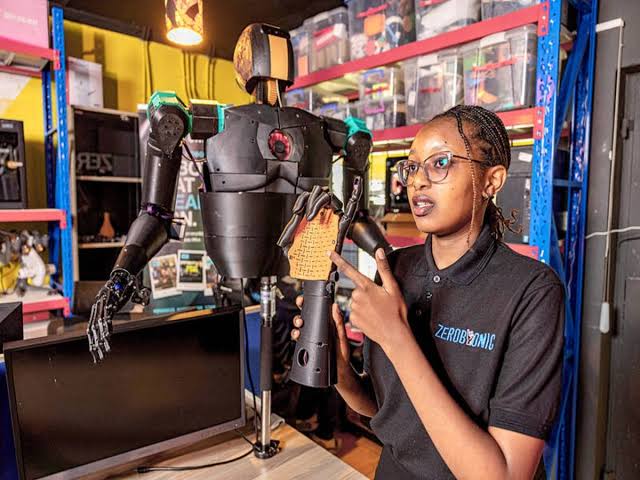
ZeroBionic, co-founded by 22-year-old Norah Kimathi, has built a mechanical hand that translates a teacher’s voice into sign language in real time. The device allows deaf children to learn alongside their hearing classmates without waiting for an interpreter who may never arrive.
Each hand costs roughly $350 and lasts up to two years. The startup already has them in 78 schools across Kenya. They carry a 92 percent speech-to-sign accuracy rate. Kimathi says the results justify the sleepless nights she spends in her lab.

Kenya’s Deaf Students Learn Without a Shared Language
Many deaf children in Kenya learn a patchwork of makeshift signs. The local dialect lacks technical terms for subjects like mathematics and biology. Teachers who do not know sign language improvise. Students fall behind, not because they cannot learn, but because the vocabulary they need does not exist in the signs they know.
Eve Awino, a physics teacher at Kasarani Treeside Secondary School for the Deaf, described the problem directly. She said the concepts she teaches and the signs available to express them often do not match. The gap between what a teacher wants to say and what a student can understand becomes a barrier to learning.
The wider education statistics reflect this. Students with deafness in Kenya consistently underperform, with average primary school scores of around 150 marks compared to 300 or 400 marks for their hearing peers. That gap does not reflect ability. It reflects the absence of tools and language resources that hearing students take for granted.
ZeroBionic Had to Build the Dataset First
Kimathi started ZeroBionic in 2021 while she was still a student at Strathmore University. What began as a robotic hand assembled from recycled plastic inside a university workshop grew into an AI-powered system that translates spoken language into sign language in real time.
The hardest part was not the hardware. Kimathi told AFP that Africa lacks a standardised sign language dataset. No one had built one on the continent. Her team had to start from scratch.
That means ZeroBionic is not just building robots. It is building a language resource. Deaf teachers at the Kasarani Treeside school are trialling the robotic arms to record and store signs using a bodysuit. In the process, they are building a database of technical terms drawn from English, American, and Kenyan signs. That database helps expand Kenyan Sign Language and makes it easier for deaf children to learn and communicate.
This is the kind of groundwork that African tech startups often have to do before they can scale. They cannot rely on infrastructure that does not exist. They build it themselves.
A Student Sees Hope in the Technology
Sharon Mumbe, a 19-year-old pupil at the deaf school, told AFP the technology gives her hope for the future. She said she will be able to understand different concepts better.
That statement captures what the technology means beyond its specifications. A 92 percent accuracy rate and a $350 price tag matter. But what matters more to a student is the ability to follow a lesson, ask a question, and understand the answer without depending on someone else to translate.
Africa One Is the Next Step
Kimathi’s lab holds numerous prototype limbs. The team works with Africa One, a humanoid robot they built to refine and expand the signs their mechanical arms can produce. The robot includes facial expressions and eye movements because sign language relies on more than hands.
Kimathi explained the shift. Her team started with basic robotic hands because sign language uses hands. They received feedback that a lot goes into signing beyond hand movements. A single gesture can mean five different things depending on facial expression. That feedback pushed them to build a full humanoid that picks up on non-verbal cues.
ZeroBionic designed and built everything in-house. The team uses recycled materials to reduce costs and environmental impact. 3D printers run constantly in the background producing components. The company has kept its production local, which keeps costs down and makes repairs easier for schools that cannot afford to ship parts abroad.
What ZeroBionic’s Work Means for African Hardware Startups
Building hardware in Africa is difficult. Supply chains are fragmented. Imported components carry foreign exchange risk. Skilled engineers are scarce. Investors often prefer software businesses because they scale faster and require less capital.
ZeroBionic has navigated these constraints by keeping production local and using recycled materials. The company built its own humanoid robot rather than importing one. It developed its own sign language dataset rather than waiting for someone else to create one.
That approach reflects the reality that African startups often have to build more than just their core product. They build supply chains, talent pipelines, and data resources that companies in other markets inherit.
Kimathi won the Young Engineer Woman Award in 2026 for her work. The recognition matters because it signals that hardware innovation in Africa can attract global attention. But the more important signal comes from the students who use robotic hands.
What’s Ahead?
ZeroBionic says the challenge now is to make the technology smarter, more accurate, and more useful in real life. The company hopes to open-source billions of parameters by 2028, which would allow other developers to build on its work.
That open-source ambition matters. If ZeroBionic shares its sign language dataset and model parameters, other teams across Africa can adapt the technology for their own local sign languages. A solution built in Nairobi could support deaf students in Accra, Lagos, or Kampala.
Kenya’s Persons with Disabilities Act and government directives require employers to reserve at least 5 percent of jobs for people with disabilities. Those policies remain difficult to implement when communication tools do not exist. ZeroBionic is building one of those tools. Its robotic hands will not solve every barrier that deaf students face. But they address one barrier that has kept too many children out of classrooms for too long.