

The race to Artificial General Intelligence (AGI) continues to dominate the AI landscape, with leading companies rolling out innovations aimed at reshaping how humans interact with technology. However, not all advancements are met with applause. Perplexity AI’s CEO, Aravind Srinivas, recently took a subtle and sarcastic jab at OpenAI’s new task automation feature, tweeting, “We wanted AGI and instead got a natural language-powered alarm clock.”
This critique highlights a growing divide in the AI industry between aspirational goals and the perceived incremental nature of some advancements. But beneath the criticism lies an opportunity to dissect OpenAI’s latest step on its roadmap toward AGI and understand how the “task feature” aligns with their long-term vision for creating an agentic universe.
OpenAI’s Vision: The Five Stages of AI Evolution
To comprehend OpenAI’s approach, it’s essential to explore its structured roadmap for AGI:
- Chatbots: Conversational AI tools like ChatGPT are designed for natural, engaging dialogue.
- Reasoners: Systems capable of human-level problem-solving.
- Agents: AI capable of autonomous decision-making and task execution.
- Innovators: AI systems assisting with inventions and creative problem-solving.
- Organizations: Advanced AI capable of operating like entire organizations, executing multi-layered objectives independently.
OpenAI’s new task feature marks its entry into Stage 3—agents. This milestone allows users to define goals, and the AI autonomously takes steps to achieve them, blurring the line between human input and independent execution.
The Task Feature: First Look at an Agentic World
OpenAI’s task automation is designed to transform the user experience:
- Autonomous Task Execution: Users can delegate multi-step actions, such as scheduling meetings, analyzing data, or managing workflows, to AI.
- Increased Productivity: By automating repetitive tasks, the feature frees up time for users to focus on strategic goals.
- Improved Adaptability: AI agents can integrate into various workflows, responding to unique demands with minimal oversight.
This new capability pushes AI into a proactive role—responding not just to commands but also taking the initiative within defined boundaries. For OpenAI, it represents the first significant leap toward agent-based AI systems that could one day dominate industries.
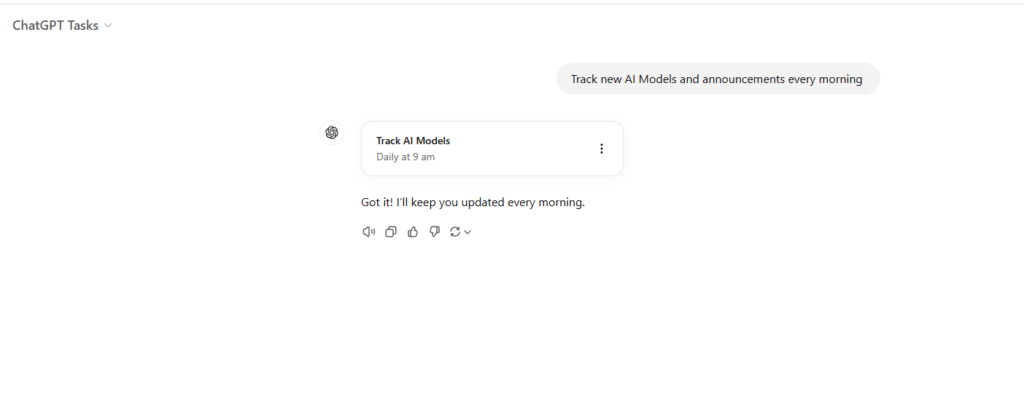
Shots Fired: Industry Reactions
Srinivas’s critique underscores skepticism among some AI leaders. Many see OpenAI’s task feature as underwhelming compared to the monumental aspirations of AGI. The comparison to a “natural language-powered alarm clock” reflects the view that the feature, while useful, lacks the transformative impact expected at this stage in AI’s development.
However, OpenAI sees this as a foundational step. CEO Sam Altman has frequently emphasized the importance of incremental progress in building trust and functionality, ensuring that AI evolves responsibly while laying the groundwork for future stages.
OpenAI’s Prescribed Path to AGI: Ushering in the Agentic Universe
The task feature’s introduction is not an isolated advancement—it aligns with OpenAI’s broader vision for AGI, which culminates in the creation of autonomous organizations (Stage 5). Here’s how the task feature contributes to this progression:
- Enhanced Adaptability: Early-stage agents learn to navigate complex workflows, paving the way for broader applications.
- Trust-Building: Users gain confidence in AI autonomy as small-scale tasks are executed reliably.
- Foundation for Innovation: These agents are precursors to systems capable of innovation and independent decision-making.
As OpenAI integrates such capabilities, it steadily moves closer to creating an agentic universe—one populated by autonomous AI agents working across industries and solving humanity’s most pressing challenges.
Challenges on the Road to AGI
While OpenAI’s vision is ambitious, achieving AGI involves navigating significant hurdles:
- Perception Gap: Balancing industry expectations with practical advancements to avoid perceptions of over-promising.
- Trust and Ethics: Ensuring that agentic systems act in the best interest of users and maintain transparency in their decision-making.
- Economic Disruption: Preparing for shifts in labour markets as autonomous systems take on more responsibilities.
The Bigger Picture
Srinivas’s critique reflects a broader industry debate: How fast should AI progress toward AGI, and what form should that progress take? While some criticize the task feature for falling short of AGI, it’s clear that OpenAI is playing the long game. As Bret Taylor, Chair of OpenAI’s Board, stated, the focus remains on building infrastructure and strategies that responsibly unlock AI’s full potential.
OpenAI’s task feature represents the beginning of the agentic age, where AI moves from reactive to proactive capabilities. This evolution promises a future where AI agents not only assist but actively collaborate with humans in reshaping industries, economies, and societies.
The Path Ahead
OpenAI’s roadmap to AGI continues to be both ambitious and polarizing. The task feature is a small but meaningful step, reinforcing the company’s commitment to thoughtful, incremental innovation. As the debate over its utility rages on, one thing is clear: the race to AGI is as much about public perception as it is about technological breakthroughs.
Will OpenAI’s deliberate approach pay off, or will competitors like Perplexity capture the market with more immediate, high-impact innovations? The agentic universe is on the horizon, and only time will reveal which players lead the charge.