


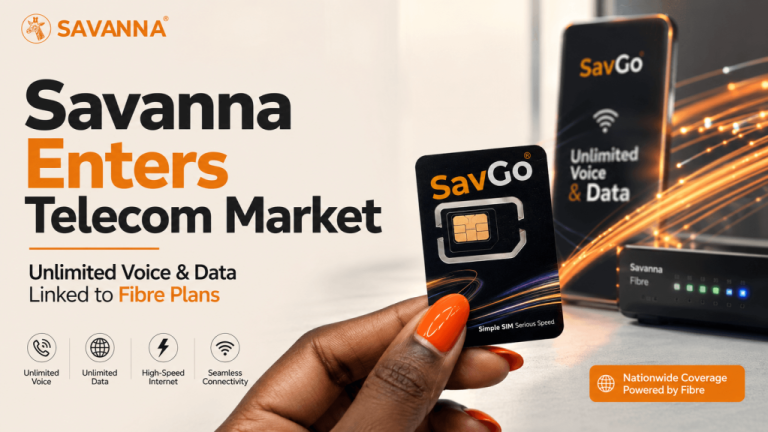
Savanna has officially entered the mobile telecommunications sector. The company, known for its fixed fibre broadband services, now operates as a fully integrated Mobile Network Operator (MNO). This move directly challenges the long-standing market dominance of MTN Uganda and Airtel Uganda.
The launch introduces a converged billing model. Existing home or office fibre internet clients can now add mobile SIM cards to their subscription plans for an incremental fee. Customers manage both fixed and mobile services under a single account. Savanna is betting that this simplified approach will attract households and businesses tired of managing separate bills for internet and mobile phone services.
Why the Market Needs a New Player
Uganda’s telecommunications sector shows strong demand for connectivity. According to the Uganda Communications Commission (UCC) market report for the first quarter of 2026, the sector recorded 61.6 million mobile subscriptions. The industry also generated 2.37 billion mobile money transactions and Shs 1.6 trillion in quarterly revenues.
Despite these numbers, many users struggle with expensive data costs. Unlimited packages remain rare, and data-heavy users often face high bills. Savanna’s entry directly addresses this pain point by offering truly unlimited voice and data at an affordable price.
How the Integrated Model Works
Savanna’s strategy combines fibre broadband and mobile services into one offering. Customers with existing fibre plans add mobile SIM cards to their accounts. This setup differs from the traditional model, where operators treat fixed broadband and mobile as separate products.
Chief Executive Officer Alex Wanyoike described the launch as a defining moment. “Today marks a transformative moment for Savanna Fibre Uganda and for the people and businesses we serve,” he said. He added that integrating mobile SIMs with fibre plans would create a seamless and scalable connectivity experience.
The company believes this convergence will become the next frontier of competition in Uganda’s telecom market. Instead of competing solely on prepaid mobile bundles, Savanna wants households and businesses to view broadband and mobile communications as one integrated service.
What This Means for MTN and Airtel
MTN and Airtel have dominated Uganda’s telecom market for years. Other players have struggled to gain significant market share. Savanna brings a unique advantage, its existing fibre infrastructure and a base of home and office internet customers.
By bundling mobile services with fixed broadband, Savanna offers a value proposition that larger competitors cannot easily replicate without significant infrastructure investment. The company is wagering that its existing fibre customers will be the first adopters, adding mobile lines to their current subscriptions.
However, the mobile market requires heavy investment. Savanna will need to build network coverage, acquire new customers, and strengthen brand awareness to compete effectively.
Starting in Kampala, Eyeing the Region
The initial rollout focuses on Kampala and the Greater Kampala region. Savanna plans to expand to other parts of Uganda in the coming months.
The company has set its sights beyond Uganda’s borders. Management indicated that its long-term strategy involves replicating this integrated connectivity model in other African markets, including South Africa.
Industry observers view the launch as a significant development, particularly as demand for affordable high-speed internet and mobile data continues to grow among households, small businesses, and digital entrepreneurs.
What Savanna Must Overcome
The mobile market is capital-intensive. Savanna needs to invest in network coverage, customer acquisition, and brand awareness to compete with established players.
Attracting customers who are not already using its fibre services remains an open question. The company will need to convince users to switch from MTN and Airtel, a challenging task given the duopoly’s strong market presence.
However, Savanna’s unlimited data proposition gives it a clear differentiator. Data-heavy users in Uganda have long complained about expensive bundles and data caps. If Savanna delivers on its promise of truly unlimited voice and data, it could carve out a niche among tech-savvy urban consumers.
The launch also comes at a time when the telecom sector faces revenue pressure. The UCC reported that sector revenue fell to Shs 1.6 trillion in Q1 2026, the lowest recorded over the last four quarters. Savanna’s entry could shake up pricing structures and force established operators to rethink their offerings.
A New Chapter for Uganda’s Digital Economy
Savanna’s transition from a fixed broadband provider to a fully integrated MNO marks a shift in Uganda’s telecom landscape. The company is betting that convergence, the integration of fixed and mobile connectivity, will become the next frontier of competition.
For consumers, this means more choices and potentially better value. The promise of unlimited data at affordable prices could transform how Ugandans access the internet and communicate.
Savanna believes the combination of unlimited mobile connectivity and its established fiber infrastructure will strengthen its competitive position while expanding digital inclusion for households, entrepreneurs, and businesses. Whether the strategy reshapes Uganda’s telecom market remains to be seen, but the company has already signalled its ambition to become a major player in Africa’s evolving digital economy.