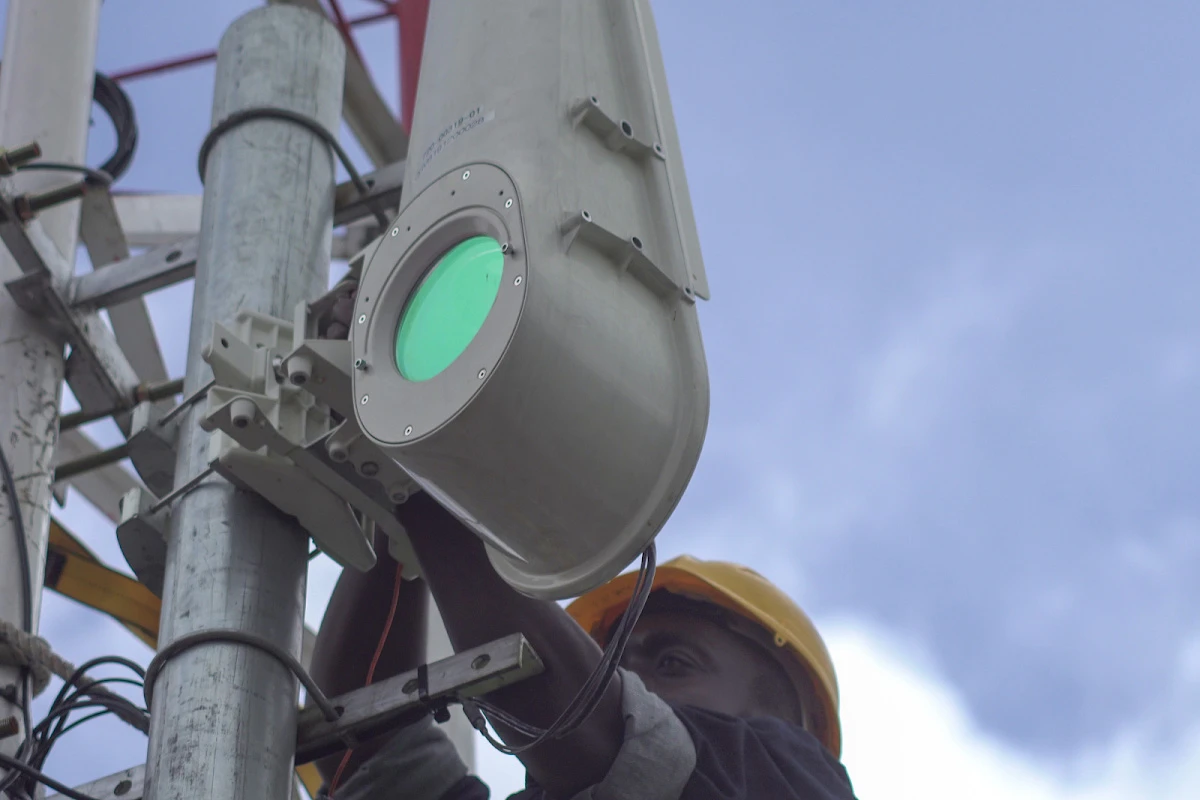
Google-backed wireless optical communications company Taara has established a foothold in Nigeria, deploying laser-powered internet links across Lagos in partnership with Liquid Intelligent Technologies to help businesses overcome persistent fibre bottlenecks.
Over the past two years, Liquid has installed nearly a dozen Taara Lightbridge links across Lagos, connecting major enterprises ranging from data centres to commercial districts while improving network resilience for internet service providers, financial institutions and hotels operating in the city.
How the Technology Works
Taara Lightbridge occupies a position between conventional fibre and traditional radio-frequency solutions. The platform delivers up to 20 gigabits per second of capacity across distances of up to 20 kilometres, using narrow, invisible beams of light rather than physical cables.
The approach allows operators to deploy high-capacity links quickly, without trenching, spectrum licensing or extensive civil works. That makes it particularly useful in dense urban environments like Lagos, where digging for fibre can be slow, costly and disruptive.
Liquid is using the technology to distribute high-capacity bandwidth from its points of presence at Africa Data Centres and other major facilities to enterprise clients located within and beyond the reach of existing fibre networks.
Addressing a Recurring Infrastructure Problem
The deployment marks one of the first large-scale commercial uses of free-space optical communications in Nigeria. It offers an alternative to conventional fibre networks that are frequently disrupted by cable cuts, costly repairs and lengthy deployment timelines, challenges that have long slowed broadband expansion across the country.
Lagos remains Nigeria’s largest and fastest-growing commercial hub, but expanding physical network infrastructure in such a dense environment has proven difficult. To meet rising enterprise demand for connectivity, operators are increasingly combining multiple technologies to extend coverage and build redundancy into their networks, rather than relying on fibre alone.
A Broader Push for Broadband Resilience
The Lagos rollout comes as Nigeria pursues ambitious digital economy targets alongside separate efforts to expand the country’s fibre backbone, including a federal government-backed initiative to lay a wholesale, open-access fibre network across the country’s six geopolitical zones and Lagos. Both approaches point to the same underlying challenge: Nigeria’s broadband infrastructure still has significant gaps that need to be closed through a mix of technologies.
Industry observers believe the arrival of laser-based communications could become a meaningful addition to Nigeria’s broadband strategy going forward. If expanded beyond Lagos, wireless optical links could help bridge connectivity gaps for other enterprises and public institutions, reducing dependence on lengthy fibre rollouts and creating a more diversified and resilient broadband ecosystem nationally.
For now, the technology remains concentrated in Lagos, but its early results suggest a growing appetite among Nigerian operators for infrastructure that can be deployed faster than traditional cable-laying allows.