Meta has launched Meta Business Agent across WhatsApp, Instagram, and Messenger. The company says the tool can answer customer questions, recommend products, book appointments, qualify leads, and hand the chat to a human when needed. Meta also says more than 1 million businesses already use earlier versions of these agents on WhatsApp and Messenger, and it is now expanding the service to businesses of all sizes around the world.
Meta wants business chat to become a real work layer inside its apps. Reuters reported that Meta showed the product at its Conversations event in London and framed it as part of enterprise AI. CNBC also noted that Meta is trying to build fresh revenue lines beyond ads, which still account for about 98 percent of its revenue.
Meta puts AI into the inbox
Meta already owns the apps where many businesses speak with customers every day. Meta says there are more than 1 billion active threads with businesses across WhatsApp, Messenger, and Instagram every day. That scale gives the company a large testing ground for business AI and a direct path to monetisation if the tool proves useful.
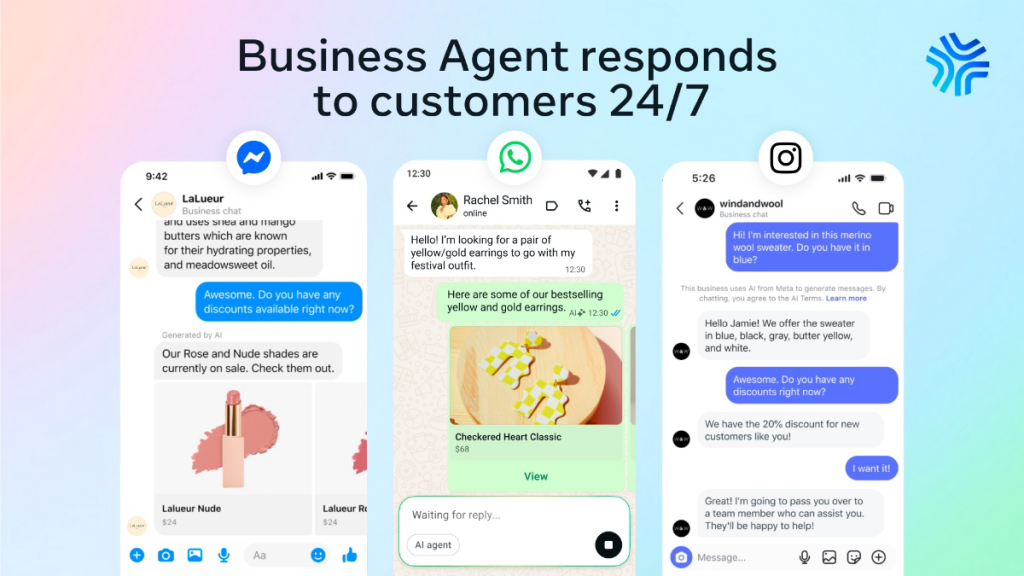
Meta says businesses can set up a Meta Business Agent in minutes. It is aiming at routine work that already fills inboxes. Meta Business Agent can answer product questions, suggest items from a catalogue, book appointments, qualify leads, and help close sales. The tool learns from a business profile, website, product catalogue, and past customer chats. It then uses that information to answer questions in the brand’s tone and only replies when it has enough confidence. If the request needs human help, the business gets a prompt to step in.
A bakery, salon, online shop, or repair service often loses sales when messages pile up after hours. Meta says the agent stays active around the clock and lets a staff member jump in at any point. The company already tested the product with small businesses in India, Mexico, and Brazil before this global launch.
Instagram joins WhatsApp and Messenger
Meta says the agent now extends to Instagram, not only WhatsApp and Messenger. New version also expands earlier chatbot features with action-taking abilities, such as booking calendar appointments and closing sales on the company’s behalf.
Tech firms no longer want assistants that only answer prompts. They want software that completes tasks inside business systems. Meta is following that same pattern and packaging it inside apps that already hold customer demand. That is a practical move because many smaller firms do not want another dashboard, another vendor, or another training cycle.
Meta wants fresh revenue beyond ads
Meta says getting started with Meta Business Agent is free, but that will not last forever. The company says paid subscription options will arrive in the coming months, with tiers for businesses of different sizes. It plans to include the agent in some WhatsApp Business Premium tiers, while large businesses will pay based on token usage. The company will include the feature in a business subscription tier under Meta One.
The company already earns money from paid messaging on WhatsApp and click-to-WhatsApp ads. A business agent adds another paid layer on top of that traffic. It also gives Meta a stronger answer to investor pressure around AI spending. In its first quarter 2026 results, Meta raised capital spending guidance and tied part of that increase to added data centre capacity for future demand.
Small businesses stand to gain first
The early win is for small businesses that already run customer contact through WhatsApp. Meta’s India rollout showed how the company plans to sell the value. It said the tool can answer questions at any hour, capture leads, book appointments, and support sales in local languages without extra tools. That gives a small team a simple way to stay responsive during busy periods or after business hours.
Meta also says business owners stay in control. They can add information, review responses, step into chats, and switch the tool off. A wrong answer about delivery, refunds, price, or stock can cost trust fast. Meta knows this, which is why its help documents stress teaching, testing, and human takeover instead of full hands-free use on day one.
Trust and safety still need work
The product arrives with the same concern that follows every AI agent launch. Businesses like automation, but they need reliability before they hand over customer contact. Reuters reported that Meta recently faced an incident in which hackers used its AI support chatbot in a way that exposed a faulty technical check tied to high-profile Instagram accounts. Meta said the flaw sat in a separate support function, not the agent itself, but the episode still shows how fast trust can slip when AI touches sensitive systems.
That is why this launch should be seen as an important step, not a finished product. Meta has strong distribution, clear use cases, and a direct business model. It still needs to prove that its agents can stay accurate, safe, and useful across millions of real customer conversations. If it gets that right, Meta will turn messaging apps into stronger business tools, not just places where brands reply to DMs.