Coursera puts learning in a scrollable feed
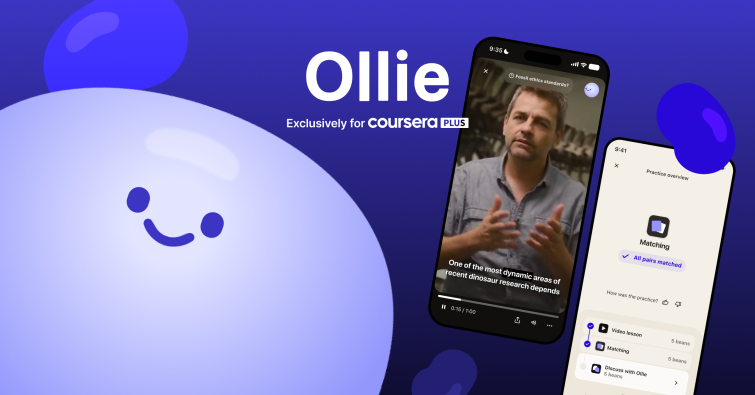
Ollie takes clips from Coursera lessons and turns them into short vertical videos, usually about 60 to 90 seconds long. Users can move through a feed, stop on a topic that interests them, answer a matching or multiple-choice question, and then ask Ollie follow-up questions by text or voice. Fast Company reports that the app also lets users keep scrolling for more range or delve deeper into a topic when they want more context.
That product design says a lot about where edtech stands right now. Coursera no longer asks users to sit down and commit to a full lecture before they get value. Instead, it gives them a lighter entry point that feels familiar on a phone, but still pushes them into active practice. The company says Ollie should complement its broader learning experience, not replace it.
Ollie keeps lessons short and personal
Coursera built Ollie around short sessions on purpose. In its launch post, the company points to a basic learning principle popularised in one of its best-known courses, Learning How to Learn. People retain more when they learn in spaced sessions instead of cramming everything at once. Ollie turns that idea into a phone-first product that fits spare minutes between meetings, during a commute, or before bed.
The AI layer does more than rank videos. Coursera says Ollie uses adaptive AI to shape lesson sequences around each learner’s interests and engagement patterns. It also offers conversational AI support so users can test what they know, ask for clearer explanations, or go deeper on a topic right away. On top of that, Coursera says the app can create lessons around emerging topics and news events. Fast Company adds an important detail here. It reports that humans review AI-generated material to check accuracy and teaching quality.
Coursera adds habit loops to keep people coming back
Ollie does not stop at short videos and AI prompts. The app also uses streaks, badges, leaderboards, and reward tokens called beans. Users can spend those rewards on in-app items, including custom looks for the Ollie mascot. There is also a Flow Mode for hands-free use and an Explore Feed that acts as the scrollable front door to the app. That mix pulls ideas from consumer apps that already know how to keep people engaged day after day.
Fast Company makes that link even clearer. It says Ollie’s mascot plays a role similar to Duolingo’s owl, and the app grew out of an effort inside Coursera to rethink what a modern learning product should feel like. That matters because Coursera is not simply shrinking course videos. It is rebuilding the habit loop around learning so the product feels natural on a phone.
This app fits into Coursera’s AI plan
Coursera has spent the last two years adding AI across its platform. In 2023, the company unveiled Coursera Coach, a generative AI tutor that answers questions, gives personalised feedback, summarises lectures, and recommends clips. That same push also included AI-assisted course-building tools for educators.
Coursera kept building in 2025. The company introduced Role Play for back-and-forth practice with AI personas, expanded Course Builder, added AI-graded questions, pushed AI-powered peer review, and launched Skills Tracks mapped to job roles. Those updates show a clear pattern. Coursera wants AI to shape the full learning cycle, including discovery, instruction, practice, assessment, and progress tracking. Ollie now extends that strategy to the first touchpoint on mobile.
Coursera has strong reasons to keep pushing AI products. Reuters reported in early 2024 that Coursera offered more than 800 AI courses, saw more than 7.4 million enrollments in those courses in 2023, and added a new learner to an AI course every minute on average that year. Reuters also reported that every learner on the platform got access to Coursera Coach, which runs on models from OpenAI and Google. That demand helps explain why Coursera now wants a faster and more frequent mobile format for discovery and repeat use.
More people expect useful content to arrive in short, easy sessions. Coursera says many learners now prefer short video-based experiences that fit their daily routines. Ollie gives that behaviour a more productive outlet. Instead of feeding idle scrolling, the company wants to turn those same phone habits into small bursts of study.
Coursera keeps this launch focused
The smartest part of this launch is its restraint. Coursera has not tried to stuff its entire catalogue into a noisy feed. It started with a select set of partners, kept the lessons short, limited access to Coursera Plus subscribers, and framed the app as an experiment. It also kept the core promise simple. Learn a little, practice right away, and come back tomorrow. That focus gives Ollie a better shot at standing out in a crowded AI app market.
For Coursera, the bigger win is not the feed itself. The bigger win is making learning feel easy to start without making it feel empty. Ollie gives the endless scroll a clearer purpose, and that makes this one of Coursera’s more practical product moves in its recent AI push.