
Across the world, artificial intelligence is changing how businesses find customers, measure performance, automate marketing, and make growth decisions. In mature markets, the conversation has already moved beyond experimentation into governance, attribution, efficiency, and measurable commercial value. For African businesses, the stakes are even sharper. AI is not just another technology trend. It represents a chance to close long-standing gaps in access, marketing intelligence, customer insight, and digital distribution.
But that opportunity will not be shaped by tools alone. It will be shaped by leaders who understand both the technology and the markets it is meant to serve.
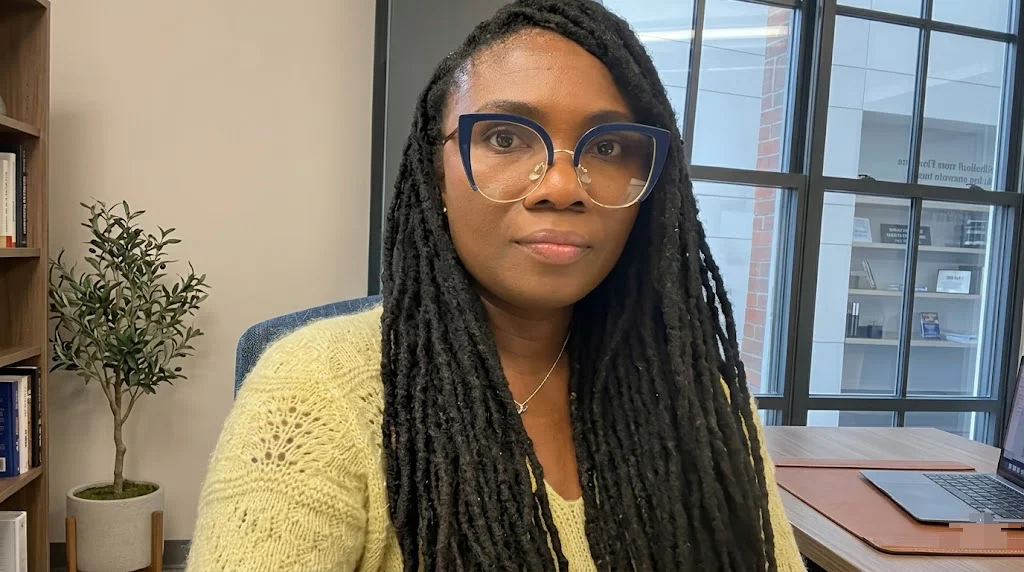
Chidinma Aroyewun sits squarely in that category. A chartered marketer and commercial growth leader, her career has moved across some of the defining shifts in modern business: the early commercial adoption of Google Ads in Nigeria, the rise of cloud and SaaS, the expansion of African fintech, global performance marketing, and now the use of AI to make digital growth more accessible to small and medium-sized businesses.
She has worked across West Africa, the United Kingdom, Australia, Europe, and North America, operating at the intersection of marketing, technology, payments, regulation, and growth. Her journey includes helping businesses understand performance marketing before it became mainstream, playing a commercial role in African fintech during a period that led to DPO Group’s landmark acquisition by Network International, and now building a marketing technology platform designed for SMEs that have historically been excluded from enterprise-grade digital tools.
At a time when businesses everywhere are trying to separate AI substance from AI noise, Aroyewun brings a rare perspective: she has seen technology waves before they became obvious. She has sold them to sceptics, scaled them across markets, and learned where the real value usually sits.
We caught up with her to discuss growth across contrasting markets, the lessons from cloud and fintech, the real role of AI in marketing, and why the next major opportunity may belong to businesses that have never had access to serious marketing infrastructure before.
Your career has taken you across some of the world’s most contrasting markets, from emerging fintech ecosystems in West Africa to regulated media and payments environments in Europe and North America. How has operating across such different contexts shaped the way you think about growth?
It rewires how you define the problem.
When you have only ever operated in one market, you tend to assume that the way growth works in that market is the way growth works everywhere. You optimise within a framework without questioning the framework itself. Operating across markets as different as Nigeria, the United Kingdom, Australia, and North America forces you to question everything, because the assumptions that drive growth in one context can actively mislead you in another.
The most important thing it taught me is that distribution is not a given. In a mature Western market, the infrastructure for reaching customers already exists. The channels work, the payment rails are reliable, and the digital literacy is there. Your job as a marketer is to outperform your competitors in a functioning system. In an emerging market, your job is often to build the system while simultaneously trying to grow within it. Those are fundamentally different challenges, and they require fundamentally different thinking.
It also taught me that trust is not universal. In regulated markets in Europe and North America, consumers often have a baseline level of institutional trust in financial and digital products. That trust was built over decades and is largely invisible to the people operating in those markets because they have never had to earn it from scratch. In West Africa, that trust does not come with the territory. You earn it community by community, language by language, and channel by channel. Once you have learned to build trust in a market where nothing is assumed, you approach every other market differently. You stop taking infrastructure for granted. You start asking who is actually being reached and who is being left out.
The third thing, and this is the one that shapes my thinking most directly now, is that constraints produce better marketing. Some of the most creative and effective campaigns I have been part of were built in markets with the tightest resource constraints, the most fragmented channels, and the most sceptical audiences. When you cannot rely on the budget to solve the problem, you have to rely on insight. That discipline follows you everywhere.
It also left me with a problem I could not stop thinking about. Across every market I worked in, the businesses that struggled most with digital marketing were not the ones without ambition or product quality. They were the ones without access. The tools available to them were built for someone else entirely, usually companies with dedicated marketing teams, substantial budgets, and users who are digitally fluent in English. A small business owner in Lagos or Nairobi who is navigating a Western-built marketing platform is not using a tool designed for them. They are working around a tool designed for someone else, and the friction it creates is enormous.
That gap eventually inspired me to start building something specifically for that user. Not a simplified version of an existing platform, but something built from scratch around the way these businesses actually operate, the payment methods they use, the languages their customers speak, the seasonal rhythms of their markets, and the kind of plain-language insight that lets a business owner make a better decision without needing to interpret a dashboard first. The work is ongoing, but the direction is clear. Fifteen years of operating across contrasting markets eventually makes the problem you are supposed to solve obvious.
Before fintech and performance marketing, you spent time in the early days of cloud technology and SaaS in Nigeria, at a time when many technology leaders were not yet convinced. What was that like, and what did it teach you?
It was a masterclass in selling the future to people who were still very comfortable in the present.
This was a period when the dominant assumption among technology leaders in Nigerian enterprises was that your data belonged in your building, on your servers, under your control. The idea of putting your business infrastructure on someone else’s hardware, somewhere you could not physically visit, managed by people you could not directly supervise, was not just unfamiliar. For many of the CIOs and CTOs I spoke with, it felt genuinely irresponsible.
My job was to change that. Not by arguing that they were wrong, but by making the case that the world they were preparing for was different from the world they were already in. The businesses that would win in five years would not be the ones with the most servers in their data centres. They would be the ones that had figured out how to scale without heavy infrastructure costs, deploy faster, maintain less and build more.
Some of those conversations took months. Some took years. Some never happened because the organisation simply was not ready, and no amount of good argument was going to change that. But the ones that moved, the ones where a CIO finally made the call to migrate, taught me the most about how technology adoption actually works.
The lesson was not about the cloud. It was about timing and trust. People do not adopt new technology because the technology is objectively better. They adopt it when they trust the person making the case, when the pain of staying still becomes greater than the fear of moving, and when they can see someone they respect having already made the move. That is not a technology insight. It is a human one. It applies to every technology conversation I have been part of since, including the ones I am having now about AI.
What I find interesting, looking back, is that the resistance we encountered then with cloud computing is almost identical to the resistance I see now with AI-driven marketing tools in certain markets. The same concerns: loss of control, system opacity, and uncertainty about what happens when it goes wrong. The same pattern of early adopters pulling the majority along behind them. The same eventual point where the question shifts from whether to adopt to how fast.
I have seen this movie before. That gives me a certain patience with the sceptics and a certain urgency about the window currently open for businesses that move early.
You were involved in the commercial operations at DPO Group during a period that ended with a $288 million acquisition by Network International. What did that experience teach you about building value in African fintech?
The biggest lesson was that the things that look boring from the outside are often the things that matter most. Regulatory compliance, merchant network depth, and institutional credibility with enterprise clients are not the things that generate conference keynotes or investor excitement. But when an acquirer sits down to assess what a business is actually worth, those are often the things they are buying.
I was responsible for building Nigeria into one of DPO’s most strategically significant markets. A large part of that was commercial: merchant acquisition, enterprise partnerships, and campaign execution. But the commercial work only landed because the regulatory foundation was solid. Global brands like Booking.com and Kenya Airways do not integrate payment partners casually. Their procurement teams ask hard questions about your licence standing, your compliance infrastructure, and your audit record. If you cannot answer those questions, the conversation about technology never happens.
The acquisition taught me that the gap between a good business and a very valuable business is often not product quality. It is whether you have built the things that are hardest to replicate.
You are now leading performance marketing in iGaming at a global level while also building a marketing technology platform for SMEs. That is an unusual combination. How do you hold both?
They are more connected than they appear.
In iGaming, I manage performance marketing at scale across regulated markets, which means I live inside the measurement and attribution problem every single day. Multi-million-pound budgets, real-time optimisation, strict compliance requirements, and highly competitive customer acquisition environments. That experience keeps my thinking sharp and grounded in what actually works commercially.
The platform I am building came from the other end of the spectrum. It came from years of watching small and medium-sized businesses in Africa and the UK struggle with digital marketing, not because they lacked ambition or product quality, but because the tools available to them were built for someone else.
The combination is deliberate. I want to bring the rigour and accountability of enterprise performance marketing to the businesses that have never had access to it.
You mentioned AI for marketing. Everyone is talking about AI right now. What is your honest assessment of where AI actually helps in marketing and where it is mostly noise?
AI is genuinely transformative in a narrow set of marketing tasks and genuinely oversold across everything else.
Where it is real is campaign optimisation and bidding. The machine learning models inside Google and Meta’s advertising platforms have made automated bidding significantly more effective than manual management for most use cases. That is not hype, that is measurable. AI-assisted creative testing is also genuinely useful. Generating multiple ad variants, testing them at scale, and identifying what performs without human intervention saves meaningful time and improves results.
Now, to where it gets noisy: most of the AI marketing tools that have emerged in the last two years are essentially content-generation engines wrapped in a dashboard. They generate copy, captions, and reports faster than a human. That is useful for efficiency, but it is not intelligence. They do not understand your customer, your market, or why a specific message resonates with a specific audience at a specific moment. That contextual understanding still requires a human who knows the market.
The challenge I foresee is that as AI tools become commoditised, the marketers and businesses that rely on AI for strategy rather than execution will find themselves at a competitive disadvantage. AI is exceptional at doing things faster. It is not yet good at knowing what things are worth doing. That judgement gap is where experienced practitioners still have an irreplaceable role.
You were there at the very beginning of Google Ads adoption in Nigeria, working at one of the first certified Google Partner agencies the company approached to support its commercial introduction in the market. How do you think about that now, looking back?
It only makes sense in retrospect.
At the time, it did not feel historic. It felt like an uphill climb in commercial terms. We were introducing a new way of thinking about advertising to a market that had perfectly functional existing ways of thinking about it, and the burden of proof was entirely on us.
Google Ads had technically been available globally since 2000, but meaningful commercial adoption in Nigeria was a different matter entirely. The infrastructure existed. What did not yet exist was the behaviour. The understanding among Nigerian businesses was that search advertising was worth budgeting for, that clicks could be measured and attributed to revenue, and that a naira spent on Google could be tracked to a naira earned in a way that a naira spent on a billboard never could be.
I was not at Google directly. I was staff at one of the first certified Google Partner agencies in Nigeria, one of the companies Google had formally approached to support this commercial education effort on the ground. That distinction matters. The Partner agency was where the rubber met the road. Google provided the product and the framework. We were the ones sitting across the table from Nigerian business owners, explaining why this thing they had never heard of should be in their marketing budget.
That ground-level experience, being the person making the case for performance marketing to sceptical decision-makers in a market encountering it for the first time, is something I would not have gotten anywhere else. I learned the product by selling it to people who did not yet want it. That is a very thorough education.
What I did not fully appreciate at the time was that I was learning something most Nigerian marketers would not learn for another five to ten years. I was inside the product, inside the methodology and inside the measurement framework before the market had broadly adopted any of it. By the time performance marketing became the expected standard for Nigerian businesses, I had already spent years understanding its foundations.
That head start is probably the single most significant structural advantage I have carried through my career. Everything I have built since, across fintech, iGaming, e-commerce and the platform I am currently developing for SMEs, was built on a foundation I gained access to before almost anyone else in this market did. You do not fully realise that at the time. You just think you are doing your job. It is only when you look back that you understand what you were actually in the room for.
You have worked with SMEs across Africa and the UK for many years. What is the most common marketing mistake you see small businesses make repeatedly?
Spreading too thin too early.
Almost without exception, the small businesses that struggle most with digital marketing are the ones trying to be everywhere simultaneously. They are posting on Instagram, running Google ads, sending email newsletters, managing a WhatsApp group, and maintaining a Facebook page, all with a budget and a team that cannot do any of those things properly.
The result is a lot of activity and very little growth. They confuse motion with progress.
The businesses that grow consistently are the ones that do one thing well before they do five things adequately. They pick the channel where their customers are most concentrated, invest enough to actually learn what works, measure the outcomes honestly, and only expand once they have a system that generates predictable results.
The second mistake, which is related, is measuring the wrong things. Most small business owners I have worked with know their follower count and their likes. Very few know their cost per acquisition or their customer lifetime value. You cannot optimise what you are not measuring correctly, and the metrics that feel good to report are almost never the ones that drive commercial decisions.
You mentioned you are building something specifically to address this. Without giving too much away, what problem are you trying to solve, and why does it need to exist now?
The problem is access. Not access to marketing in the abstract sense, but access to the specific combination of tools, insight, and infrastructure that makes digital marketing actually work for a small business operating in an African market.
Right now, there is a significant gap between what a well-resourced marketing team can do and what a small business owner can do on their own. That gap is not primarily about budget. It is about the tools available. The platforms that dominate digital marketing were built for a user with a dedicated team, a substantial minimum spend, English as a first language, and a customer base that behaves according to Western consumer patterns. Most African SMEs are none of those things.
What I am building is designed around the user who has been left out of that model. It integrates with the payment methods and channels these businesses actually use. It communicates in plain language rather than marketing jargon. It surfaces insight in a form that a business owner can act on without needing to translate it first. And it is calibrated to the market rhythms and consumer behaviours of African markets rather than assuming a universal consumer that does not exist here.
The reason it needs to exist now is that the window for getting this right is open. Smartphone penetration is growing fast across sub-Saharan Africa. Digital payment infrastructure is maturing rapidly. The businesses that figure out digital marketing in the next three to five years will have a structural advantage over those that figure it out later. I want to be part of giving more of those businesses a real chance at getting it right.
Final question. What does the next chapter look like for you?
More of the same, but at a greater scale and with greater clarity of purpose.
I have spent fifteen years learning how growth works across the world’s most contrasting markets. I have managed campaigns that reached tens of millions of people across multiple continents. I have been part of building a business that sold for nearly $300 million. I have led performance marketing for global media companies in some of the most competitive, regulated industries.
All of that was preparation for the problem I am now focused on: making the kind of marketing capability that drives real business growth accessible to the businesses that have never had access to it.
That is the work. Everything else is in service of it.