
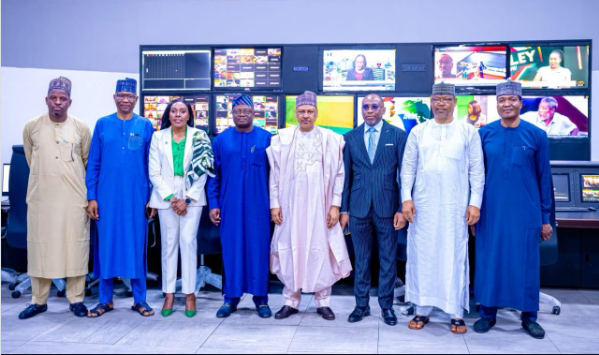
Nigeria has officially set June 17, 2026, as the date it will launch its nationwide Digital Switch Over programme. The announcement came from Information Minister Mohammed Idris during an inspection of the Nigerian Communications Satellite Limited headquarters in Abuja on May 13, 2026. He described the launch as a turning point for Nigeria’s broadcasting sector and a direct delivery on President Bola Tinubu’s reform agenda.
For Nigerians, the practical change is straightforward. Television broadcasting moves from analogue signals, an older technology that most TV sets have used for decades, to a digital system that delivers clearer picture quality, better sound, and far more channels. The National Broadcasting Commission says the new platform will carry over 100 free-to-air channels, including dedicated language channels in Yoruba, Hausa, Igbo, Tiv, Fulfulde, Ijaw, Edo, Ibibio, Efik, Nupe, and more.
Eighteen Years in the Making
Nigeria first committed to a digital broadcasting transition in 2008, following a directive by the International Telecommunication Union that required all member nations to complete the switch by June 2015. Nigeria did not meet that deadline. It also missed targets in 2012, and then several more between 2017 and 2023, each time citing funding gaps, political transitions, infrastructure problems, and disputes over the technology framework.
This is the fifth serious attempt. The government insists this one is different, and the evidence it presents to support that claim is more concrete than in previous cycles.
What Makes This Attempt More Credible
The biggest structural difference in 2026 is the technology approach. Previous DSO attempts relied almost entirely on Digital Terrestrial Television infrastructure, physical transmitters that needed to be built, maintained, and distributed across Nigeria’s diverse geography. That model proved expensive and slow. Coverage in rural areas remained weak even after years of effort.
This time, the National Broadcasting Commission and NIGCOMSAT have adopted a hybrid model that combines terrestrial broadcasting with satellite delivery through Nigeria’s own NigComSat-1R satellite. The satellite can beam digital signals across 100 percent of Nigeria’s landmass, reaching communities where no terrestrial transmitter exists. That directly addresses the coverage problem that derailed earlier rollouts.
NBC Director General Charles Ebuebu confirmed at a press conference that the framework aligns with the 2012 Federal Government White Paper on DSO, which recognised both terrestrial and satellite broadcasting standards. He pointed to comparable transitions in the United Kingdom, Australia, Kenya, South Africa, and Morocco, all of which used hybrid delivery models during their own digital migrations.
No Monthly Subscription, and Many Households Already Have the Decoder
Access to the FreeTV platform requires no monthly subscription fee. That addresses one of the biggest barriers from previous DSO attempts, when encrypted set-top boxes cost more than most households could afford. The new open-standard DVB-S2 decoder carries an open market price of between N15,000 and N25,000. The government is also considering subsidy schemes and financing options for low-income households.
NIGCOMSAT Managing Director Jane Egerton-Idehen confirmed that millions of DVB-compatible set-top boxes already in circulation across Nigeria will work with the new system. Households that already own a compatible decoder only need to realign their dish to the NigComSat-1R satellite. Additionally, for the estimated 10 million households that already own DVB-S2-compatible TVs or decoders, access begins immediately at launch. A FreeTV mobile app will also extend viewing beyond the television set.
Advertisers and Broadcasters Gain Verifiable Audience Data
One of the less-discussed benefits of the DSO is what it does for the Nigerian advertising industry. Analogue broadcasting provided no reliable way to measure who was actually watching. Advertisers paid broadcasters based on estimated audience figures, with no independent verification. That made it harder for broadcasters to set fair rates and for advertisers to justify spending.
The new digital platform integrates a real-time audience measurement system developed in partnership with global analytics firm GARB. The system tracks viewership patterns across devices and regions, giving broadcasters and advertisers access to verified data. NBC projects this will unlock a N605 billion advertising market. Minister Idris described the shift directly at the press briefing, noting that the new system lets everyone see exactly who is watching what programme, across every demographic, something analogue broadcasting never achieved.
The Spectrum Freed Up Is Worth More Than the TV Channels
Digital broadcasting uses the spectrum far more efficiently than analogue. When Nigeria completes the transition, it will free up a large block of radio frequency spectrum that analogue television currently occupies. The government projects this freed-up spectrum will generate more than $1 billion through digital spectrum auctions, money that goes directly into public funds and can support further infrastructure investment.
This “digital dividend” spectrum also opens the door for expanded mobile broadband services. Spectrum freed after digital transitions in other countries was reused to extend 4G and 5G networks into rural and underserved areas. Nigeria faces significant mobile connectivity gaps in those same communities, and the spectrum from the DSO represents a direct path to closing them. NBC confirmed NigComSat plans to acquire two additional satellites by the end of 2028 to support that expansion.
Industry Concern That Still Needs an Answer
Not everyone in the broadcasting industry accepts the current approach without question. The Set-Top Box Manufacturers Association of Nigeria publicly stated that the NBC’s current plan does not fully match the original 2012 DSO White Paper, which specified Digital Terrestrial Television as the primary delivery standard. The association argued that aggregating channels on the NigComSat satellite platform is technically different from a full DTT migration.
The association also warned that rushing the process without carrying critical stakeholders along risks eroding public confidence and creating disruptions in the broadcasting sector, particularly given the 2027 elections. The NBC has maintained that the hybrid model is legally consistent with national policy and that the satellite approach was always contemplated within the original framework. That disagreement is unlikely to delay the June 17 launch, but it reflects genuine implementation complexity that the government will need to manage carefully.
June 17 Is the Start, Not the Finish Line
The June 17 date launches the new digital broadcasting platform. It does not immediately shut down analogue signals. The government has set December 31, 2028, as the date when analogue transmissions will finally go dark across all of Nigeria. That gives households, broadcasters, and distributors more than two years to complete the transition, a timeline NBC says reflects the scale of Nigeria’s geography and population.
The window between June 2026 and December 2028 will create clear business opportunities. Set-top box distribution, digital content production, audience analytics, and spectrum services will all see increased activity as Nigeria works through the migration. Countries that completed similar transitions, such as Kenya and South Africa saw measurable growth in local content production and media investment in the years following switchover. Nigeria’s market is significantly larger than either.