

Ghana’s 5G market is entering a new phase as telecom operators move towards independently deploying next-generation networks following the government’s decision to end the exclusive wholesale model that previously underpinned the country’s 5G strategy.
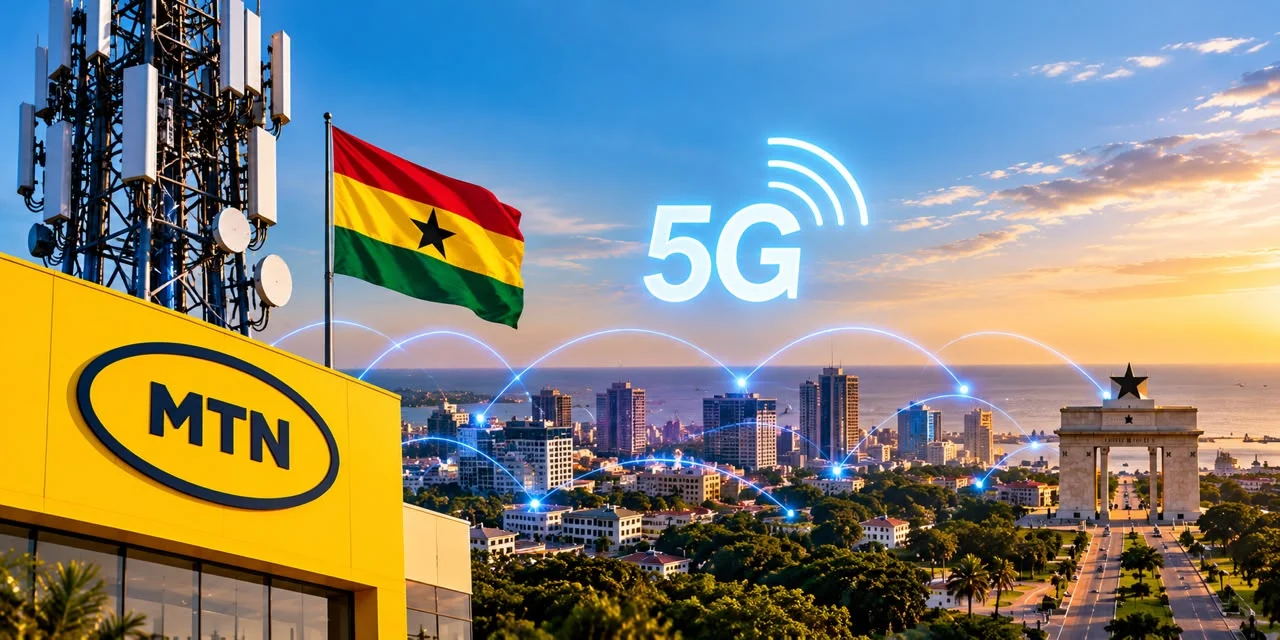
MTN Ghana has secured spectrum in the 700 MHz and 3 GHz bands worth a combined $202 million, while Telecel Ghana is preparing to launch commercial 5G services on its own network in December 2026.
The developments mark a significant change in Ghana’s approach to 5G deployment, opening the market to greater competition after the country initially relied on Next-Gen InfraCo (NGIC) as the exclusive provider of wholesale 5G infrastructure.
MTN Ghana Secures $202 Million in Spectrum
MTN Ghana has been awarded two 20 MHz lots in the 700 MHz band and 150 MHz in the 3 GHz band, according to recent disclosures.
The licences will run for 15 years and carry a combined cost of approximately $202 million.
Of that amount, MTN is expected to pay $100.9 million for its 700 MHz allocation and $101.1 million for its 3 GHz spectrum.
The company says the additional spectrum will be deployed alongside its existing holdings to expand network capacity, improve service quality and accelerate both mobile 5G and home connectivity services.
The 700 MHz portion of the award had already been confirmed by Ghana’s National Communications Authority in September.
MTN, operating legally as Scancom Plc in Ghana, was the sole qualified applicant for the available 700 MHz spectrum and secured two lots for a total licence fee of $100.9 million.
Demand for the 3 GHz spectrum was more competitive, with MTN and Telecel both qualifying to participate in the process.
Telecel Targets December 5G Launch
Telecel is also moving ahead with plans to operate its own 5G network.
Telecel Group CEO Moh Damush said the company plans to launch commercial 5G services in Ghana in December 2026, according to reporting by Mobile World Live.
The planned deployment means Ghana could soon have multiple operators building independent 5G networks rather than depending exclusively on a single wholesale infrastructure provider.
That represents a major departure from the strategy Ghana adopted when it initially introduced 5G.
Ghana’s Original 5G Model
Ghana originally placed Next-Gen InfraCo at the centre of its 5G rollout.
NGIC was designed as a shared wholesale infrastructure company that would build 5G infrastructure and provide network capacity to mobile operators, rather than requiring each telecom company to construct an entirely separate network.
The company brought together several technology and telecommunications partners, including Reliance Industries’ Radisys, Tech Mahindra, Nokia, Telecel and AT Ghana, alongside the Ghanaian government and other local partners.
Under the original framework, NGIC received exclusive rights to operate as Ghana’s wholesale 5G infrastructure provider.
But that exclusivity did not last.
Ghana Removes NGIC’s Exclusive 5G Rights
On July 15, Ghana’s National Communications Authority formally amended NGIC’s licence, removing the condition that gave the company exclusive rights to operate as the country’s sole wholesale 5G infrastructure provider.
The regulator said the decision was taken in the public interest.
According to the NCA, Ghana’s evolving telecommunications market would be better served by a competitive wholesale 5G market capable of encouraging greater investment, innovation, network resilience, service quality and wider access to advanced telecommunications services.
NGIC has not lost its entire licence.
The NCA specifically stated that the amendment affected the exclusivity condition, while the remainder of NGIC’s licence, including its existing spectrum assignment, remained valid.
That distinction means NGIC can continue operating, but it no longer has exclusive control over Ghana’s wholesale 5G infrastructure market.
Ghana Opens the Door to Competition
The government subsequently moved ahead with a competitive spectrum licensing process covering the 700 MHz, 2.3 GHz and 3 GHz bands for mobile broadband services, including 5G.
Four companies initially submitted applications.
Following its assessment, the NCA announced that three had qualified to continue: MTN Ghana, Telecel Ghana and Goal Telecommunications.
MTN subsequently secured the available 700 MHz spectrum, while competition continued for other frequencies.
The result is a substantially different 5G environment from the one Ghana originally envisioned.
Instead of relying exclusively on a shared network provider, major telecom operators are gaining the spectrum required to expand their own infrastructure.
What It Means for Ghana’s 5G Future
Allowing operators such as MTN and Telecel to deploy their own networks could accelerate 5G availability by introducing direct infrastructure competition into the market.
For consumers and businesses, greater competition could eventually translate into wider coverage, improved network quality and more choices for high-speed connectivity.
For operators, however, independent deployment also requires substantial capital expenditure on spectrum and infrastructure.
MTN’s $202 million spectrum commitment alone demonstrates the scale of investment required.
Ghana is therefore moving from an experiment centred around a single shared 5G infrastructure provider towards a more competitive model in which multiple players can invest directly in next-generation connectivity.
With MTN preparing to deploy its newly acquired spectrum and Telecel targeting a December launch, the coming months will provide the clearest indication yet of whether that change can accelerate Ghana’s 5G rollout.