
Techsoma Africa
Latest FinTech Startups AI Tech Global Apps African Opinions
Policy & Regulations Artificial Intelligence Reports About Contact Advertise FinTech & Digital Money African Startup Ecosystem Artificial Intelligence Technology Global News Apps, Gadgets, Tools & Softwares African Telecommunications Opinions & Perspectives
Advertisement Advertise on Techsoma
Techsoma Africa
No Result
View All Result
Techsoma Africa
No Result
View All Result
Techsoma Africa
No Result
View All Result
Home Explainers

Fintech vs Bank in Nigeria: What Actually Sets Them Apart

by Kingsley Okeke
September 23, 2026
in Explainers, Opinions & Perspectives
Reading Time: 3 mins read
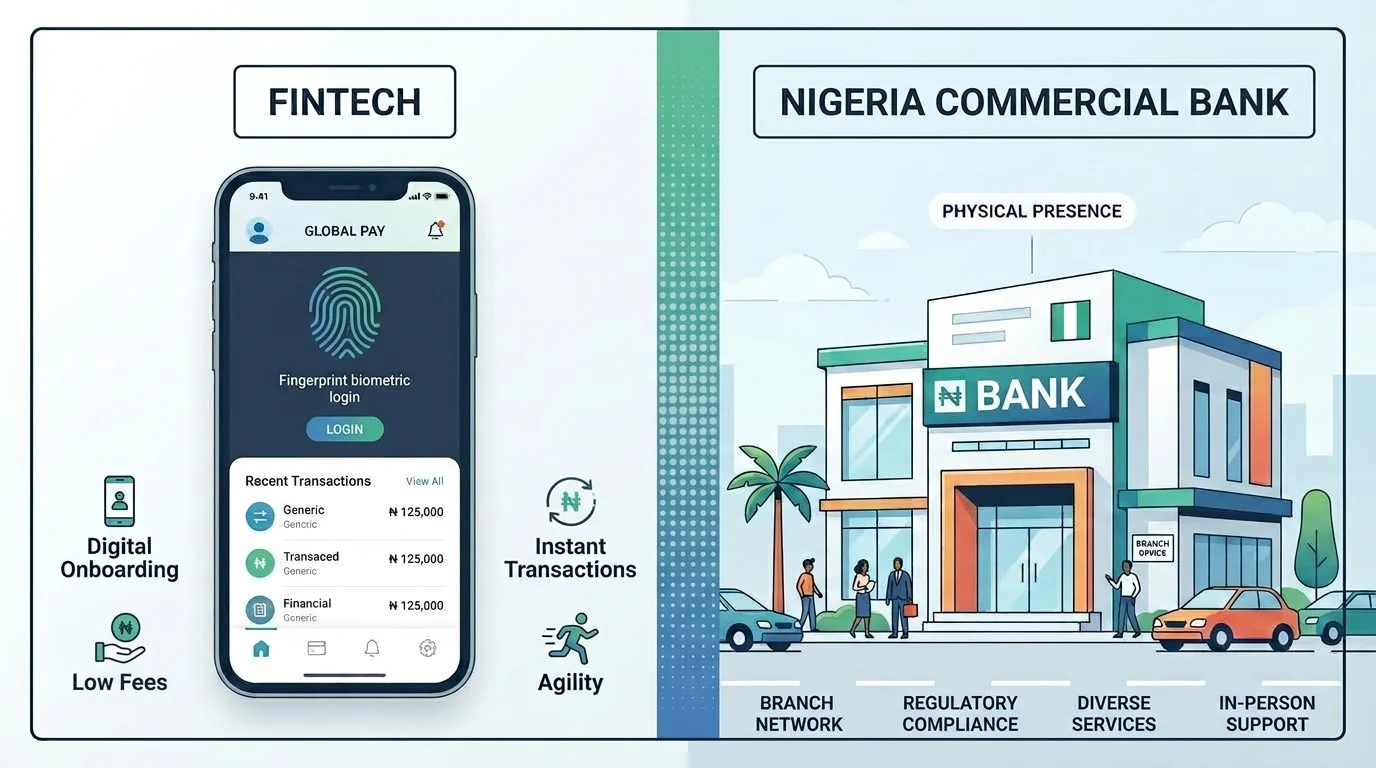
A Comparison of a Nigerian commercial bank with a Fintech

Ask ten Nigerians to explain the difference between Opay and GTBank, and you will likely get ten different answers. Some will say fintechs are “not real banks.” Others will insist there is no difference at all. The truth sits somewhere in between, and it comes down to licensing, structure, and what each one is legally allowed to do.

What a bank actually is

A commercial bank in Nigeria operates under a full banking licence issued by the Central Bank of Nigeria (CBN). This licence allows it to take deposits, give out loans, hold foreign currency, issue letters of credit, and offer the full range of services you would expect from an institution like Zenith Bank or Access Bank. Commercial banks also carry the heaviest capital requirements and compliance obligations in the financial system, which is part of why they can offer services like international transfers and large corporate loans that most fintechs cannot.

What a fintech actually is

Fintech is a broad label, not a single type of licence. Most Nigerian fintechs you use daily, including Kuda, Opay, Moniepoint, and PalmPay, are technically registered as microfinance banks, not commercial banks. Others operate under different categories such as Payment Service Providers or Payment Service Banks, depending on whether they primarily move money, hold deposits, or offer credit. The licence a fintech holds determines what it can legally do, and this is where a lot of public confusion comes from, since the apps often look and feel just like a regular bank app.

Same app experience, different rulebook

Opay fintech User Interface
A Classic example of a Fintech User Interface from Opay

This is the part most users never see. A microfinance-licensed fintech has a lower minimum capital requirement than a commercial bank, and until recently, many of these licences restricted where a company could operate, either to a single branch, a single state, or nationwide. That changed in early 2026, when the CBN upgraded several major fintechs, including Kuda, Opay, Moniepoint, and PalmPay, from regional to national microfinance licences after regulators found their operations had already outgrown their original licence scope. National microfinance status now requires a higher capital base, tighter governance, and closer supervision, but it still does not make these companies commercial banks. The CBN has been explicit that the upgrade is not a conversion to commercial banking status.

Advertisement Advertise on Techsoma

Why this distinction actually matters to you

The practical differences show up in daily use. Commercial banks generally offer broader services, including forex accounts, larger loan facilities, and corporate banking. Fintechs tend to win on speed, lower fees, simpler onboarding, and better mobile experiences, which is exactly why millions of Nigerians, especially those in the informal economy, have adopted them so quickly. But the flip side is that oversight has sometimes struggled to keep pace with growth. The CBN has flagged this gap directly, noting that many fintech customers operate informally and may not always know where to report problems when something goes wrong. Regulators have also shown they are willing to act. Earlier in 2026, dozens of dormant or non-compliant microfinance licences, some acquired by fintechs looking for a fast route into banking, were revoked entirely.

The bottom line

A bank and a fintech can look identical on your phone screen, but they are built on different legal foundations. Banks operate under the CBN’s toughest licence category with the broadest permissions. Fintechs operate under lighter licence categories, most commonly microfinance banking, that come with lower capital thresholds but real restrictions on what they can offer. Deposit protection also differs depending on the specific licence and insurance coverage involved, so it is always worth checking how your provider is licensed rather than assuming an app is “basically a bank” just because it functions like one.


Related Techsoma coverage

  • What is DPCO in Nigeria: How Data Protection Compliance Organisations Help Businesses
  • A Simple Guide to NDPC and What It Does in Nigeria
  • How Dangote’s Refinery IPO Boosted His Net Worth Overnight
Kingsley Okeke

Kingsley Okeke

I'm a skilled content writer, anatomist, and researcher with a strong academic background in human anatomy. I hold a degree...

Recommended For You

1680619424771
Explainers

What is DPCO in Nigeria: How Data Protection Compliance Organisations Help Businesses

by Faith Amonimo
September 22, 2026

For businesses collecting and processing personal data in Nigeria, understanding the law is only the first step. Organisations also need to know how to put data protection requirements into practice....

Read moreDetails
NDPC Nigeria and the Nigeria Data Protection Commission explained

A Simple Guide to NDPC and What It Does in Nigeria

September 22, 2026
A picture of Dangote and his refinery

How Dangote’s Refinery IPO Boosted His Net Worth Overnight

September 16, 2026

Nigeria Chose Bolt and inDrive Long Before Uber Left

September 3, 2026

Monieworld UK Phase-Out: Proof That Fintech’s True Calling is in Developing Economies

August 26, 2026
Please login to join discussion

Browse by Category

  • African Startup Ecosystem
  • African Telecommunications
  • Apps, Gadgets, Tools & Softwares
  • Artificial Intelligence
  • Business & Markets
  • Consumer Tech
  • Creator Economy
  • Cybersecurity
  • Digital Work-Life Series
  • E-Commerce
  • Education
  • Event Radar Africa
  • Exclusive Interviews
  • Explainers
  • Features/Spotlights
  • FinTech & Digital Money
  • Funding news
  • GenZ Desk!
  • Global News
  • Healthtech
  • Logistics & Mobility Tech
  • Media & Entertainment
  • News
  • Opinions & Perspectives
  • Opportunities, Careers & Learning
  • Partner
  • Policy & Regulations
  • Reports
  • Reviews
  • Tech Insights for Creators
  • Technology
  • Thought Leadership
  • Uncategorized
  • About Us
  • Advertise on Techsoma
  • Contact
  • Corrections Policy
  • Editorial Standards
  • Ownership and Funding
  • Privacy Policy
  • Publish Your Articles
  • Techsoma Africa
  • Terms of Service

Copyright 2026 Techsoma Africa. All rights reserved.

Welcome Back!

Login to your account below

Forgotten Password?

Retrieve your password

Please enter your username or email address to reset your password.

Log In
Advertisement Advertise on Techsoma
Techsoma Africa

© 2026 Techsoma Africa Media.

Company

Policy AI Reports About Contact Advertise

Legal

Terms Privacy RSS

Latest

Fintech vs Bank in Nigeria: What Actually Sets Them Apart Ask ten Nigerians to explain the difference between Opay and GTBank, and you will likely get ten different...  Nigeria Fintech Week 2026 Talking Points Cover AI Infrastructure And Africa Expansion Nigeria Fintech Week 2026 opened in Lagos this week with a noticeably different tone from past editions. Instead... MTN And Gates Foundation Launch AI Maternal Health Platform For Nigerian Women MTN Group Foundation and the Gates Foundation have announced a new partnership to roll out an AI-powered maternal...
Techsoma Network Techsoma Network Techsoma Africa Techsoma Middle East Techsoma Canada
Transparency About Editorial Standards Corrections Ownership & Funding Privacy Terms Contact
No Result
View All Result
  • About Us
  • Advertise on Techsoma
  • Contact
  • Corrections Policy
  • Editorial Standards
  • Ownership and Funding
  • Privacy Policy
  • Publish Your Articles
  • Techsoma Africa
  • Terms of Service

Copyright 2026 Techsoma Africa. All rights reserved.