
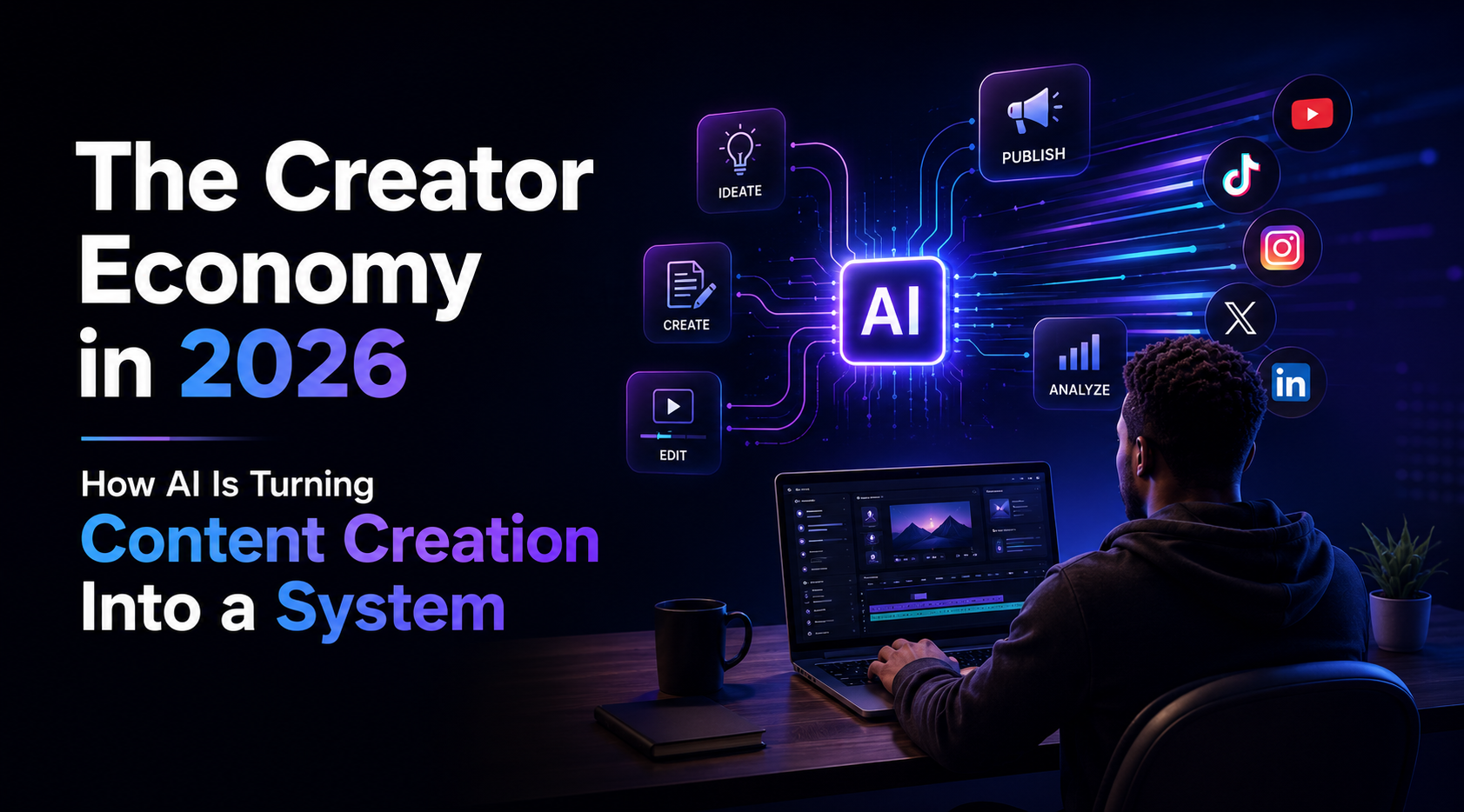
Artificial intelligence is no longer something creators experiment with on the side or treat as an occasional productivity shortcut, because it has now become deeply integrated into how content is planned, produced, and distributed across almost every digital platform.
In 2026, content creators are no longer relying solely on manual effort to move from idea to finished output, since many of them are now building structured workflows where AI systems assist in research, scripting, editing, and even content distribution across multiple channels.
This shift is not only about speed or convenience, but also about how the entire rhythm of content creation has changed, especially as audiences now expect more frequent posting, more consistent engagement, and more content adapted to different platforms at the same time.
A single idea is no longer confined to one format, because it is now expected to move across video platforms, short form content feeds, newsletters, and social media threads almost instantly, which means creators are under increasing pressure to scale their output without losing quality or personal identity.
That tension between rising demand and limited human capacity is one of the main reasons AI has moved from being optional support to becoming part of the core infrastructure of modern content creation.
The Shift From Individual Content to Structured Content Systems
The significance of this shift is that content creation is no longer just about producing one strong video, article, or post, but about designing a repeatable system that allows consistent output over time without exhausting the creator.
Across different parts of the world, including Africa’s fast-growing digital ecosystem, this systems-based approach is becoming more common among independent creators who are building personal media brands without traditional production teams.
The market is already moving in this direction, and creators who understand how to structure their workflow rather than just focus on individual outputs are beginning to gain a noticeable advantage in consistency and reach.
Why Artificial Intelligence Has Become Central to Modern Content Creation
Artificial intelligence has become central to content creation not because it replaces human creativity, but because it reduces the amount of time and effort required to move from an idea to a finished piece of content.
Tasks that once took hours or even days, such as researching topics, drafting scripts, editing long videos, or repurposing content into different formats, can now be completed in significantly shorter timeframes when supported by AI systems.
This has created a new kind of creative environment where creators can focus more on thinking, storytelling, and strategic direction, while delegating repetitive or time-consuming production tasks to automated systems.
The deeper implication of this shift is that creativity is no longer limited by execution capacity in the same way it used to be, which means that ideas can now move from concept to publication much faster than before.
As a result, the creators who are adapting most effectively are not necessarily those who work harder, but those who are able to design workflows that allow them to move quickly without compromising quality or originality.
However, this increased opportunity comes with a growing challenge, because maintaining consistent output across multiple platforms can quickly lead to burnout if creators do not build sustainable systems around their work.
The result is a widening gap between creators who are scaling intentionally with structured systems and those who are simply producing more content without long-term strategy or balance.
The Risks and Limitations Emerging From AI-Driven Content Growth
While artificial intelligence has significantly improved the speed and efficiency of content creation, it has also introduced challenges that are becoming more visible as adoption increases.
One of the most common concerns is content similarity, where creators using similar tools and workflows begin to produce content that feels repetitive or lacking in distinct personality, which can make it harder to capture audience attention over time.
Another concern is misinformation, especially in fast moving industries such as technology, finance, and public policy, where the speed of content production can sometimes outpace proper verification and fact checking processes.
There are also ongoing questions around originality and ownership, since AI generated content raises complex issues about intellectual property, creative rights, and how ownership should be defined in a system where machines contribute significantly to production.
In addition to this, there is the risk of over automation, where creators begin to rely too heavily on AI systems not only for execution but also for creative judgment, which can gradually weaken their personal voice and cultural relevance.
Finally, platform dependency remains a structural issue, because many of the tools powering modern content creation are controlled by a small number of companies, which means creators are exposed to shifts in pricing, access, and platform policies that are outside their control.
What the Next Phase of Content Creation Is Likely to Look Like
The next phase of content creation will be shaped by systems that can manage far more than individual tasks. Instead of using separate tools for ideation, writing, editing, publishing, and distribution, creators and businesses are increasingly moving toward integrated AI-powered workflows that can coordinate multiple stages of the content process.
One of the most significant developments is the emergence of AI agents that can assist with content operations from start to finish. These systems can research topics, generate drafts, optimize content for different platforms, schedule distribution, and monitor performance with minimal human input.
At the same time, personalization is expected to become more sophisticated. Content will increasingly adapt to audience preferences, languages, locations, and behavioral patterns, allowing brands and creators to deliver more relevant experiences at scale.
Real-time translation and localization will also continue to expand access to global audiences. For creators operating in diverse and multilingual markets, this could significantly reduce the barriers associated with producing content for different regions.
Synthetic media, including AI-generated voices, avatars, and video content, is likely to become more common as production costs fall and technology improves. This may enable individuals and small teams to produce content at a scale that was previously achievable only by larger organizations.
While these developments will make content production more efficient, they will also raise important questions about quality, authenticity, transparency, and audience trust. As AI capabilities grow, the challenge will not simply be producing more content, but producing content that remains useful, credible, and relevant.
The Real Competitive Advantage in an AI-Powered Content Economy
The future of content creation will not be determined by who has access to the most advanced tools. As AI capabilities become more widely available, technology itself will become less of a differentiator.
What will continue to separate successful creators, media brands, and businesses is their ability to develop original perspectives, understand their audiences, and tell stories that resonate in meaningful ways.
AI can accelerate research, streamline production, and improve efficiency, but it cannot fully replace human judgment, lived experience, cultural understanding, or creative insight. These qualities remain central to building trust and maintaining audience engagement.
For creators, the opportunity is not to compete with AI, but to use it strategically. Those who combine technological efficiency with strong editorial direction, subject-matter expertise, and authentic storytelling will be best positioned to thrive in the years ahead.
As content creation enters a more automated era, the most valuable skill may no longer be the ability to produce more content. It may be the ability to create content that people genuinely want to consume, remember, and act upon.