

The fintech world in Nigeria woke up this week to news that, under normal circumstances, would have been met with widespread celebration: PayPal, the global payments leader, is officially back for inbound payments through a strategic partnership with local fintech pioneer Paga. For nearly two decades, Nigerians endured a “send-only” status on PayPal, a restriction that forced an entire generation of digital entrepreneurs and freelancers into complex, often precarious, workarounds to receive international payments.
However, the announcement, by Paga CEO Tayo Oviosu, has not been met with the euphoria one might expect. Instead, social media platforms are alight with skepticism, anger, and a deep-seated resentment that speaks to a profound “financial trauma” experienced by many Nigerians.
The sentiment can be distilled into several key narrative pillars:
1. The “21-Year” Resentment: A Legacy of Exclusion
The most potent source of the current backlash is the sheer duration of PayPal’s previous restrictions. Many Nigerians recall with bitterness how, since 2004, they were effectively locked out of crucial facets of the global digital economy. This wasn’t merely an inconvenience; it was, for many, a stigmatization.
Critics argue that PayPal’s initial decision was rooted in negative perceptions of Nigeria, largely influenced by the infamous “Nigerian Prince” scam. This narrative, however, fails to account for the countless legitimate businesses and individuals who were unfairly penalized. While other nations with comparable, or even higher, fraud profiles were granted full access, Nigeria remained largely excluded from the ability to receive payments, creating a narrative of systemic bias.
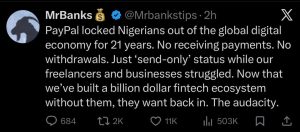
2. “We Built Our Own Table”: A Thriving Ecosystem Forged in Exclusion
Perhaps the most striking aspect of the current sentiment is the widespread declaration that Nigeria’s fintech scene no longer needs PayPal. During PayPal’s prolonged absence, the nation’s entrepreneurial spirit flourished, giving rise to a robust and innovative local fintech ecosystem. Companies like Grey, Raenest, Payoneer, Deel, and even crypto platforms stepped in to fill the massive void, empowering freelancers and businesses to connect with the global economy on their own terms.
This groundswell of local innovation has fostered a sense of self-reliance and pride. Many Nigerians view PayPal’s return as opportunistic – a global giant seeking to re-enter a market it once ignored, now that it has demonstrated its immense value. The sentiment is clear: we built our own solutions, and our loyalty lies with those who supported us when PayPal did not.

3. The “180-Day” Trauma: Fear of Arbitrary Account Freezes
Beyond the historical resentment, a practical and deeply concerning fear looms large: PayPal’s reputation for arbitrary account freezes and extended fund holds. Many Nigerians recount harrowing experiences of having their PayPal accounts abruptly suspended or their hard-earned funds frozen for up to 180 days under vague “security review” pretexts, often with little to no clear communication or effective customer support.
This experience has created a lasting mistrust. For gig workers and small business owners, the prospect of having their income suddenly locked away without recourse is a terrifying one. The concern is exacerbated by the perception that, unlike in some other regions, there is no strong governmental or consumer protection framework to advocate for Nigerian users against a global entity like PayPal.

4. The “Sell-Out” Narrative: Questioning Local Partnerships
In a surprising turn, some of the backlash has extended to Paga itself and its CEO, Tayo Oviosu. While Oviosu framed the partnership as the culmination of a decade-long effort to bring full PayPal functionality to Nigeria, some online commentators have viewed it through a more critical lens.
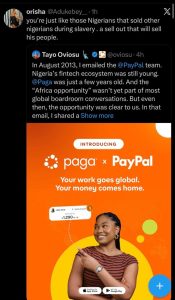
Accusations, sometimes as harsh as comparing the move to historical betrayals, suggest that partnering with PayPal is a “sell-out” of the local ecosystem. This perspective highlights the deep emotional connection many feel to Nigeria’s independent fintech journey, making any collaboration with the former “gatekeeper” a contentious issue.
Editor’s Note
The PayPal Paga partnership is undoubtedly a significant development in Nigeria’s fintech space. It offers access to a global payment network, potentially unlocking new opportunities for millions. However, to truly succeed, both PayPal and Paga will need to navigate this deep “resentment gap” with transparency, robust customer support, and a clear understanding of the historical context. The road ahead for regaining trust, it appears, is far longer than the path to technical integration.