


Nigeria’s transition to electric, connected and technology-enabled transportation will require far more than the introduction of new vehicles. It will depend on local assembly, charging infrastructure, intelligent mobility platforms, technical expertise, accessible financing and collaboration between government and the private sector.
Chief Diana Chen is bringing these elements together.
As she celebrates her birthday on 29 July, her work offers a valuable case study in how patient investment, technology transfer and disciplined execution can transform an emerging industry.
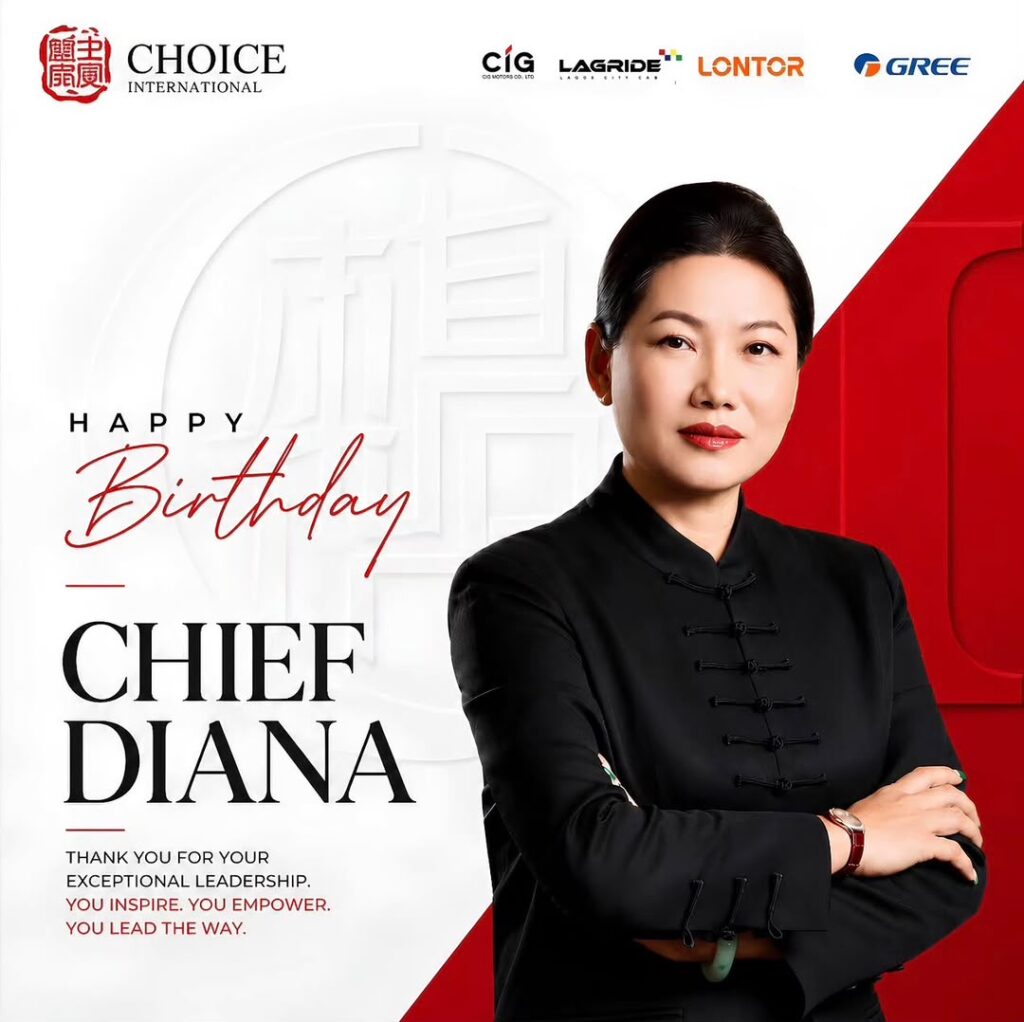
Chief Diana serves as Chairman of CIG Motors Nigeria, Chairman of GAC Motors Nigeria, Chairman of LagRide Nigeria and Vice-Chairman of the China-Africa Business Council. Across these positions, she is building an integrated ecosystem connecting automotive manufacturing, electric vehicles, urban mobility, digital platforms, infrastructure and human capital.
From Market Entry to Technology Transfer
Chief Diana arrived in Nigeria during a defining period in the development of China-Africa economic relations.
China’s “Going Global” policy was encouraging Chinese companies and entrepreneurs to expand internationally, enter new markets, build global brands and establish lasting commercial operations outside China. The Forum on China-Africa Cooperation was also creating a stronger institutional framework for trade, investment, industrialisation and technology exchange between China and African countries.
Chief Diana belonged to a generation of outward-looking Chinese entrepreneurs who recognised Africa’s long-term economic potential. Her work in Nigeria has since progressed from international trade and brand development into local assembly, technical training, public-private partnerships and mobility technology.
For over 14 years, she has studied the Nigerian market, built relationships and invested in the infrastructure required to support long-term growth.
Nigeria has consequently become the centre of her African growth strategy and an important platform for connecting Chinese manufacturing and technology with African demand, talent and enterprise.
Building an Integrated Automotive Platform
As Chairman of CIG Motors Nigeria, Chief Diana oversees a business whose operations extend across vehicle distribution, local assembly, aftersales services, spare parts, dealerships, fleet solutions and electric mobility.
CIG Motors represents automotive brands including GAC Motor, Wuling and JMC, covering passenger vehicles, commercial vehicles, buses and electric vehicles.
The wider Choice International Group also operates across energy and consumer technology through brands such as GREE and Lontor.
The strategic value lies in how these businesses can work together. Electric vehicles require dependable energy and charging systems. Local assembly requires technicians, suppliers and industrial infrastructure. Mobility platforms require vehicles, financing, data and operational technology. Aftersales services require diagnostic tools, trained professionals and access to components.
Chief Diana’s ecosystem approach connects these requirements instead of treating them as separate commercial activities.
CIG Motors’ investment in local assembly and modern service facilities also provides a foundation for developing permanent automotive capacity within Nigeria. Local assembly can support employment, technical training and the eventual growth of component production across batteries, electronics, plastics, glass, steel and software.
Changing the Perception of Chinese Automotive Technology
As Chairman of GAC Motors Nigeria, Chief Diana has played an important role in changing Nigerian perceptions of Chinese vehicles.
When GAC Motor entered the Nigerian market, many consumers remained sceptical about the quality, durability and long-term support available for Chinese automotive brands.
Building confidence required globally competitive vehicles supported by strong local systems.
Chief Diana invested in modern showrooms, workshops, technical support and aftersales operations. Customer experience became central to the company’s market strategy.
Over time, GAC Motor gained recognition among private buyers, corporate organisations and government institutions. The brand’s growth demonstrated the increasing competitiveness of Chinese automotive engineering, design and in-vehicle technology.
This evolution also reflects a broader shift within the global automotive industry. Chinese manufacturers have become major players in electric vehicles, batteries, intelligent driving systems, digital dashboards and connected mobility.
Nigeria’s ability to participate in this technological shift will depend on companies capable of translating global innovation into products and systems suited to local conditions.
LagRide and the Digitalisation of Urban Mobility
Chief Diana’s role as Chairman of LagRide Nigeria extends her automotive strategy into platform-based transportation.
Established through a joint venture with the Lagos State Government, LagRide brings together vehicles, drivers, financing, government oversight, customer service and digital technology.
The platform demonstrates how technology can structure transportation at scale.
Digital onboarding can improve driver verification and compliance. Data can support fleet monitoring, vehicle maintenance and performance management. Cashless transactions can create more transparent payment records. Driver histories can support financing and progression towards vehicle ownership.
LagRide also connects mobility with economic empowerment. Through rental, financing and Drive-to-Own structures, drivers can earn an income, build a verified performance record and progress towards owning productive assets.
This model turns mobility data into economic infrastructure. A driver’s activity, consistency and repayment history can create a formal record capable of supporting access to finance.
The platform also provides a framework for working with individuals, companies, local governments and other institutions seeking to sponsor people into transportation entrepreneurship.
The Transition to Electric Mobility
Nigeria’s e-mobility transition will require solutions built around local realities.
Vehicle affordability, charging availability, electricity supply, maintenance capacity, financing and consumer confidence will determine the pace of adoption.
Chief Diana’s e-mobility vision addresses these requirements as parts of one system.
Through GAC and Wuling, CIG Motors is introducing electric vehicles for personal, commercial and institutional use. The portfolio includes passenger cars and electric buses suited to different mobility needs.
The next stage involves expanding charging infrastructure through partnerships with governments, energy companies, financial institutions, commercial property owners and service-station operators.
Charging points will be required in homes, offices, shopping centres, transport terminals, government facilities and major travel corridors. Each installation creates opportunities across hardware supply, software, energy management, maintenance, payments and data services.
Electric mobility can also change the economics of commercial transportation. Lower energy and maintenance costs can improve long-term operating efficiency, particularly for high-mileage vehicles used in taxi, delivery and public transport operations.
The technology will achieve scale when vehicles, charging, financing and maintenance are deployed as one coordinated solution.
Artificial Intelligence and the Vehicle of the Future
The automotive industry is increasingly becoming part of the technology industry.
Modern vehicles combine mechanical engineering with software, sensors, batteries, connectivity, diagnostics and artificial intelligence. This transformation will create demand for professionals whose skills extend beyond conventional vehicle maintenance.
AI can support predictive maintenance by identifying potential faults before they lead to breakdowns. Connected systems can monitor battery health, vehicle location, driver behaviour and energy consumption. Fleet operators can use this data to improve safety, reduce downtime and manage costs.
For public transportation and security fleets, connected vehicles can also support central monitoring, route management and emergency response.
Chief Diana’s long-term vision includes developing Nigerian expertise across these emerging areas. Nigeria requires engineers, software developers, battery specialists, data analysts, diagnostic technicians and charging-infrastructure professionals who understand the interaction between vehicles and digital systems.
Developing Nigeria’s Automotive Technology Talent
Human capital sits at the centre of Chief Diana’s mobility strategy.
Through the Chief Diana Chen Foundation and its partners, 25 students from Yaba College of Technology received opportunities to undertake an intensive automobile engineering programme in China.
The programme demonstrates a practical model for technology transfer. Nigerian students gain exposure to advanced automotive engineering and manufacturing, then return with knowledge that can support the development of local industry.
Chief Diana’s broader ambition includes training thousands of Nigerians in automotive engineering, artificial intelligence in automobiles and emerging mobility technologies.
These skills will become increasingly valuable as Nigeria expands local assembly and adopts more electric and connected vehicles.
Technical education also determines whether Nigeria captures meaningful value from the e-mobility transition. A country dependent entirely on foreign expertise will retain only a limited share of the economic opportunity. Developing local professionals allows more value to remain within the economy.
Connecting China’s Technology Ecosystem With Africa
As Vice-Chairman of the China-Africa Business Council, Chief Diana occupies a strategic position between two major economic regions.
She understands Chinese manufacturing, investment and business culture while possessing extensive knowledge of Nigeria’s institutions, market conditions and commercial opportunities.
This enables her to connect Nigerian organisations with Chinese manufacturers, investors and technology partners.
Her work supports a model of China-Africa cooperation centred on industrial capacity, technology transfer, skills development and long-term investment.
The strongest partnerships will enable African countries to assemble, maintain, adapt and eventually develop technologies locally. They will also create opportunities for African entrepreneurs and professionals to participate across the value chain.
Chief Diana’s businesses provide a practical platform through which these relationships can produce vehicles, infrastructure, employment and technical capacity.
Technology, Mobility and Nigeria’s US$1 Trillion Economy
President Bola Ahmed Tinubu has articulated the ambition of developing Nigeria into a US$1 trillion economy.
The automotive and e-mobility sectors can contribute through manufacturing, energy, transportation, software, logistics, insurance, financing and professional services.
Each locally assembled vehicle creates demand across a wider value chain. Each charging station creates opportunities in energy, hardware, software, payments and maintenance. Each mobility platform produces data that can improve fleet management, financing and urban planning.
CIG Motors provides the industrial platform. GAC Motor brings advanced automotive engineering and connected vehicle technology. LagRide applies digital systems to transportation, driver management and vehicle ownership. The China-Africa Business Council supports the international investment and technology relationships required to scale these solutions.
Chief Diana’s four leadership roles therefore converge around a single objective: building a technology-enabled mobility ecosystem capable of creating industrial and economic value for Nigeria.
A Technology Legacy in Motion
Chief Diana Chen’s legacy will be visible in the systems and people created through her work.
It will be seen in locally assembled vehicles, electric buses operating in Nigerian cities, charging points across major transport corridors and service centres equipped with advanced diagnostic technology.
It will be seen in drivers who build verified digital records and progress towards vehicle ownership.
It will be seen in Nigerian engineers, software developers and technicians building careers around electric and connected mobility.
For over 14 years, Chief Diana has combined investment, technology, partnerships and disciplined execution to expand Nigeria’s automotive capacity.
As she celebrates her birthday on 29 July, her work points towards a future in which Nigeria becomes a producer, operator and developer of next-generation mobility technology.
Chief Diana Chen is building the technology stack for that future.