
OpenAI has confirmed it will begin testing advertising inside ChatGPT in the United States, starting with the Free plan and the new low-cost ChatGPT Go tier. The company is framing the move as a way to expand access to capable AI while preserving trust, privacy, and answer quality.
This is not a full-scale global rollout yet. It is a controlled test. But it is also the clearest sign that OpenAI is building the foundations of an advertising product inside the most widely used AI interface on the market.

What OpenAI actually announced
OpenAI’s announcement has two linked parts:
- ChatGPT Go expansion and positioning
Go is being rolled out everywhere ChatGPT is available, and in the US it is priced at $8/month. OpenAI positions Go as expanded access to key features, sitting between Free and Plus. - Ads testing in the US for Free and Go
OpenAI plans to start testing ads in the coming weeks for logged-in adults in the US on Free and Go. Higher tiers (Plus, Pro, Business, Enterprise) remain ad-free.
How the ads will work inside ChatGPT
OpenAI is starting with a format that looks closer to search and commerce than classic social advertising.
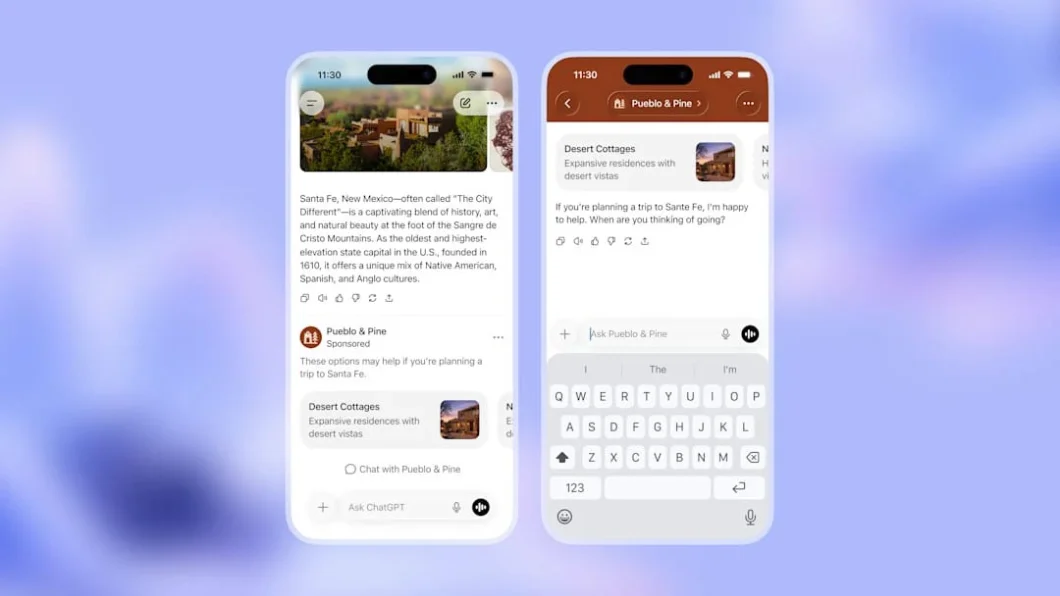
- Placement: ads appear at the bottom of answers when there is a relevant sponsored product or service based on the current conversation.
- Separation and labelling: ads are clearly labelled and separated from the organic response.
- User controls: users can see why they received an ad, dismiss it, and give a reason. OpenAI also says users can turn off personalisation and clear ad-related data.
- Restrictions: OpenAI says it will not show ads to users it knows or predicts are under 18, and ads will not appear near sensitive or regulated topics such as health, mental health, or politics.
The subtext is obvious: OpenAI wants ads to feel like utility, not disruption.
The “ad principles” OpenAI is using as guardrails
OpenAI published five explicit principles to stop advertising from corroding the product:
- Mission alignment: advertising supports the mission to benefit humanity by expanding access.
- Answer independence: ads do not influence ChatGPT answers.
- Conversation privacy: chats stay private, and OpenAI says it does not sell user data to advertisers.
- Choice and control: users can opt out of ad personalisation and clear ad data, with an ad-free paid option always available.
- Long-term value: OpenAI says it will not optimise for time spent, prioritising trust over revenue.
These principles read like a direct response to the standard playbook of surveillance advertising. OpenAI is signalling a different model: conversational relevance without turning the product into a slot machine.
What this means for users
For users on Free and Go, the immediate change is simple: you will start seeing sponsored placements in some conversations, under specific conditions, in the US first.
The bigger shift is behavioural. ChatGPT is already where people draft emails, plan travel, shop, learn, research, and decide. Once ads sit inside those decision moments, the interface becomes a new kind of marketplace. OpenAI is promising that the assistant stays objective, and the ad stays clearly separate. The entire test will be judged on whether users believe that promise.
What this means for businesses and advertisers
OpenAI is effectively opening a new lane for customer acquisition: intent-driven advertising inside a conversational assistant.
If the early format is “sponsored product or service relevant to your current conversation,” then the winners will be brands that can show up at the point of intent with an offer that genuinely helps.
OpenAI also highlights small businesses explicitly, arguing that conversational discovery could help emerging brands compete, not just incumbents with massive budgets.
What this means for developers and the product ecosystem
Two things are happening in parallel:
OpenAI is scaling distribution through pricing and tiers (Free, Go, Plus, Pro).
It is diversifying revenue beyond subscriptions, with ads positioned as a way to keep access broad without raising the floor for entry.
That matters because developer ecosystems follow attention. If ChatGPT becomes both the interface and the marketplace, then “being discoverable in ChatGPT” becomes a new category alongside SEO and app store optimisation.
The real risk: trust
OpenAI is trying to do the hardest version of advertising: introduce ads in a product people use for personal, high-trust tasks, without degrading the perception of neutrality.
That is why the company is being unusually explicit about answer independence, privacy, sensitive-topic exclusions, and control.
If OpenAI executes this cleanly, it creates a template other AI assistants will copy. If it feels even slightly manipulative, it becomes a gift to every competitor selling “ad-free truth” as a differentiator.
OpenAI is not just adding ads. It is testing a new economic model for AI access: lower-cost intelligence subsidised by tightly scoped, clearly labelled, conversation-relevant sponsorships, with premium tiers kept clean.
The test will not be decided by CPMs. It will be decided by whether users keep believing that ChatGPT is recommending what is best for them, not what pays best.