
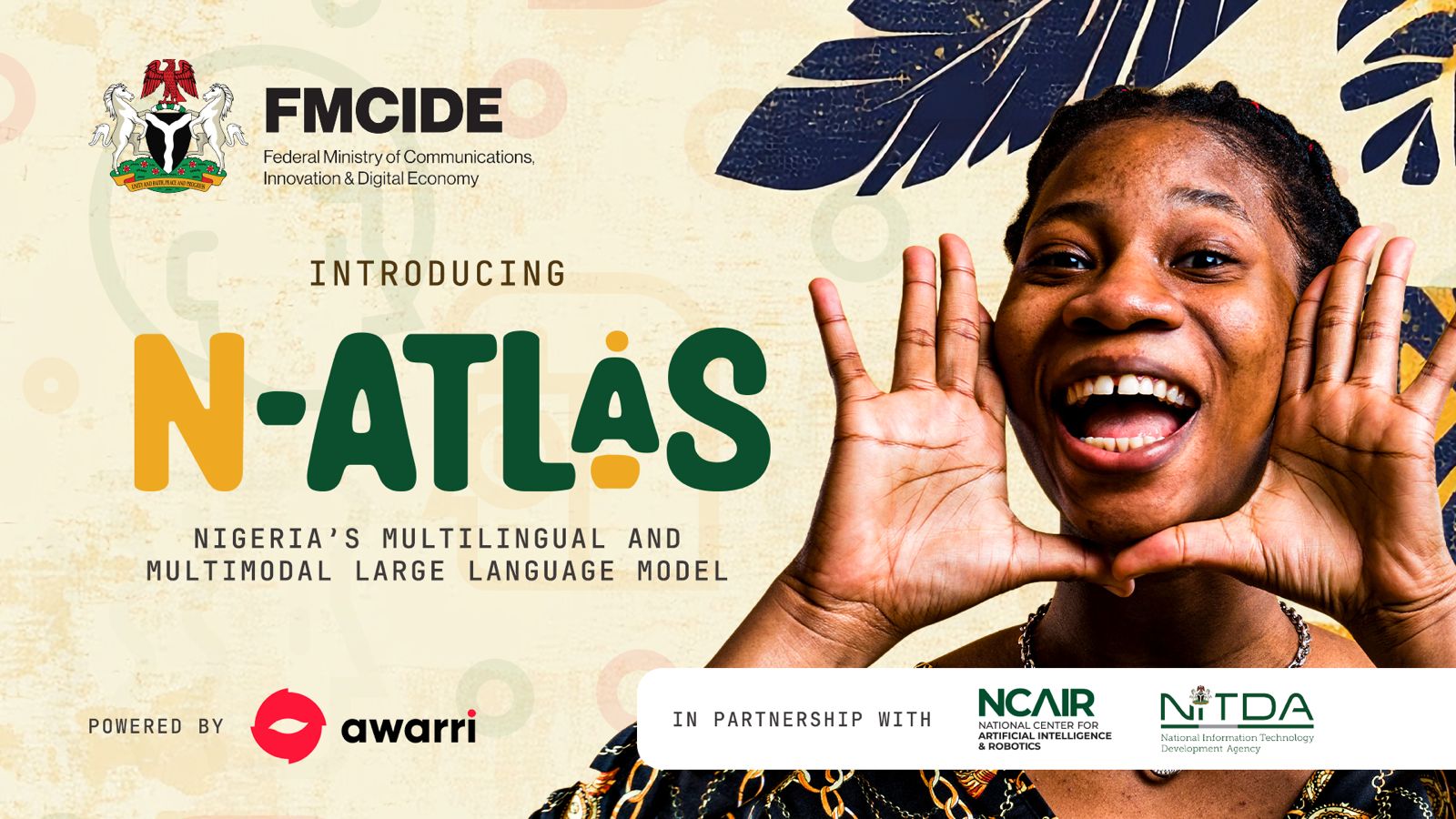
Nigeria just stunned the global AI community at the United Nations General Assembly in New York. The West African nation unveiled N-ATLAS V1, an open-source AI model that speaks four African languages fluently.
Dr. Bosun Tijani, Nigeria’s Minister of Communications, Innovation, and Digital Economy, made the announcement on September 21, 2024. Nigeria chose the world’s biggest diplomatic stage to show that African languages deserve equal space in the AI revolution.
N-ATLAS V1 supports Yoruba, Hausa, Igbo, and Nigerian-accented English. The model scored impressive results in human evaluations across all languages. English performance reached 4.21 out of 5.0, while Hausa achieved a perfect 5.0 score for usefulness.
Nigerian researchers trained the model on nearly 400 million tokens of multilingual instruction data. They processed over 918,000 samples across the four languages, with English leading at 318,000 samples and each African language receiving 200,000 samples.
N-ATLAS V1 can handle complex conversations in Hausa about governance. It explains cultural concepts in Yoruba with nuanced understanding. The model processes Igbo queries while maintaining the cultural context that Western AI systems miss entirely.
The Federal Ministry of Communications, Innovation, and Digital Economy partnered with the National Information Technology Development Agency (NITDA) and the National Centre for Artificial Intelligence and Robotics (NCAIR) to build N-ATLAS.
Awarri Technologies powered the technical development. The collaboration shows Africa’s first coordinated government effort to create indigenous AI capabilities rather than importing Western solutions.
“N-ATLAS places Africa’s voices and diversity at the foundation of AI,” Dr. Tijani explained. “This is the first step in a broader journey to make Africa a contributor and leader in shaping AI’s future.”
Instead of waiting for tech giants to add African language support as an afterthought, Nigeria built its own foundation model from scratch.
Four Languages Open New Possibilities for 200 Million Speakers
N-ATLAS V1’s language capabilities unlock practical applications across Nigeria’s diverse population. The model can power chatbots that help citizens access government services in their native languages. Call centers can deploy the AI to handle customer queries in Hausa, Yoruba, or Igbo without human translators.
The AI transcribes radio and television content in all four languages. News organizations can generate captions and subtitles automatically. Educational platforms can create learning materials that speak directly to students in their mother tongues.
Healthcare applications become possible for the first time. Patients can describe symptoms in Yoruba and receive accurate medical guidance. Rural communities gain access to health information in languages they actually speak.
Open Source Strategy Challenges Big Tech Dominance
Nigeria made a strategic choice that surprises many observers. N-ATLAS V1 launches as fully open-source software available on Hugging Face. Anyone can download, modify, and build upon the model without paying licensing fees.
This approach contrasts sharply with closed AI systems from major tech companies. While Google, OpenAI, and others guard their models behind paywalls and APIs, Nigeria chose radical transparency.
The open-source license includes important limitations. Organizations with more than 1,000 active users need commercial licenses. Military and surveillance applications are prohibited. The terms ensure the model serves community development rather than exploitation.
Nigeria’s choice sends a clear message to Silicon Valley. African nations won’t wait for Western companies to decide when African languages matter. They’ll build their own AI infrastructure and set their own terms.
Global AI Race Gets New African Competitor
Western models dominate current conversations, but Nigeria’s entry proves that AI leadership isn’t predetermined. Countries with strong technical capabilities and clear vision can compete effectively.
The model’s technical specifications impress industry observers. Built on Meta’s Llama-3 8B architecture, N-ATLAS includes 32 layers with 4,096 hidden dimensions. The 128,256 vocabulary size and 131,072 maximum position embeddings match enterprise-grade systems.
Human evaluation results show the model performs competitively across multiple metrics. Fluency, coherence, relevance, and accuracy scores demonstrate that African-built AI can match Western standards while adding unique cultural understanding.
African Languages Finally Get Serious AI Investment
For decades, African languages remained afterthoughts in technology development. Major platforms added basic translation features, but true conversational AI stayed out of reach. N-ATLAS V1 changes this dynamic completely.
The model handles code-switching naturally; the common practice of mixing languages within conversations. Nigerian speakers often blend English with local languages, and N-ATLAS V1 processes these patterns seamlessly. Western AI systems struggle with this linguistic complexity.
Cultural context makes the difference. When discussing traditional practices, family structures, or local customs, N-ATLAS V1 provides accurate, culturally sensitive responses. Generic AI models trained primarily on Western content miss these nuances entirely.
Commercial Applications Create Economic Opportunities
N-ATLAS V1 opens new business possibilities across Nigeria and beyond. Software developers can build applications serving African markets in their native languages. Customer service companies can expand into markets previously blocked by language barriers.
Educational technology becomes viable for African schools. Learning platforms can create content in local languages rather than forcing students to learn through English or other foreign languages. This approach improves comprehension and cultural relevance.
Media organizations gain new distribution capabilities. News outlets can automatically generate content in multiple Nigerian languages. Entertainment companies can localize content for different ethnic groups within the country.
Government services benefit from direct citizen engagement. Citizens can interact with digital platforms in their preferred languages, improving access to healthcare, education, and administrative services.
Nigeria Sets Template for African AI Development
Other African nations are watching Nigeria’s approach closely. The N-ATLAS model proves that countries can develop indigenous AI capabilities without depending entirely on Western technology companies.
The open-source strategy creates opportunities for continental collaboration. Researchers in Ghana, Kenya, South Africa, and other nations can build upon Nigeria’s foundation to create models supporting their own languages.
Regional cooperation becomes possible in ways that weren’t available before. African countries can share research, data, and development costs while maintaining sovereignty over their AI infrastructure.
The Nigerian government’s commitment demonstrates how policy makers can prioritize technological independence. Countries can ensure their cultural values and languages receive appropriate representation in AI systems by funding domestic AI research,
Next Steps Include More Languages and Applications
The N-ATLAS team plans significant expansions in coming months. Additional African languages will join the platform, extending coverage beyond Nigeria’s borders. Performance improvements target better accuracy across all supported languages.
Reinforcement learning with human feedback will enhance the model’s capabilities. Extended context length support will enable more complex conversations and document processing. Bias mitigation strategies will address fairness concerns identified in initial evaluations.
Commercial partnerships will accelerate adoption across industries. The team seeks collaborations with telecommunications companies, educational institutions, and government agencies to deploy N-ATLAS in real-world applications.
Research applications will explore advanced capabilities. Natural language processing tasks, content generation, and cultural preservation projects will test the model’s potential across different domains.
Nigeria’s N-ATLAS V1 signals Africa’s determination to participate actively in defining AI’s future rather than accepting predetermined roles as consumers of Western innovation. The global AI community just gained a new competitor that speaks languages Silicon Valley forgot existed.