

A woman paralyzed since her teens has just broken through one of medicine’s final frontiers, controlling technology with pure thought. Audrey Crews recently became the first female recipient of Elon Musk’s Neuralink brain chip, and the results have stunned the world.
For two decades, Audrey couldn’t lift a pen. Today, she’s writing her name without moving a muscle.
The Power of Thought Becomes Reality
Last month, doctors at the University of Miami Health Center implanted a quarter-sized chip into Audrey’s brain. The procedure, part of Neuralink’s PRIME clinical trial, involved placing 128 thread-like electrodes into her motor cortex, the brain region responsible for movement.

Within days, Audrey did something she hadn’t done since she was 16 years old. She wrote her name. Using nothing but her thoughts, she controlled a cursor to write “Audrey” on a computer screen.
From Simple Writing to Digital Drawing
Audrey’s progress didn’t stop there. She quickly moved from basic writing to creating digital art, all through mental commands alone.
“Here are some more of my doodles! I’m taking requests. Lol.” she shared in a recent post showing colorful drawings including a heart, a face, a bird, and even a slice of pizza.
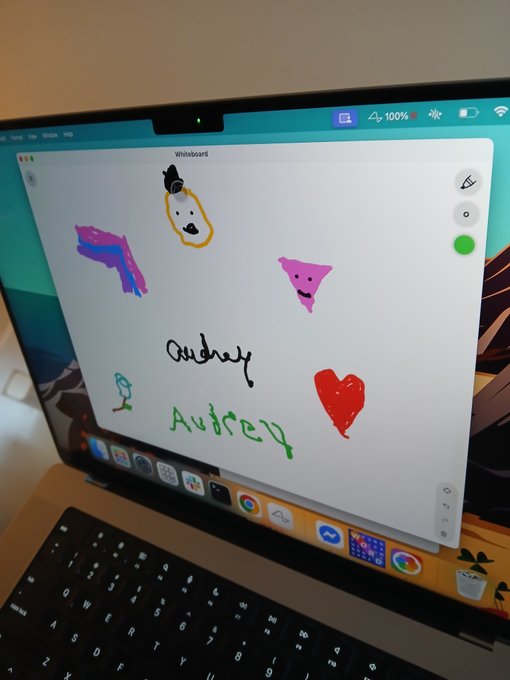
She described the experience as similar to controlling your finger and wrist movements, but without physically doing anything.
“Imagine your pointer finger is the left click and the cursor movement is with your wrist—without physically doing it. Just a normal day using telepathy.” she explained.
How the Neuralink Brain-Computer Interface Works
Neuralink’s technology translates neural activity directly into computer commands. The implant reads signals from the brain’s movement center and converts them into cursor movements in real-time.
The quarter-sized device includes a surgical robot that precisely places 1,024 electrodes into the brain using ultra-thin threads. These threads detect electrical signals from neurons, which are then processed by specialized algorithms to identify patterns associated with intended movements.
While the technology won’t restore Audrey’s physical movement, it offers something perhaps equally valuable which is digital independence. She can now control computers, communicate, and create art solely through mental effort.
Beyond the First Patient
Audrey, known as “Patient 9” in Neuralink’s PRIME clinical trial, isn’t the first person to receive this revolutionary implant. In January 2024, Noland Arbaugh became the first Neuralink recipient, demonstrating he could control a computer mouse through thought alone.
Since then, the company has successfully implanted chips in multiple patients, including completing two surgeries in a single day. According to Neuralink’s updates, all participants are “recovering well and in great spirits.”
The PRIME Study (Precise Robotically IMplanted Brain-Computer InterfacE) specifically targets individuals with tetraplegia from cervical spinal cord injury or ALS, offering hope to those with limited or no ability to use their hands.
Future of Mind-Controlled Technology
While Neuralink’s achievements are impressive, they represent just the beginning of what brain-computer interfaces might accomplish.
Future applications could extend beyond basic computer control to advanced prosthetic limbs, speech synthesis for those who cannot speak, and potentially treating neurological conditions like epilepsy, Parkinson’s disease, and depression.
“Most people don’t realize this is possible,” commented Elon Musk, who co-founded Neuralink in 2016. The company’s long-term vision extends far beyond helping those with paralysis. It creates a direct connection between human brains and artificial intelligence.
The Human Behind the Headlines
Lost in the technological marvel is the human story. Audrey has lived with complete paralysis for twenty years, since she was just 16 years old. The ability to write her name, create art, or control a computer independently is not just a scientific breakthrough, but a deep personal victory.
“It’s strictly for telepathy only,” Audrey noted about her implant, managing expectations about physical recovery. But the mental freedom she’s regained speaks volumes about the life-changing potential of this technology.
As she continues sharing updates about her journey, Audrey is becoming not just the face of a scientific breakthrough but an ambassador for how technology can transform lives when placed directly at the intersection of mind and machine.
For millions living with paralysis worldwide, Audrey’s experience offers something that has been in short supply, that is, the hope that the mind’s capabilities might someday overcome the body’s limitations.