
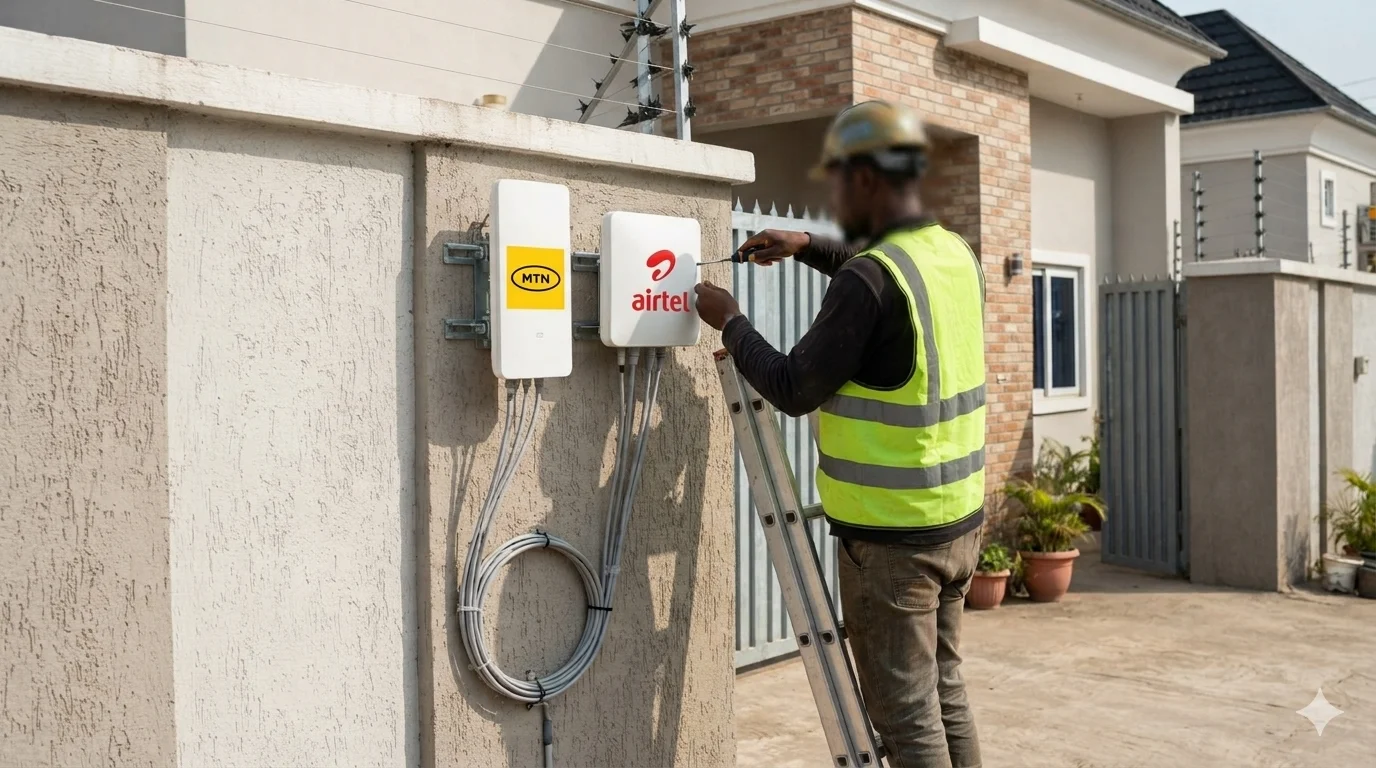
If it feels like every third house on your street has grown a small white box on the outside wall, you’re not imagining it. The ODU has become one of the most talked-about home internet options in Nigeria, and for a specific group of people it solves a problem nothing else does.
What an ODU Actually Is
ODU stands for Outdoor Unit. Instead of a router sitting in your living room fighting through concrete walls to find a signal, the receiver gets mounted outside, wherever the signal is strongest, and feeds a stable connection to a Wi-Fi router inside your home.
That’s the whole idea, and it matters more than it sounds. Nigerian buildings are not kind to wireless signal. A MiFi on your table is working with whatever makes it through the wall. An outdoor antenna isn’t. It runs on MTN or Airtel’s 4G and 5G networks, which reach vastly more of the country than fibre does, and it needs no trench, no cable on your street, and no waiting list.

The Actual Prices
MTN runs two unlimited tiers, both on a 30-day cycle: 50Mbps at ₦30,000 and 100Mbps at ₦45,000.
Airtel is cheaper at entry. Its Unlimited 50 is ₦25,000 for 30 days and Unlimited 100 is ₦45,000, with an initial ₦40,000 setup package that includes the first month. Airtel also sells 90-day and 180-day windows, which bring the monthly cost down if you’re willing to commit.
Promotional bundles move around, so confirm what’s actually on offer at your point of purchase rather than working from any article, including this one.
The Part the Adverts Skip
Both networks market these plans as unlimited, but you should know they operate a Fair Usage Policy.
That means your connection doesn’t stop when you cross the threshold, but your speed drops. On MTN, once you hit the limit within a 30-day cycle, download speed falls to around 5Mbps and stays there until the next month begins.
So unlimited here means uncapped, not unthrottled. Whether that matters depends entirely on how heavily you use it, which brings us to the useful part.
A Month With MTN’s ODU
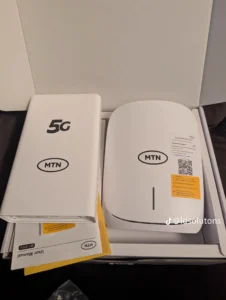
I’ve been running the MTN ODU for a month in a household of four people using it daily, and I haven’t hit the throttle once.
That’s the most useful thing I can tell you, because the fair usage threshold is the main thing that makes people hesitate. Also, with four people using it daily, it hasn’t lagged, speed and connectivity have been consistently good.
The detail that surprised me most had nothing to do with speed. There were moments when the MTN SIM in my phone couldn’t find service at all, and the ODU was still holding a connection. The same network in the same location. The difference is the antenna sitting outside with a clear line to the tower instead of inside a building trying to work through the walls. That alone explains a lot of why these things perform the way they do.
Buying it was straightforward too (which I found isn’t universal). I picked the unit up at Ikoyi, and MTN sent an installer to my home to mount and set it up. Not every review reports the same experience, and some buyers have found the purchase process more frustrating than the product, so results clearly vary by location and stock.
Who This Is Genuinely For
The honest answer is that ODU isn’t the best option for everyone. It’s the best option for a specific situation, and it’s worth being clear about which one.
If fibre reaches your building, fibre is usually still the better deal. MTN FibreX starts around ₦25,000 a month for 50Mbps with free installation, and fixed-line latency beats wireless for video calls and gaming.
If fibre doesn’t reach you, which is most of Nigeria, ODU is the strongest non-fibre option available. This was my situation. I moved from somewhere with fibre running to the building to somewhere without it, and ODU filled the gap completely.
If you’re comparing it to Starlink, the gap is mostly upfront cost. Starlink runs about ₦57,000 monthly plus roughly ₦590,000 for hardware. An ODU is a fraction of that to get started. Starlink’s advantage is that it works essentially anywhere with sky view, including places no tower reaches. If you have decent MTN or Airtel coverage, ODU is far cheaper for a similar everyday experience.
The One Thing That Decides Everything
Coverage at your exact address.
The advertised 50Mbps and 100Mbps are maximums under good conditions, not guarantees. In a strong coverage zone, an ODU is genuinely excellent. In a weak one, no amount of outdoor mounting fixes a signal that isn’t there, and you’ll have paid for hardware that underperforms. Check coverage for your specific location before you buy, and if you can, ask a neighbour who already has one what they’re actually getting.
So, Is It Worth It?
For me, comfortably yes. With a family of four, a month of daily use, no throttling, no lag, and a device that found network when my phone couldn’t. My only real complaint is that I didn’t get it sooner.
I must say that heavier users have admitted to hitting their limit sooner. And my coverage area is clearly good, which is the variable that determines almost everything about this product.
If fibre can reach you, take fibre. If it can’t, and you have solid coverage from MTN or Airtel, the ODU is the best home internet most Nigerians can actually get right now.