
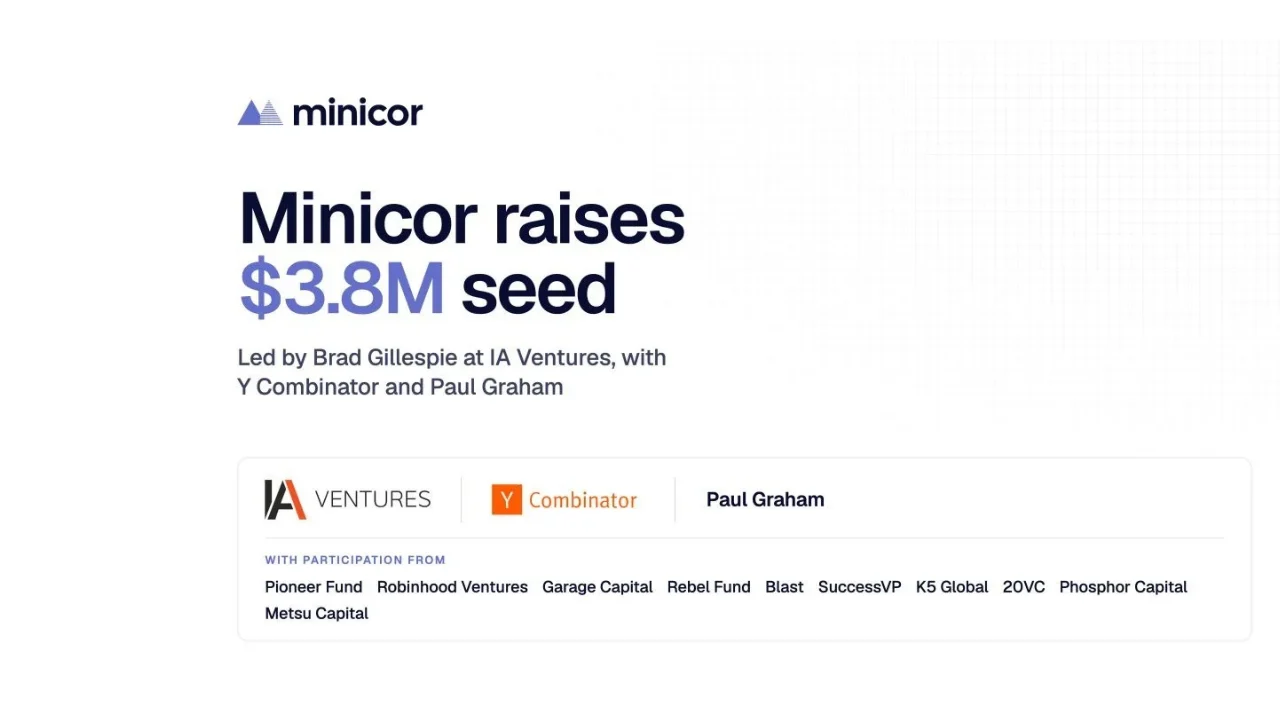
Minicor, a San Francisco-based artificial intelligence startup co-founded by Nigerian software engineer Saheed Akinbile, has raised $3.8 million in seed funding to help businesses connect AI applications to older software systems that lack modern integrations.
The round was led by Brad Gillespie of IA Ventures, with participation from Y Combinator, Paul Graham, Pioneer Fund, Robinhood Ventures, Garage Capital, Rebel Fund, K5 Global, 20VC and other investors.
Minicor announced the investment on Wednesday, October 14, positioning itself to address a growing challenge in enterprise AI adoption: how to make intelligent software work with the ageing applications that many businesses still depend on.
Founded by Faizaan Chishtie and Akinbile, Minicor develops automation infrastructure that enables AI-powered tools to interact with traditional desktop applications without requiring those applications to have modern application programming interfaces (APIs).
The company is targeting AI startups and enterprise software providers serving industries such as healthcare, financial services, automotive services and logistics, where older systems remain central to daily operations.
Its pitch is straightforward: businesses should be able to adopt AI without first replacing the software infrastructure they have spent years building their operations around.
Solving One of Enterprise AI’s Biggest Integration Problems
Much of the recent attention surrounding artificial intelligence has focused on increasingly capable models and AI agents that can perform complex tasks.
However, deploying these technologies within established businesses presents a different challenge.
Many companies still rely on desktop applications and internal systems that were built long before modern cloud computing became widespread. These applications often contain critical operational information but provide limited ways for external software to access or update that information.
For example, a healthcare technology company might develop an AI system capable of preparing patient documentation, only to discover that the hospital’s electronic health record software requires employees to manually enter the information.
An automotive software provider could face a similar problem when attempting to connect its technology to a dealership’s existing management system.
Even when these applications have APIs, the available integrations may not support every task a business needs to automate.
That creates a significant obstacle for AI companies attempting to sell their products to customers in traditional industries.
Minicor addresses the problem by allowing developers to turn desktop workflows into API endpoints that other applications can call.
Instead of building a separate integration for every legacy system, customers can describe the task they want to automate and use Minicor’s infrastructure to interact with the software through its existing interface.
The platform uses AI agents to build and repair workflows, while routine tasks are executed through predetermined automation steps.
This distinction matters because an AI agent that independently interprets a screen and decides what to click during every interaction can introduce delays, unpredictable behaviour and additional computing costs.
Minicor’s approach attempts to reduce those problems by reserving AI-driven reasoning for building workflows and handling unexpected changes rather than relying on it for every routine action.
According to the company, the platform also supports activity logs, video recordings and human approval controls, allowing businesses to review automated actions and intervene when necessary.
These capabilities are particularly important in industries where incorrect data entry or an undetected automation failure can have serious operational consequences.
Minicor Reports 2.5 Million Automation Executions
Although Minicor is still an early-stage startup, it has disclosed some indicators of product usage.
The company’s website currently displays a figure of 2.5 million automation executions, although it does not specify the period covered or disclose how many customers generated those executions. The figure has not been independently verified.
In an earlier Y Combinator launch announcement, the founders said the platform was processing thousands of workflows every week, including operations involving healthcare record systems.
They also reported bringing one customer into production three weeks after completing a proof of concept.
These disclosures suggest that Minicor has moved beyond demonstrating its technology, although the company has not publicly provided enough financial information to assess the commercial scale of its operations.
Its revenue, number of paying customers and customer retention figures remain undisclosed.
Minicor also did not reveal its valuation in the latest funding announcement or provide a detailed breakdown of how the $3.8 million would be spent.
However, the company is actively recruiting engineers as it continues developing its product.
According to its Y Combinator profile, Minicor was founded in 2024, participated in the accelerator’s Spring 2026 batch and has an eight-person team.
The startup also describes a usage-based commercial approach in which customers pay when automated data-entry tasks are successfully completed.
For enterprise customers, the effectiveness of that model will depend on how reliably Minicor can complete high-volume workflows, particularly when legacy applications experience updates, interruptions or unexpected errors.
Meet Saheed Akinbile, Minicor’s Nigerian Co-Founder
Minicor’s Nigerian connection comes through Akinbile, its co-founder and chief technology officer, who grew up in Lagos before moving to Canada at the age of 18.
He initially planned to study mechanical engineering but eventually pursued software engineering at the University of Ottawa.
Before founding Minicor, Akinbile worked at Morgan Stanley and Ford, gaining experience in software systems that operate in complex business and engineering environments.
At Ford, his work involved automotive technologies, including camera-based systems, parking assistance and vehicle driving controls.
In a personal essay published in September 2026, Akinbile explained that his interest in automation centres on making software capable of performing complex tasks while keeping its actions predictable and subject to human control.
That philosophy is reflected in Minicor’s product architecture, which combines AI-assisted workflow creation with more predictable execution methods.
Akinbile’s co-founder, Chishtie, also has a background in software integrations.
According to the founders’ Y Combinator introduction, the pair met in 2019 and began working together on the technology that eventually became Minicor in 2023.
Their initial product focused on monitoring integrations and recovering from errors. They later moved into desktop automation after encountering demand from a prospective customer seeking to connect to an on-premises medical records system.
That experience helped shape Minicor’s current focus on connecting AI products to software that lacks sufficient integration capabilities.
While the company is headquartered in San Francisco, Akinbile’s involvement highlights the contribution of Nigerian-born engineers to an emerging segment of the global AI industry.
Minicor has not announced plans to establish operations in Nigeria or expand into other African markets.
Competing in an Established Automation Market
Minicor is entering a market that already includes established automation providers such as UiPath and Microsoft’s Power Automate.
These platforms help businesses automate repetitive tasks across applications, including some systems that lack modern APIs.
UiPath, for example, offers desktop automation supported by computer vision, deterministic execution and AI-assisted capabilities designed to help workflows adapt when interfaces change.
That means Minicor is not introducing desktop automation as an entirely new concept.
Instead, its opportunity lies in making legacy software integration easier for developers building AI products, particularly smaller companies that may lack the engineering resources to create and maintain extensive automation infrastructure.
Its model centres on providing developers with an API endpoint while handling much of the underlying desktop automation.
That approach could appeal to AI startups attempting to sell into industries where customers cannot easily replace existing software.
However, Minicor must demonstrate that its technology can compete with more established platforms on reliability, cost, security and deployment at scale.
For businesses operating in sensitive sectors such as healthcare and finance, successful automation involves more than completing tasks quickly. Systems must also protect data, maintain audit trails and minimise the risk of incorrect actions.
Minicor says its platform addresses these concerns through verification, access controls, monitoring and human oversight, but publicly available information does not establish how its performance compares with competing products in independent testing.
Why the Funding Matters
Minicor’s latest investment reflects a broader opportunity emerging as AI companies move from building standalone applications to integrating their products with the systems businesses already use.
An AI agent may be capable of analysing documents, preparing reports or handling customer requests, but its commercial usefulness can be limited if it cannot interact with the software where business records are stored.
Solving that last-mile integration problem could become increasingly important as AI developers target established industries rather than businesses already operating entirely on modern cloud platforms.
For Minicor, the $3.8 million round provides additional capital to pursue that opportunity, backed by investors including IA Ventures and Y Combinator.
The company’s next challenge will be converting its automation capabilities into sustainable revenue while proving that its infrastructure can operate reliably across different legacy software environments.
For Nigeria’s technology community, Akinbile’s role also illustrates the growing participation of Nigerian engineering talent in the international AI economy.
Although the investment is not funding a Nigeria-based startup, it puts a Nigerian-raised software engineer at the centre of a venture-backed company tackling a complex enterprise technology problem.
Whether Minicor can turn that opportunity into a large business will depend on how effectively it helps AI companies overcome a challenge that increasingly powerful models alone cannot solve: making new technology work with old systems.