
African business finance platform Bujeti is introducing a new artificial intelligence layer designed to take repetitive financial work off finance teams without handing AI control over company funds.

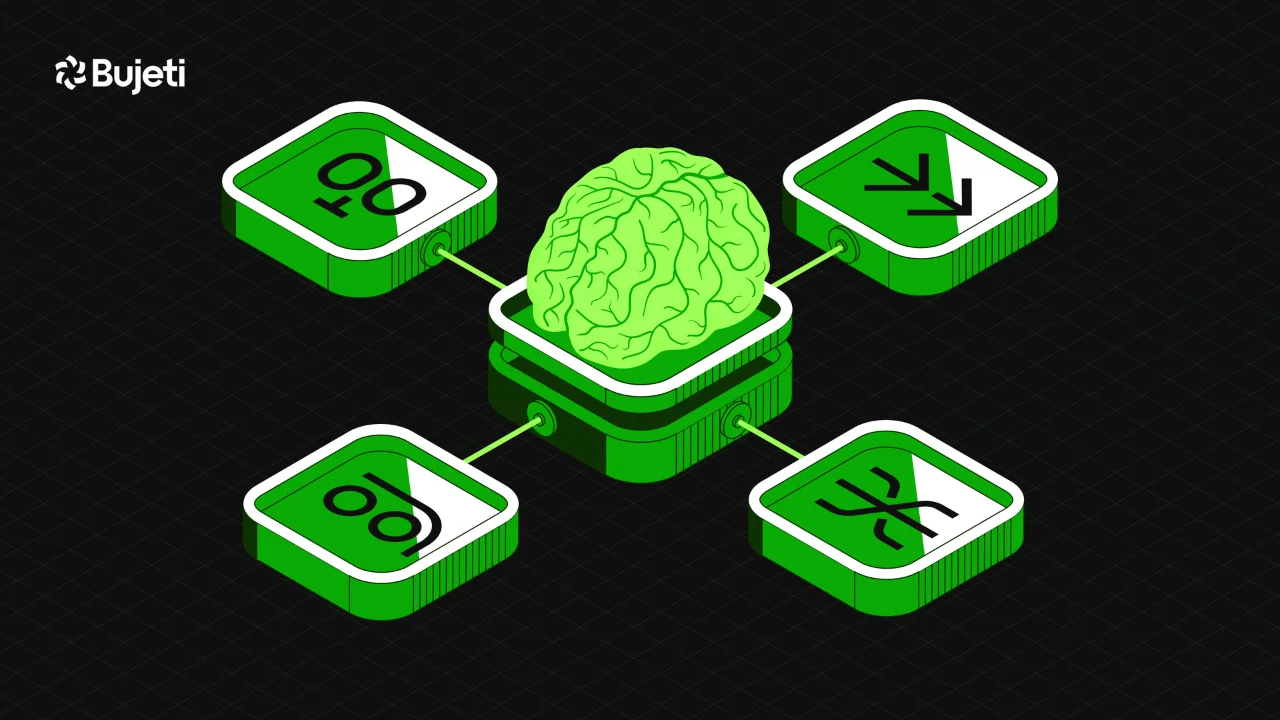
The new product, called BRAIN, introduces four specialised AI agents, which Bujeti calls “AI Teammates,” into its existing financial management platform.
The rollout begins on September 16 with a private beta for selected businesses, ahead of wider public availability on September 30.
Rather than functioning as a general-purpose chatbot, the agents are designed to work within specific areas of a company’s finance operations, including collecting financial documents, following up on unpaid invoices, monitoring transactions and answering internal finance-policy questions.
It marks Bujeti’s attempt to move beyond helping businesses manage how money moves towards using AI to understand and act on the financial information those businesses already generate.
Meet Bujeti’s Four AI Teammates
BRAIN launches with four agents, each assigned a different finance function.
Fetch: Head of Document Intelligence
Fetch, described as the Head of Document Intelligence, connects to email, storage and accounting applications to locate invoices, receipts and statements.
It extracts information from those documents, assigns a confidence score and sends uncertain cases to a human for review.
Chaser: Head of Accounts Receivable
Chaser, the Head of Accounts Receivable, handles invoice collection across email, SMS and WhatsApp. Businesses can set different stages, channels and tones for collection messages.
More interestingly, Chaser is designed to go beyond simply sending reminders. If a customer cannot settle an invoice in full, the agent can act as an intermediary to work towards a payment plan or partial settlement, while disputes and questions are escalated to humans.
Watchdog: Head of Financial Controls
Watchdog acts as the Head of Financial Controls. It monitors transactions, vendor activity and contracts, generating severity-ranked alerts and identifying contracts approaching expiration or automatic renewal within a 30-day window.
Concierge: Head of Finance Knowledge
Finally, Concierge, the Head of Finance Knowledge, is designed to answer employees’ financial questions based on their organisation’s own policies rather than relying solely on generic information.
Together, the four agents represent Bujeti’s vision of AI not simply explaining financial information, but completing parts of the work surrounding it.
But Bujeti Isn’t Giving AI Control of Your Money
Allowing autonomous software into a company’s finance operation raises an obvious question: how much authority should an AI agent actually have?
Bujeti’s answer is to draw the line at moving money.
According to the company, none of its AI Teammates has standing authority to move funds. Tasks that fall below predefined confidence thresholds are escalated to a human, while actions taken by the agents are recorded in an audit trail.
Businesses can also control each agent independently, and Bujeti says customer data will not be used to train models for other customers.
The approach creates a distinction between automating financial work and automating financial authority.
An agent might find an invoice, chase a customer or flag a suspicious transaction, but the final authority over a company’s money remains with people.
Why Bujeti Built the Finance Platform Before the AI
Bujeti’s argument for BRAIN rests heavily on what it built before generative AI became the centre of the technology industry.
The company has spent roughly three years developing financial infrastructure for African businesses.
Its existing platform includes corporate cards with real-time controls, automated vendor payments with multiple approval levels, budgets, invoicing, business accounts, tax tools, payroll and a mobile application.
Bujeti says more than 2,000 finance professionals across Nigeria and Kenya currently use its platform.
That existing infrastructure is important to how BRAIN is supposed to work.
Instead of sitting outside a company’s finance system and requiring information to be repeatedly supplied to it, Bujeti says its agents can operate across the accounts, budgets, vendors, contracts and transactions already contained within the platform.
An invoice captured by Fetch, for example, becomes part of the same financial environment monitored by Watchdog.
The company believes this context can make specialised financial agents more useful than simply attaching a chatbot to existing software.
From Moving Money to Understanding It
Bujeti sees BRAIN as part of a broader evolution in African fintech.
Its thesis is that the industry’s early development largely focused on giving consumers better ways to move money through cards, transfers and digital wallets.
A subsequent wave brought more financial infrastructure into businesses through tools such as invoicing, payroll, vendor payments and controlled corporate spending.
Bujeti believes AI could create another layer: software capable of interpreting the information generated by those systems and completing routine work based on it.
For finance teams, that could mean spending less time gathering documents, sending payment reminders, checking transactions or repeatedly answering internal policy questions.
Instead, those tasks could increasingly be delegated to specialised software while employees concentrate on decisions requiring human judgement.
Bujeti Is Already Thinking Beyond BRAIN
The company is also developing additional AI capabilities beyond the initial four agents.
Chaser is expected to expand from invoice collections into broader debt and loan recovery. Bujeti says early internal testing on difficult collection accounts produced recovery results 3.2 times higher than a manual team, although the company explicitly describes this figure as an early test rather than a guaranteed or currently shipped capability.
Another development could have wider implications.
Bujeti is working on Bujeti MCP, a secure connector intended to allow external AI assistants and coding agents, including ChatGPT and Claude, to query a business’s financial intelligence and perform permitted actions using the controls established within Bujeti.
That capability remains on the company’s roadmap.
If delivered, it would mean businesses would not necessarily have to interact with their financial data exclusively through Bujeti’s own interface.
The Agentic Finance Experiment Begins
From September 16, Fetch and Chaser are entering private beta with selected existing customers and prospects, while Watchdog and Concierge are being made available to enterprise customers.
The larger rollout comes on September 30, when BRAIN and all four AI Teammates are expected to become available to businesses using Bujeti.
For Bujeti, the launch represents a shift from building a financial control centre to building what it describes as a financial intelligence platform.
For the broader African fintech ecosystem, it also creates an interesting test.
AI agents are increasingly being pitched as software that can perform work rather than merely answer questions. Bujeti is now applying that idea to one of the areas where autonomy carries particularly high stakes: business finance.
Its approach is to let AI do more of the work while keeping humans in control of the money.