

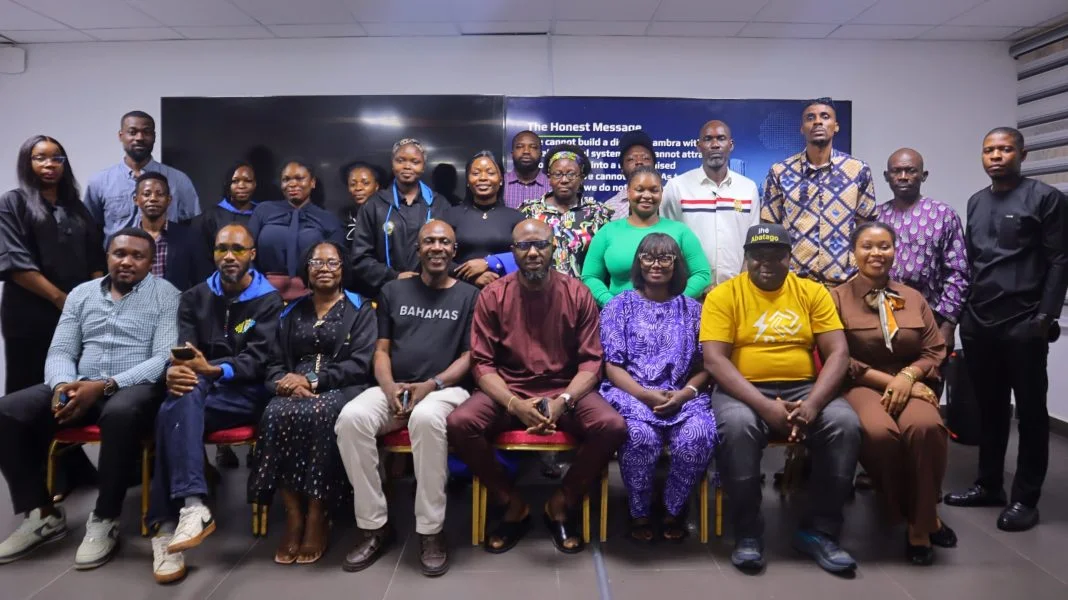
The Anambra State ICT Agency has declared a bold direction for its second tenure, centring its four-year strategy on becoming Nigeria’s first AI-native state ICT institution. The declaration came during the Agency’s Second Tenure Team Retreat 2026, held at the ICT Conference Hall under the theme: “The Next Four Years: Becoming Nigeria’s First AI-Native ICT Agency.”
MD/CEO Chukwuemeka Fred Agbata opened the retreat by charging staff to treat AI fluency as a professional requirement, not an option. In his address, he stressed that the Agency’s next phase must be defined by creativity, operational speed, and a willingness to work differently. “We must use AI intelligently, execute with speed, and do things differently,” he told the assembled team.
The retreat framed the AI pivot as an extension of Governor Charles Chukwuma Soludo’s broader vision for a smart and liveable Anambra. This is a vision the Agency has been mandated to drive through digital infrastructure, e-governance, and institutional reform.
Building an AI-First Institution
The keynote strategic session was delivered by the Agency’s Chief Technology Officer, Chinonso Okoye, PhD, who made the case for an institutional shift from digital awareness to AI-first operations. Drawing on the governance models of Singapore, Estonia, and Ireland, Okoye outlined how public institutions in those countries have used artificial intelligence to automate services, improve efficiency, and build more responsive government systems.
His presentation set the strategic framework for the next four years: strengthen internal AI competence while rolling out digital solutions capable of transforming how public services are delivered across Anambra State.
Retrospective and Strategic Groupings
The retreat included a structured four-year review covering the Agency’s achievements, gaps, and lessons from its first tenure. Participants examined progress across broadband penetration, internal operations, institutional culture, and inter-agency collaboration before breaking into four working groups: Smart Government and Infrastructure; Cybersecurity and E-Government; Digital Economy; and Human Capital, Institutional Capacity, and Governance.
The Agency’s Technical Personnel, Rev. Canon Sunday Folayan, anchored the proceedings around discipline and planning rigour, reminding participants that every strategy must be Specific, Measurable, Achievable, Realistic, and Time-bound.
Closing with Accountability
CFA closed the retreat by urging staff to consolidate the gains of the first tenure and commit fully to the digital transformation agenda ahead. Acting Director Chinyelu Odigbo, delivering the vote of thanks, acknowledged the significance of the moment, describing the retreat as an opportunity to shape the direction of Anambra’s digital story.
The session ended with a collective resolution to deploy smarter, more innovative approaches to governance while investing in continuous learning across emerging AI tools.
For a state that has already earned national recognition for ICT development (including the Best Overall State in ICT Development award at the 13th National Council on Communications, Innovation and Digital Economy), the Agency’s AI-native ambition represents a significant step up in both scope and expectation.