
X has published the code behind its ‘For You’ feed on GitHub, and Elon Musk confirmed the release in a post on May 15, 2026. This new repository gives the public a look at how X picks posts for each user. It shows a full system that decides which posts appear for you, in what order, and which get filtered out.
According to the repository, it combines posts from people you follow with posts found from across X, then uses a Grok-based model to predict what you’re most likely to engage with. It also adds new parts for ads, content understanding, and a runnable pipeline that developers can test.
How the feed picks posts
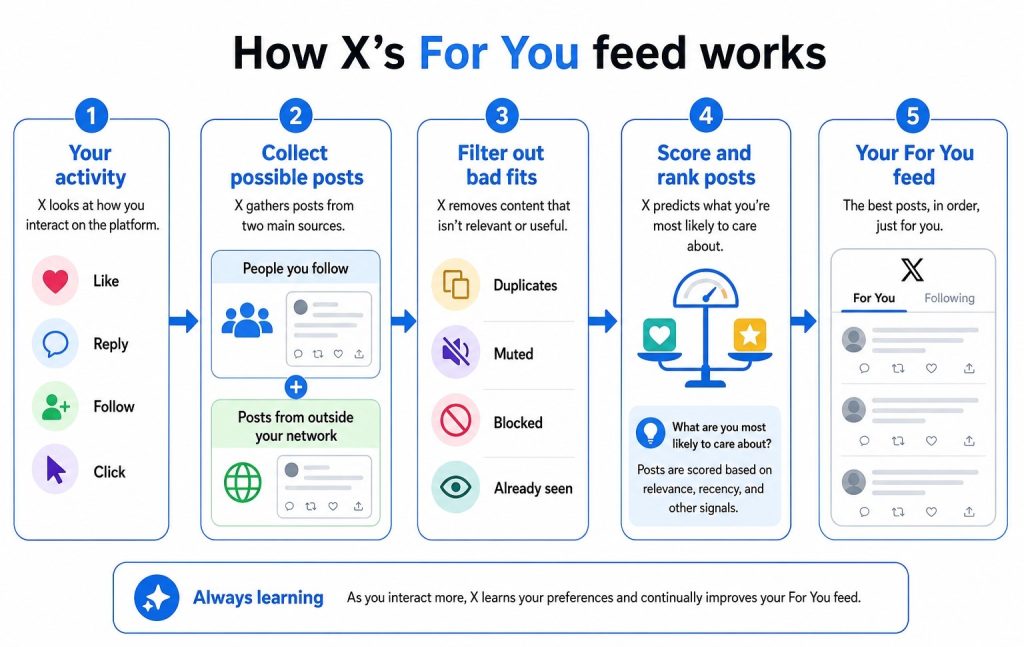
The system starts by building a large list of possible posts for you. Some come from people you follow. Others come from the wider platform. X says it finds these outside posts through machine learning-based retrieval across a global pool of content.
After that, X checks your context. The repository says the system looks at signals such as your engagement history, your following list, followed topics, starter packs, mutual follow graphs, and served history. In plain terms, the feed looks at what you tend to like, reply to, click, and spend time on.
Then the system enriches each possible post with extra details. The code calls this hydration. That means the feed pulls in useful information such as author details, media data, engagement counts, language signals, and brand safety information before ranking begins.
The feed removes posts before it ranks them
X does not rank every possible post it finds. First, it removes content that does not fit. The repository lists filters for duplicates, old posts, your own posts, blocked or muted authors, muted keywords, posts you have already seen, and subscription posts you cannot access.
It also applies checks after ranking. Those include visibility filters for deleted posts, spam, and violent or graphic material, along with conversation deduplication so the feed does not fill up with too many branches of the same thread.
It shows that the feed is not only about finding interesting posts. It also tries to avoid repetition, reduce clutter, and respect account blocks, mutes, and content controls.
The model predicts your next action
X says its Phoenix model, which the repository describes as a Grok-based transformer, predicts the chances that you will take different actions on a post. Those actions include like, reply, repost, quote, click, share, video view, photo expand, follow author, and dwell time. It also predicts negative actions such as not being interested, blocking the author, muting the author, and reporting.
In plain English, the feed makes an educated guess about what you will do next. If the system thinks you will like, read, watch, or share a post, that post gets a stronger chance of appearing near the top. If it thinks you will hide it, mute the author, or report it, that post loses ground.
The repository says the system has removed hand-built relevance features and relies on the Grok-based transformer to do the heavy lifting. That means the platform wants the model to learn patterns directly from user behaviour instead of leaning on a long list of manual rules.
Thunder, Phoenix, and Home Mixer
The code uses names that sound technical, but each one has a simple job.
Thunder handles recent posts from people you follow. It acts like a fast local store for in-network content. The repository says it tracks recent posts in memory and serves them quickly without calling an outside database.
Phoenix does two jobs. First, it finds outside posts that fit your interests. Second, it ranks all candidate posts by predicted engagement. That is the part that tries to figure out what deserves a higher spot in your feed.
Home Mixer sits on top and combines everything into one timeline. It gathers user context, pulls posts from different sources, enriches them, filters them, scores them, sorts them, and returns the final list. If you want one simple picture, Thunder finds posts from your network, Phoenix finds and ranks likely matches, and Home Mixer turns all of that into your ‘For You’ feed.
The 2026 release adds more than a code dump
The repository says X now includes a runnable end-to-end inference pipeline through phoenix/run_pipeline.py. That gives developers a chance to see how retrieval and ranking work together.
X also added a pre-trained mini Phoenix model that ships as a roughly 3 GB archive through Git LFS. That lowers the barrier for people who want to test the system without training a model from scratch.
Another new part is Grox, a content understanding service. The repository says it includes classifiers, embedders, and a task engine for jobs such as spam detection, post category classification, and policy enforcement. That shows X now treats content understanding as a bigger part of how the feed works behind the scenes.
The new release also includes an ad blending system inside Home Mixer. That code handles ad placement in the feed and tracks brand safety boundaries around sensitive content. This detail stands out because X’s 2023 transparency post said the earlier release did not include the code that powered ad recommendations. The newer repository, therefore, offers a view of how the feed mixes organic content with ads and other prompts.
Your own activity shapes the feed
What you do on X shapes what you see next. If you keep liking a topic, watching certain videos, opening posts from a certain kind of account, or spending time on similar content, the model learns from those actions and adjusts your feed.
That also explains why ‘For You’ often feels highly personal. Two people can open X at the same time and see very different timelines because the system uses each person’s history, network, preferences, and recent feedback to rank content.
Again, if you mute words, block accounts, or give negative feedback, the system uses those signals to reduce similar content. The feed does not just chase engagement. It also uses negative signals to decide what to push down.
Transparency carries more weight now
Platforms now face more public pressure to explain how feeds shape attention, news exposure, creator reach, and ad placement. X’s own 2023 posts framed algorithm disclosure as a trust-building move. TechCrunch reported that critics still saw the earlier effort as incomplete and viewed the latest release through that same transparency debate.
That makes this repository important even for people who will never read a line of code. It gives users, journalists, researchers, and creators a stronger factual base for understanding how X ranks posts and how the company describes its own recommendation system.
Editor’s Note
For You works as a prediction system. It studies your behaviour, estimates what you will care about, and builds the feed around those signals. The new GitHub release does not remove every mystery around platform ranking, but it gives the clearest public view yet of how X says the system works today.
RELATED: