An in-depth analysis of why AI-powered vibe coding tools excel at rapid prototyping but fall short for production applications, and what developers need to know.
The Promise vs. Reality
AI vibe coding tools promise rapid development and make programming accessible to everyone. While they excel at creating impressive mockups and prototypes, the transition to production-ready applications reveals fundamental limitations that can cost developers time, money, and sanity.
The Context Overload Problem
One of the most hidden issues with AI vibe coding tools is what I call “context overload.” As your project grows and accumulates more files, components, and complexity, the AI system begins to struggle with maintaining coherent understanding of your entire codebase.
When you request changes to existing functionality, AI tools might regenerate entire components or sections, inadvertently overriding custom modifications, bug fixes, or optimizations you’ve previously implemented. This creates a destructive cycle where progress is constantly being undone.
The Recovery Nightmare: My Lost UI Experience
Let me share what happened to me recently. I had built this beautiful, functional interface that worked exactly how I wanted it. The design was perfect, the interactions were smooth, and everything just felt right. Then I made what seemed like a simple request, just a small tweak to improve one feature. The AI completely regenerated the entire interface.
What I got back looked similar but felt completely different. The spacing was off, the interactions weren’t as smooth, and that perfect “vibe” I had achieved was gone. I spent the next three days desperately trying to get back to what I had before, describing it in every way I could think of: “make it more like before,” “the previous version was better,” “can you recreate the original design?” Nothing worked.
The AI couldn’t remember or recreate what we had built together just days earlier. I was stuck with something that was “close but not quite right”, the most frustrating place to be as a vibe coder.
The cruel irony: The AI that helped you create the original UI can’t remember or recreate it, leaving you in a worse position than when you started.
This scenario is devastatingly common. Spending entire weekends trying to recreate a UI that worked perfectly before, only to end up with something that’s “close but not quite right.” The AI tool that seemed so helpful initially becomes a source of endless frustration as it fails to understand what you’re trying to recover.
Why This Happens
- Limited Context Windows: AI models have finite context limits, meaning they can’t simultaneously consider your entire codebase when making changes.
- No Visual Memory: AI tools don’t “remember” how your UI looked or functioned in previous iterations, making recovery nearly impossible.
- Stateless Interactions: Each request is often treated as independent, lacking memory of previous customizations and architectural decisions.
The Point of No Return
The saving grace, fortunately, I’m a technical engineer with years of experience. I was able to download the code, dive into the files, and manually fix the issues myself. But this got me thinking, what would have happened if I wasn’t technical? What if I was just a pure vibe coder with no ability to read or modify code directly?
The most dangerous moment comes when you encounter a bug or need a feature that the AI tool cannot fix or implement correctly. For someone who codes through AI tools rather than traditional programming, you’re faced with a devastating choice:
The Vibe Coder’s Dilemma
- Option 1: Continue relying on the AI tool, accepting that certain bugs may never be fixed, features may never work correctly, and you may never get back that perfect UI you once had.
- Option 2: Try to manually fix the code yourself, but as a vibe coder, you’re working outside your comfort zone and risk breaking things further, plus any changes will likely be overwritten the next time you use the AI tool.
- Option 3: Abandon the AI-generated project entirely and either hire a traditional developer or start over with a completely different approach.
The Non-Technical Nightmare
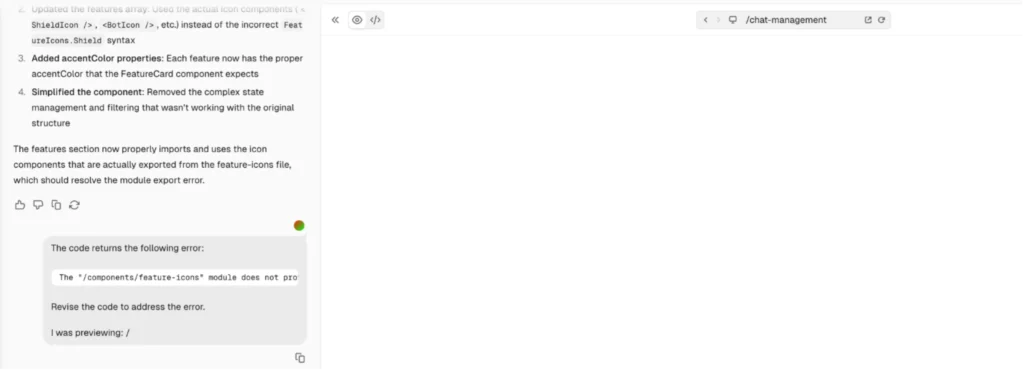
For non-technical users who rely entirely on AI tools, this situation becomes exponentially worse. When the AI breaks something or can’t recreate what you had, you have absolutely no recourse. You can’t download the code and fix it yourself. You can’t debug the issue. You can’t even understand what went wrong.
You’re completely helpless, watching your perfect creation slip away with no way to get it back. The frustration compounds because you know exactly what you want, but you have no way to achieve it when the AI fails you.
This creates a uniquely painful experience for vibe coders. You have the creative vision and can iterate toward great designs, but when things go wrong, you’re trapped. You can’t peek under the hood, can’t make surgical fixes, and can’t work around the AI’s limitations. Every bug becomes a potential project-killer, and every “small change” becomes a roll of the dice that might destroy hours or days of work.
Where AI Vibe Coding Excels
Despite these limitations, AI vibe coding tools have legitimate strengths that make them valuable in specific contexts:
- Rapid Prototyping: Perfect for creating quick mockups and proof-of-concepts
- Design Exploration: Excellent for testing different UI/UX approaches quickly
- Learning Tool: Great for understanding modern development patterns and frameworks
Best Practices for AI-Assisted Development
If you choose to use AI vibe coding tools, follow these guidelines to minimize risk:
- Set Clear Boundaries: Use AI tools only for initial scaffolding and mockups.
- Screenshot Everything: Take screenshots of your UI at every major milestone. Since AI tools can’t remember visual states, these become your only reference for recovery attempts.
The field is rapidly evolving, and future AI coding tools may address many of these limitations through:
- Better Context Management: Tools that maintain long-term memory of your codebase
- Visual State Memory: AI that can remember and recreate previous UI states
- Incremental Updates: AI that can make surgical changes without overriding existing code
- Architecture Awareness: Systems that understand and respect your application’s structure
AI vibe coding tools represent an exciting frontier in software development, but they’re not a complete solution. They excel at rapid prototyping and design exploration but fall short when it comes to building maintainable, scalable production applications.
The key is understanding these limitations upfront and using AI tools strategically within their strengths. Treat them as powerful prototyping tools rather than complete development solutions, and always have an exit strategy for transitioning to traditional development practices when your project demands it. Most importantly, protect your work with screenshots because once that perfect UI is gone, you may never get it back.