

Talksign, an AI research lab focused on translation between spoken and sign languages, has announced Morph 1.0, its first video-to-video model for sign language. The tool lets organisations and creators swap the person appearing in a signing video without recording the content again.
Why Re-Filming Has Been the Only Option
Sign language video has always been tied to the person who recorded it. Organisations that publish announcements, lessons and public information for Deaf audiences often have to film everything from scratch when they want a new presenter, even if the signed message is still accurate. That is slow and expensive.
Talksign says general avatar tools do not solve the problem. They were built for talking heads driven by a script or a voice, while sign language carries meaning through the hands, face and body moving together.
Edidiong Ekong, CEO and co-founder of Talksign, put it this way: “For years, changing who appears in a sign language video meant filming it all again. With Morph, the signing stays with the signer, and the person on screen becomes a choice. It opens up a new world of possibilities for sign language video, and gives anyone who creates sign language content more freedom, more privacy and more consistency.”
How Morph Works
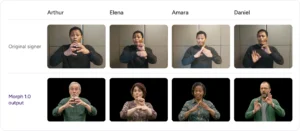
A user uploads a signing video and a photo of a person. Morph then re-renders the entire video as that person. Every handshape, movement and facial expression comes from the original signer. The output keeps the same timing, frame count and size as the source, so it can slot straight into an existing edit.
Users can choose a preset signer or upload their own photo, change the background, and export in 480p or 720p HD. Morph is powered by Echo, Talksign’s model for generating photorealistic sign language video, and a new version of Echo is due soon.
Watch the Demo here.
Who It Is Built For
Talksign points to several situations where the tool applies. A school or ASL learning company may have hundreds of lessons signed by a teacher who has since left, or whose consent to use their likeness has ended. Large organisations that record with different signers on different days can publish everything with one consistent presenter. Some signers prefer not to be the public face of a company, and a children’s channel or regional service may want a character or presenter its audience relates to.
The company groups these into three main uses: consistent presenters, creative freedom for Deaf creators who want to sign as a character, and privacy for signers who do not want to show their own face.
Consent and Privacy Safeguards
Talksign says uploaded videos and photos are stored privately, used only for the request in question, and never used to train its models. Morph may only be used with the consent of both the signer in the video and the person in the photo, and every output is labelled as machine-generated. The company says it evaluates its models with fluent Deaf signers.
Availability and What Comes Next
Morph 1.0 is open through early access at talksign.co/morph. Talksign is also inviting design partners, including educators, ASL learning companies and publishers of sign language content, to help shape future versions.
Beyond Morph, the company’s platform includes Echo, which turns speech and text into signing, and Palm, which turns signing into text and speech. Talksign is currently in beta on the web, with general availability on web, mobile and desktop coming soon. Its current focus is bringing sign language translation to smart glasses, planned for early 2027, and into the third-party apps people already use.