

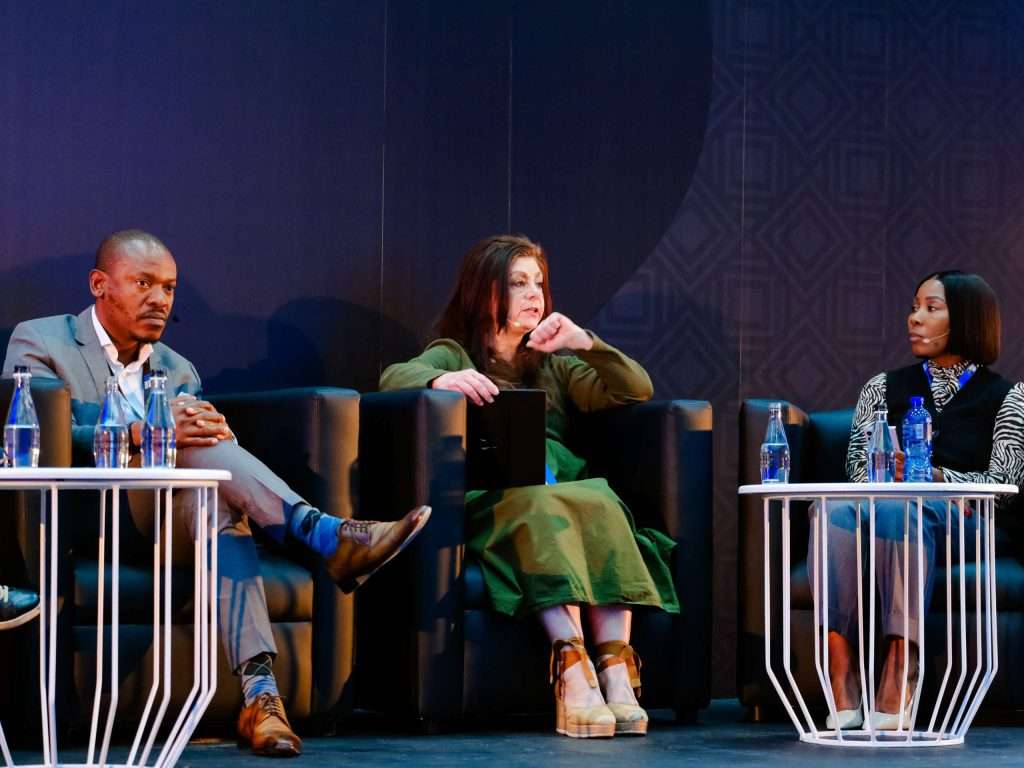
Three tech leaders at the 2025 IT Indaba has shattered the industry’s comfort zone as they delivered harsh truths. Sne Dlamini from AECI, Khomotso Molabe from Standard Bank, and former Helen Constantinides from Avbob didn’t mince words about Africa’s tech future.
Why Your Diverse Team Still Builds Broken AI Models
Dlamini exposed a dangerous reality plaguing African tech companies. “Much of our data carries bias,” she warned the packed audience. “If we keep building AI models from this flawed foundation, we create systems that exclude entire communities.”
Her words hit harder when she explained the real cost. Teams without neurodiversity miss patterns others can’t see. Companies mixing young talent with seasoned experts create balance between innovation and compliance. But most African firms still hire carbon copies of themselves.
The AECI executive pushed further. AI hallucination and bias stem from historical data that never questioned who got left behind. African companies risk building tomorrow’s technology on yesterday’s exclusions.
Africa’s 60% Youth Population Advantage Nobody’s Using
Molabe dropped statistics that should wake up every African tech executive. The continent houses over 400 million young people aged 15-35. That’s more potential innovators than the entire United States population.
Yet Standard Bank’s group CIO sees this demographic goldmine getting wasted. “Africa has the youngest population globally and faster economic growth than anywhere else,” Molabe stated. “But our IT departments ask wrong questions.”
Instead of copying Silicon Valley solutions, African tech teams should tackle local problems. Why does Africa face the biggest energy gaps? Why do infrastructure projects fail? Why import technology instead of creating homegrown solutions?
The World Bank confirms Africa’s population advantage. More than 60% are under 25 years old, with projections showing 42% of global youth will be African by 2030.
Digital Sovereignty: Africa’s Next Tech Battleground
Constantinides delivered the session’s most provocative statement. “Diversity should already be foundational in 2025. The real battle now is digital sovereignty.”
Kenya pioneered mobile money through M-Pesa in 2007, years before Apple Pay or Google Wallet gained traction. The system now processes over $270 billion annually with 66 million users across seven African markets.
Rwanda uses drones for medical deliveries in rural areas where traditional logistics fail. Nigeria’s Nollywood produces more films annually than Hollywood, creating a $6.4 billion industry from local storytelling.
“Africa isn’t waiting for the future,” Constantinides declared. “We’re already building it.”
Research from Carnegie Endowment supports her claims. Africa leads global mobile money adoption with nearly half of all registered accounts worldwide and over half of monthly active users.
The Bias Problem Killing African AI Innovation
The diversity discussion took a technical turn when Dlamini addressed algorithmic fairness. African AI systems trained on Western datasets often fail local contexts completely.
Recent research from the National Center for Biotechnology Information confirms this challenge. Algorithm bias poses substantial fairness problems across Africa, particularly affecting healthcare, financial services, and education technologies.
Current large language models overwhelmingly favor English and dominant languages, marginalizing African linguistic diversity. This creates AI systems that serve urban elites while excluding rural populations who speak indigenous languages.
The solution requires diverse development teams who understand local contexts. Teams with varied backgrounds challenge biased assumptions and build more inclusive models.
Mental Software Updates for African Tech Leaders
Molabe’s most quotable moment came when discussing leadership transformation. “IT departments must upgrade their mental software before upgrading their technical systems.”
This means asking strategic questions first. Why do African countries depend on foreign technology platforms? What unique innovations could emerge from addressing African challenges directly?
The Standard Bank executive pointed to successful examples. Mobile money solved banking access issues that traditional branches couldn’t address. Solar power solutions emerged from grid electricity limitations. Agricultural technology apps developed because farmers needed crop management tools.
From Talk to Action: Building Africa’s Digital Future
The three leaders agreed on one point: Discussion time is over. African tech companies need concrete action plans for inclusive innovation.
Practical steps include:
- Hiring beyond traditional networks to capture diverse perspectives and experiences.
- Training AI teams on bias detection and fairness testing protocols.
- Investing in local data collection that represents all population segments.
- Building partnerships with rural communities to understand their technology needs.
- Creating mentorship programs that pair experienced leaders with young innovators.
The Economic Case for Digital Independence
Africa’s digital economy shows tremendous potential. The continent’s tech sector could reach $712 billion by 2050, according to World Economic Forum projections.
But this growth depends on African companies owning their digital destiny. Relying on foreign platforms, cloud services, and AI models keeps profits flowing elsewhere.
Constantinides emphasized ownership importance. “We need to own our data, our platforms, and create digital industries that attract global attention to Africa.”
Lessons for African Tech Professionals
The IT Indaba messages create clear expectations for technology professionals across Africa. Junior developers should learn bias testing and inclusive design principles. Senior engineers must question data sources and model assumptions. Executive leaders need strategies for digital sovereignty.
Companies ignoring these warnings risk building irrelevant products for global markets while missing local opportunities. Those embracing inclusive innovation and digital ownership position themselves for long-term success.
The Global Stakes of Africa’s Tech Evolution
Africa’s technology choices affect global innovation patterns. The continent’s young population will shape future technology adoption worldwide. Their preferences, needs, and innovations will influence how technology develops globally.
If African tech leaders build inclusive, locally-relevant solutions, they create models other developing regions can adopt. If they continue copying Western approaches, they miss opportunities to lead technological innovation for the Global South.
Africa’s tech future depends on leaders who think beyond diversity checkboxes toward true digital independence. The question now is which companies will lead this transformation and which will get left behind.