
Introduction: The Myth of the Technical Founder
In the mythology of innovation, the “founder who codes” is often seen as the ultimate archetype, the prodigy who builds a prototype in their garage, launches it online, and changes the world. Yet the true landscape of global technology tells a far richer story. Some of the most important companies of our time were built not by coders, but by storytellers, strategists, designers, and visionaries who could translate big ideas into human experiences.
From Silicon Valley to Lagos, from San Francisco to Sydney, a new class of non-technical founders has redefined how technology is imagined, financed, and scaled. They may not write code, but they shape the cultures that write history. This is a celebration of those leaders, the non-technical co-founders who have built or co-built the technologies that power the modern world.
Steve Jobs and Sam Altman: Vision, Personality, and Influence
Before examining this new generation, it’s worth reflecting on two figures who represent the bookends of visionary leadership: Steve Jobs and Sam Altman.
Steve Jobs: The Iconic Visionary (but not the engineer)
Steve Jobs is often mythologized as a technical genius, but he was never an engineer in the classical sense. His strength was an unparalleled sense of design, storytelling, product intuition, and his relentless drive to merge technology with emotion. He demanded excellence from his teams and understood that beauty and usability were not afterthoughts; they were the product.
Jobs didn’t code the Macintosh or the iPhone, but he defined what they would mean to humanity. His insistence on empathy and experience over mere functionality permanently reshaped the relationship between people and technology.
Sam Altman: The Modern Architect of AI Strategy
Sam Altman represents the next evolution of the visionary archetype. While he understands technology deeply, his genius lies in synthesis, combining foresight, strategy, investment, and diplomacy. As the CEO of OpenAI, Altman doesn’t write neural network code; he orchestrates an ecosystem of engineers, scientists, investors, and policymakers to shape the trajectory of artificial intelligence.
His leadership through OpenAI’s upheavals, his navigation of the ethical and political dimensions of AI, and his role as a global voice for the future of intelligence position him as a distinctly 21st-century founder, more strategist than scientist, more architect than engineer.
Altman’s brief ousting and dramatic reinstatement at OpenAI revealed the same lesson that Jobs’ own Apple exile did decades earlier: organizations are as much about trust and vision as they are about technology. In a sense, Altman and Jobs bookend a lineage. One built the modern architecture of intelligence and startups; the other reinvented how consumer tech feels, looks, and sells. They share a fundamental truth: the power to build the future belongs as much to the visionary as to the technician.
From Vision to Velocity: The Builders Who Don’t Code But Move the World
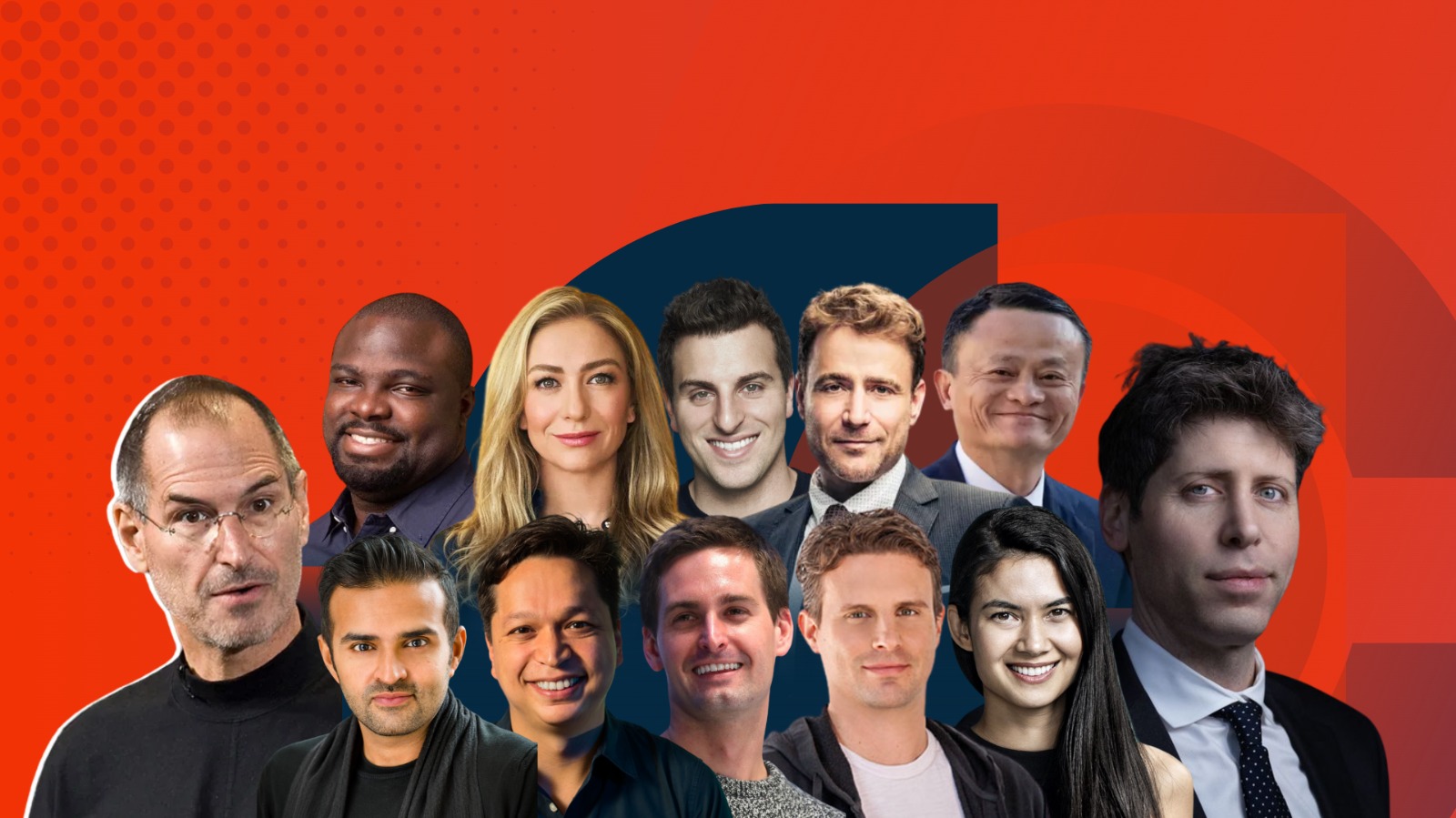
Here are ten additional extraordinary non-technical co-founders who have helped build the technology shaping our age. They prove that while code is critical, it is vision, empathy, and narrative that make technology meaningful.
| # | Founder | Venture(s) | What Makes Them Great (non-tech superpower) |
| 1 | Brian Chesky | Airbnb | A designer who transformed travel through trust, community, and belonging, redefining hospitality as human connection at a global scale. |
| 2 | Stewart Butterfield | Slack, Flickr | A philosopher-founder who turned conversations into companies, building products that respect human nuance and culture. |
| 3 | Evan Spiegel | Snap Inc. | A design-driven visionary who reimagined communication through camera-based storytelling, championing simplicity and self-expression. |
| 4 | Ben Silbermann | A curator of curiosity who made visual discovery and taste exploration part of everyday life through emotional design and community. | |
| 5 | Michael Dubin | Dollar Shave Club | A marketing revolutionary who used humour, storytelling, and a direct-to-consumer model to transform how tech-enabled commerce connects with users. |
| 6 | Whitney Wolfe Herd | Bumble | A culture-first founder who redefined online dating through safety, empowerment, and inclusion, creating a billion-dollar social brand. |
| 7 | Melanie Perkins | Canva | A non-technical designer who democratised creativity, turning design into a universal skill through accessibility and elegance. |
| 8 | Jack Ma | Alibaba | A teacher-turned-strategist who built one of the largest digital economies on earth through vision, partnerships, and storytelling. |
| 9 | Iyinoluwa Aboyeji | Andela, Flutterwave, Future Africa | A builder of ecosystems who connects capital, policy, and African talent to power the continent’s most transformative tech ventures. |
| 10 | Ashish J. Thakkar | Mara Group | A visionary African entrepreneur who wove together finance, infrastructure, and technology to create continental growth platforms. |
Each of these founders reflects a different dimension of non-technical mastery: design, storytelling, community, operations, capital, and policy. Together, they represent the unseen architecture of modern technology, the leadership that translates code into culture.
What Non-Technical Founders Do (When They Don’t Write Code)
Non-technical founders are not defined by what they lack, but by what they bring. Here are the crucial functions they perform when they don’t touch a line of code.
- Vision and Storytelling
They set the horizon, articulate meaning, and rally people around a mission that transcends features or lines of code. - Domain Expertise and Market Insight
They often emerge from the industries they disrupt, spotting inefficiencies and emotional needs that engineers might overlook. - Product Intuition and User Experience
They translate human desires into product direction, ensuring technology feels intuitive, not intimidating. - Recruitment and Team Building
They attract exceptional talent, shape culture, and build organisations that can outlast any single founder. - Fundraising, Partnerships, and Capital Allocation
They forge alliances, manage investor relations, and strategically allocate resources to achieve maximum impact. - Operational Discipline and Execution
They drive execution, ensure momentum, and bridge the gap between vision and delivery. - Adaptiveness and Learning
They learn technical fluency at a strategic level to communicate effectively with engineers and make informed trade-offs. - Trade-off Management and Prioritisation
They decide what not to build as much as what to build, ensuring focus in the face of endless possibilities.
Non-technical founders are translators, turning complexity into clarity, ideas into institutions, and ambition into momentum.
Comparisons, Patterns, and Lessons
What Jobs, Altman, and Non-Technical Founders Share
- Vision before tech. They start with “what if” and build the world to match it.
- Bias to action. They move fast, learn constantly, and pivot without paralysis.
- Talent magnetism. They attract people far more technical than themselves by articulating meaning, not just metrics.
- Narrative mastery. They understand that the story drives the strategy and that the story recruits the world.
- Dual thinking. They grasp both business imperatives and technological potential, bridging art and analytics.
Pitfalls for Non-Technical Founders
- Over-dependence on engineers can lead to loss of control or alignment.
- Communication gaps between business vision and technical execution can slow progress.
- Investor bias still favours technical founders in some circles.
- Product drift can occur if they chase trends over true user needs.
The New Era: AI, Low-Code, and the Rise of the Visionary Founder
The line between technical and non-technical is dissolving. Artificial intelligence, automation, and low-code platforms now allow visionaries to prototype and test ideas faster than ever. The ability to think technologically now rivals the ability to code technologically.
Today, investors and teams increasingly look for founders who can orchestrate ecosystems, design user journeys, and align technology with human outcomes. The question is no longer “Can you code?” but “Can you connect?” Can you connect talent, capital, design, ethics, and timing into one coherent movement?
Concluding Reflections for Founders and Future Builders
You don’t need to be a coder to build a technology company, but you must deeply understand technology, believe in it, and lead those who make it real. Vision is your compass, but without execution, it is only poetry. The best founding teams blend the dreamers and the doers, the coders and the connectors.
Modern tools have democratised creation, but storytelling, empathy, and leadership remain the rarest assets in the world.
Non-technical founders remind us that technology itself is never the destination; it is the bridge. The destination is progress. And the greatest founders are those who build bridges that carry all of us forward.