


Nigerian-Canadian professor Rita Orji has been appointed to the United Nations Independent International Scientific Panel on Artificial Intelligence, joining a 40-member group tasked with strengthening scientific understanding of AI and supporting evidence-informed international deliberations on the technology.
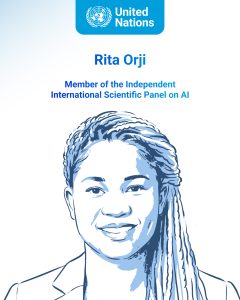
Orji, a computer science professor at Dalhousie University, is one of only two Canadians named to the panel and will serve a three-year term. Her work focuses on human-centred AI, digital health, and persuasive technologies, research areas that align with the panel’s mandate to assess how AI systems affect people, societies, and outcomes across different contexts.
What the UN panel is and what it will do
The panel was approved by the UN General Assembly in a recorded vote of 117 in favour to two against, with two abstentions, underscoring both the urgency and the geopolitics now attached to AI governance. According to reporting on the vote, the United States opposed the panel’s creation and argued that AI governance should not be dictated through the UN system, while many countries backed the initiative as a necessary global mechanism for global technology.
Crucially, the panel is positioned as a scientific body, not a political negotiating forum. Its job is to generate independent assessments of AI’s opportunities, risks, and impacts, and to ensure international AI deliberations are informed by the best available evidence. Digital policy watchers say it is expected to produce annual evidence-based reports examining AI’s opportunities, risks, and broader societal effects.
António Guterres has framed the panel as a step towards “rigorous, independent scientific insight” that allows all member states, including those without deep AI capacity, to engage on an equal footing.
How members were selected
The selection process drew from a pool of more than 2,600 candidates and went through an independent review involving the International Telecommunication Union, UNESCO and the UN Office for Digital and Emerging Technologies, according to the report on the General Assembly decision. The goal, as described by Dalhousie’s announcement, was to form a multidisciplinary group that is geographically diverse and gender balanced.
This appointment places the Nigerian-Canadian AI researcher in a high-leverage global structure that will shape how evidence is compiled, interpreted, and translated into international discussions about AI’s real-world impacts. For Nigeria and the wider Global South, that matters because the risks and harms of AI often scale fastest in markets where regulation, consumer protection, and institutional oversight are still catching up.
Orji’s research focus is particularly relevant because a major portion of AI harm does not come from dramatic science fiction scenarios. It comes from routine systems that influence behaviour, shape access, and reproduce inequity at scale, including in health, finance, employment, and public services. Her work, according to Dalhousie, centres on inclusive and equitable AI development, especially for underserved communities and the Global South. That framing fits the panel’s explicit emphasis on assessing AI across diverse global contexts, not only the priorities of the biggest AI-producing economies.
The bigger context: science as the missing layer
The core problem in global AI governance today is that policy debates often outrun credible shared evidence. Countries are being asked to align on rules for systems they do not fully understand, while powerful private-sector incentives accelerate deployment faster than public institutions can evaluate effects. The UN panel is designed to close that gap by producing structured scientific assessments that governments can reference, rather than relying on vendor claims, national lobbying, or fragmented research.
That is also why the composition of the panel matters. If the evidence base is produced only through the lens of a few regions, it will not reflect how AI behaves in multilingual, lower-resource, culturally diverse environments or in countries with different infrastructure realities. A Nigerian-Canadian researcher with a track record in human-centred, culturally adaptive systems brings practical credibility to those dimensions.
What happens next
Members will serve in their personal capacity over the three-year term, beginning in February 2026. The panel’s assessments are expected to feed into the Global Dialogue on AI Governance, supporting the international deliberations that will increasingly define what “responsible AI” means in practice, across borders.