
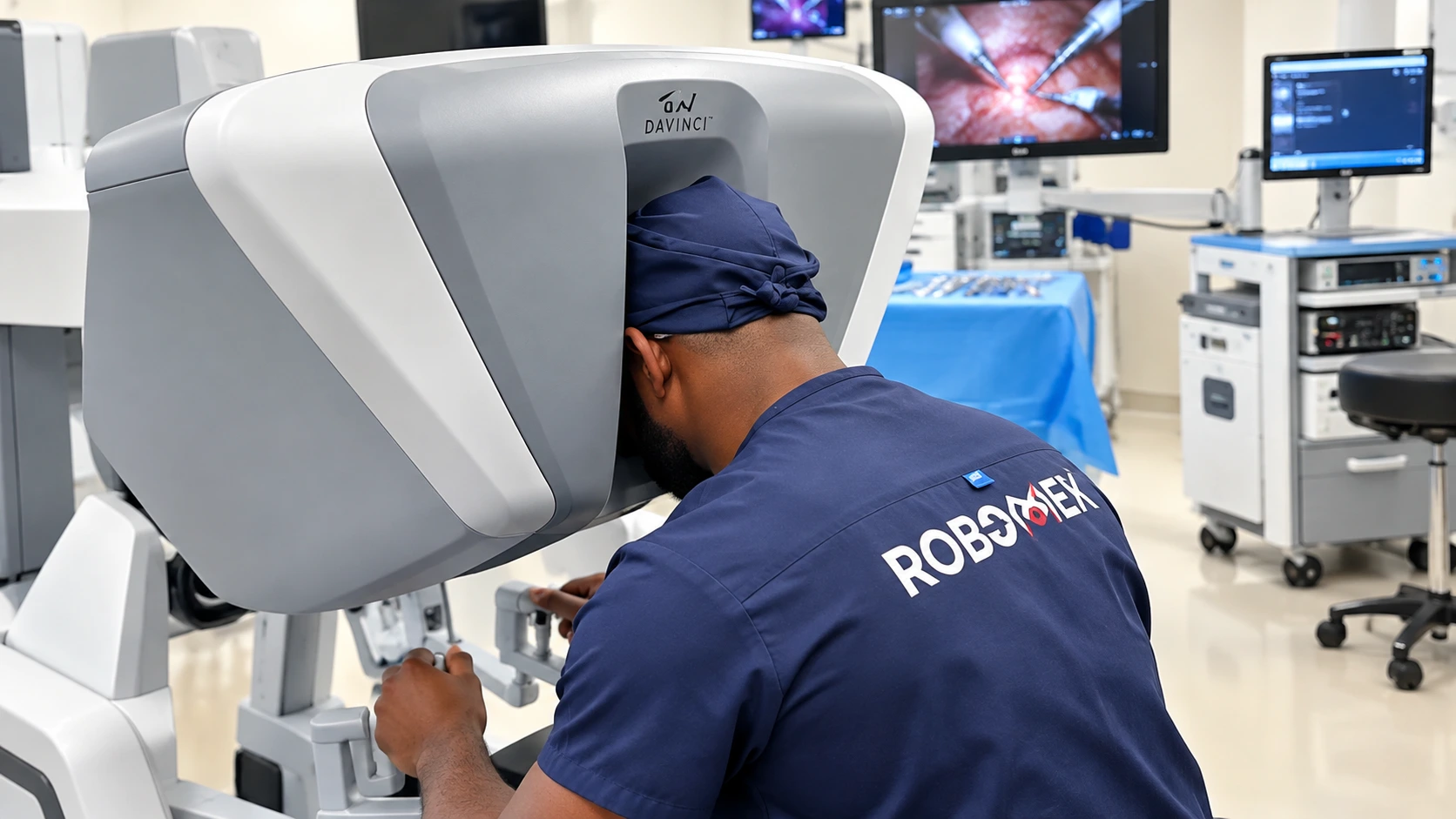
A surgeon in Ogun State has removed a cancerous kidney from a patient in Abuja, about 500 kilometres away, in what has been described as Nigeria’s first tele-robotic surgery.
How the Surgery Worked
The operation was carried out on Saturday, September 19, as a robot-assisted right radical nephrectomy, in which the whole kidney affected by a tumour is removed. Professor Obi Ekwenna-Davis, a professor of urology and transplantation, controlled the robotic system from a Toumai console at Redeemer’s Health Village in Mowe, Ogun State. The patient was at Nisa Premier Hospital in Abuja.
His hand movements at the console were transmitted in real time to the robot in the operating theatre in Abuja. Medical teams were present at both locations. The operation lasted about three hours, with brief pauses to confirm that the equipment and communication links were working.
The Partners Behind It
The procedure was a joint effort by Redeemer’s Health Village, RoboMed Global and Nisa Premier Hospital. RoboMed Global is a US-based firm that Ekwenna-Davis co-founded. Redeemer’s Health Village is a 300-bed multispecialty hospital established by the Redeemed Christian Church of God. Nisa Premier says it has run as a robotic surgery centre since November 2025.
Earlier this month, Redeemer’s Health Village announced its first robotic-assisted prostate cancer surgery, so the tele-surgery builds on a programme already underway.
Why Connectivity Mattered
A robot can only follow a surgeon’s commands as fast as they reach it. According to reports, the operation used Starlink satellite internet, with MTN providing backup connectivity.
The hospital’s chief executive, Dr Adedamola Dada, acknowledged that connectivity remains a challenge as telesurgery expands. Weather, equipment quality and the availability of trained staff can all affect how reliably it works.
What the Organisers Are Claiming
Dada described the operation as the first telesurgery in West Africa. That is the hospital’s own claim, and other remote operations have taken place elsewhere in Africa. In 2025, for example, a surgeon in the United States operated on a patient in Angola.
The organisers stress that the robot does not act on its own. The hospital board’s chairman, Dr Kunle Onakoya, said the machine stays under a human surgeon’s control, magnifying his movements and adding precision.
What Comes Next
Ekwenna-Davis said the patient was in good condition and expected to go home within 24 hours. He added that telesurgery could let Nigerians get specialist care without travelling abroad. It could also allow Nigerian surgeons in the diaspora to help patients back home.
The hospital plans a robotic academy to train at least 150 surgeons within two years. Dada urged the government to fund scholarships for surgeons, nurses and biomedical engineers, so that Nigeria can build its own pool of robotic surgery professionals.
For patients, the real test will be whether telesurgery can be offered reliably and affordably beyond one landmark operation.