

Mazerance founder Elvis Obi has stepped down as chief executive of the gaming startup amid a growing public dispute over unpaid salaries and compensation allegedly owed to former members of the company’s team.
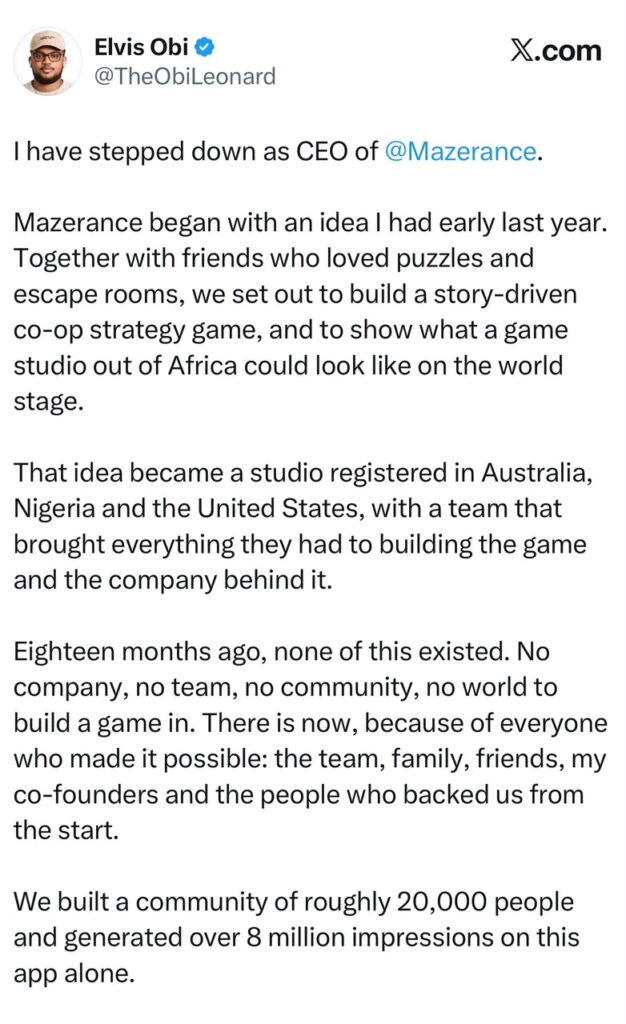
The controversy emerged after Obi announced his departure from the CEO position, describing an 18-month journey building Mazerance from an idea into a gaming company with operations and contributors across multiple countries.
But the announcement quickly drew responses from people who said they had worked for Mazerance and were still waiting to be paid.
One former team member publicly alleged that Mazerance owed workers as much as seven months in unpaid salaries. Another former contributor said there remained unresolved compensation disputes involving people who had contributed their time and work to the company.
The claims have placed the financial and management challenges inside one of Africa’s more visible emerging gaming projects under scrutiny.
Obi acknowledges outstanding payments
Obi subsequently acknowledged that former Mazerance workers are owed money.
“People who worked at Mazerance are owed money. That is true and I am not going to dress it up,” he wrote in a follow up statement.
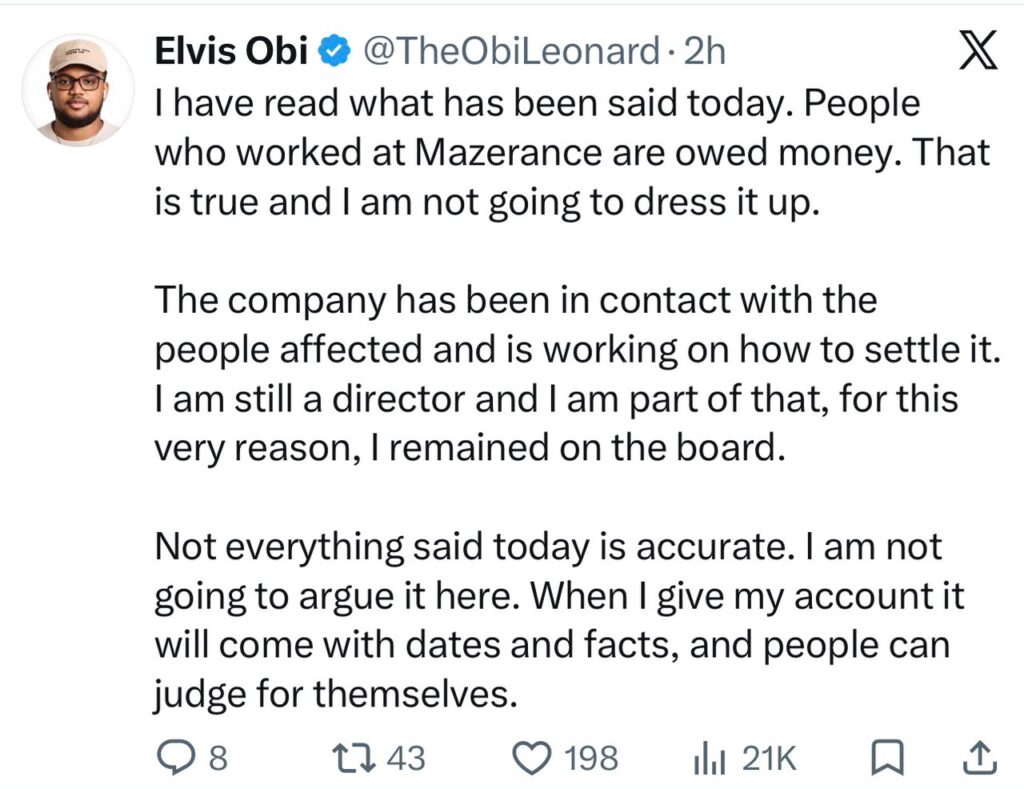
According to Obi, the company has contacted affected workers and is working towards resolving the outstanding payments. He also confirmed that although he has stepped down as CEO, he remains a director and member of the board.
Obi said he intends to provide a more detailed account of events with dates and facts, while disputing some of the wider allegations being made about him and the company.
The admission is significant because Mazerance had publicly positioned itself as a company seeking to build a globally competitive African gaming business while attracting and compensating skilled talent.
Public profiles describe Mazerance as a computer games company founded in 2025, specialising in game design, development, puzzles and world building. Its LinkedIn page lists the company as having between 11 and 50 employees.
Previous public accounts of the company had also highlighted compensation as part of its proposition to African technology talent, with reported monthly remuneration ranging from about $700 for junior positions to more than $5,000 for specialised roles.
That makes the current dispute particularly consequential for the company’s reputation.
What happened at Mazerance
Obi’s account suggests Mazerance’s problems developed despite substantial progress on its flagship game.
In announcing his departure, he said more than 25 people across three continents had worked on Mazerance and that the company had built a community of roughly 20,000 people.
He also pointed to campaigns including Project 9, Rancers Remix and Pass It On as evidence of the studio’s progress. Mazerance’s development work predates the current dispute: Obi previously shared footage from internal play testing and said the project was expected to require more than two additional years of development.
The studio had also been seeking outside capital. Earlier this year, Obi publicly said Mazerance was looking to speak with investors, founders and partners interested in gaming while attempting to build support for a Kickstarter campaign.
According to a public post from Leye, who said he knew people who worked at the company, Mazerance had genuinely been developing a game but subsequently encountered leadership, trust and financial problems.
He said Obi had acknowledged privately that things were not going according to plan and that workers were owed several months of compensation. Leye criticised the failure to communicate with affected workers early enough but rejected social media characterisations of Obi as a fraud.
Those comments represent Leye’s account of events rather than independently verified findings.
An ambitious African gaming proposition
The controversy comes against the backdrop of Mazerance’s unusually ambitious positioning.
The studio has presented itself as an African led attempt to compete in the global gaming industry rather than simply produce games primarily for a domestic audience.
Obi previously said development involved teams across countries including Nigeria, Ghana, Australia, Singapore and Spain.
The company has also produced publicly visible design and development work. Obi shared Mazerance’s game interface work in 2025, describing the project as an opportunity to demonstrate what African led game design could achieve.
Its Project 9 campaign similarly incorporated original sound, artwork, interaction design and storytelling created by Mazerance contributors.
The question confronting the company now is less about whether work was being produced and more about the financial and corporate structure supporting that work.
Obi remains on the board
Despite leaving the CEO position, Obi has not left Mazerance.
He said an interim successor has been selected and that he will remain on the board while supporting the company.
“The game is still in development,” Obi wrote, arguing that completing it would represent the best outcome for the team, community and other stakeholders.
He said his decision to leave the CEO role would allow him to return his attention to design and storytelling, describing those areas as his core professional strengths.
Public professional profiles support his longstanding background in product and UX design, including work in gaming before and during Mazerance.
But his continued position on the board also means the salary dispute does not simply disappear with his resignation as chief executive.
The immediate challenge for Mazerance is resolving the money owed to affected workers while establishing whether the studio has the financing and management structure required to complete its game.
For employees and former contributors, the central issue is considerably simpler: when they will receive the compensation they say they are owed.
For Mazerance, a company created around the proposition that an African-led gaming studio could compete globally, resolving that question may now be as important as finishing the game itself.