


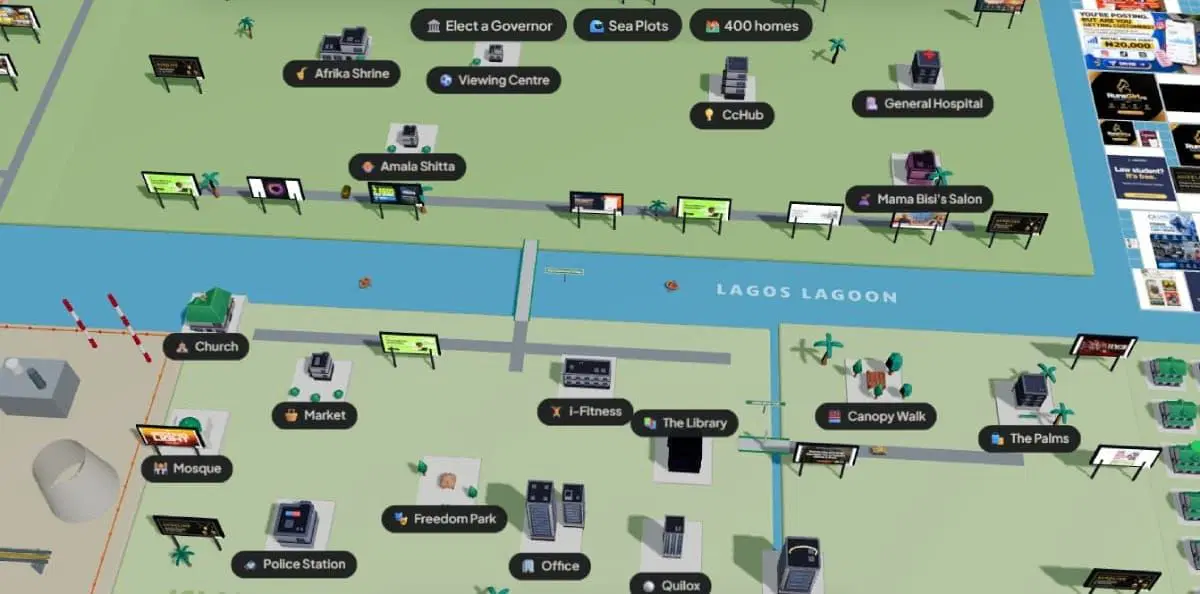
I joined Lagos Life this week. My handle is Ifeanyiabraham, the game made me a “Nepo baby”, its term for players born into money, and I work at the bank. I went in for one reason, which was to find the fastest route to one billion naira.
I found it sooner than I expected. Within five hours I was a billionaire, thanks to gifts from two generous ladies in the city. I am now working towards my first trillion, and I am running for Governor of the game’s central bank. I will explain all of that below.
I should confess early. I have already spent ₦20,000, about $15, of real money on in-game funds. I am a grown man with a company to run.
I understood how far the game had travelled on my way to the airport. I got into a taxi with it open on my phone, and the driver recognised the tune before I said a word. “Sir, you are playing that game,” he told me. “It will make you addicted o.” We spent part of the ride talking, quite happily, about virtual millions. When a taxi driver can identify a game from its soundtrack and warn you about it like an uncle, it belongs to the street.
For readers outside Nigeria, here is what happened. On 1 October, Nigeria’s Independence Day, a Nigerian developer living in the UK posted a link on X. It opened a free game that runs in a phone browser. You rent a room, look for work, pay rent every Saturday, eat at a famous amala restaurant, go to a well-known nightclub and wait for the electricity to come back. You download nothing. Within six days, two million people had played it.
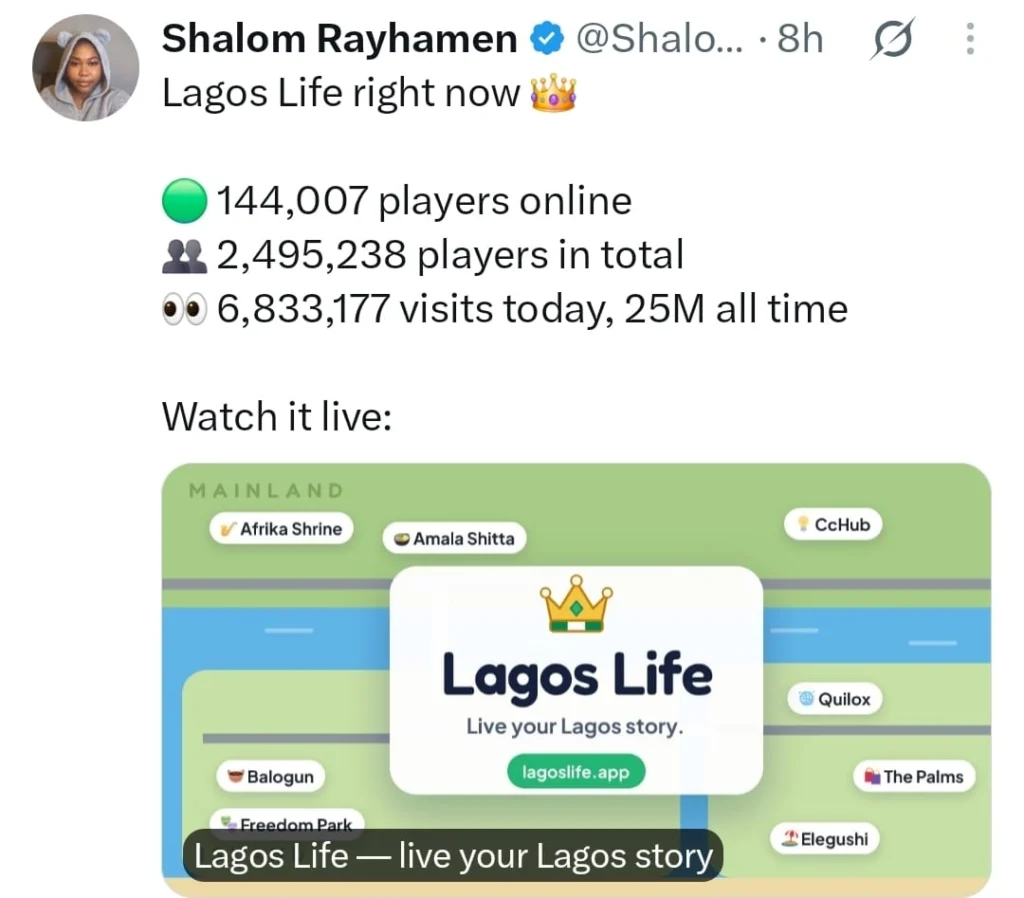
She posts as Shalom Rayhamen. In an interview this week she said she built the first version in under twelve hours, after seeing another Nigerian game in which you drive a danfo, one of Lagos’s yellow minibuses, through traffic.
I have worked in media and PR long enough to distrust anything that trends for a week. I am taking this seriously because of what people did once they got inside. They were handed an empty Lagos and pretend money. In about three days they had produced trillionaires, a governor’s race, weddings, hackers and a police station that collects bail.
That is where my headline comes from. I watched Nigerians decide what to do with a city where nothing has consequences. They wanted to be richer than anyone alive, and they found crime quite funny.
One million players in three days
Lagos Life passed one million players on 4 October, three days after launch. The figures below come from the game’s public dashboard and the developer’s own posts. The last row is what I saw on my screen this morning.
| When | Total players | Online at once | Visits, all time |
| 1 Oct | Launch | ||
| Early Oct | 399,187 | 50,266 | 2.32 million |
| 4 Oct | 1,000,000+ | 109,000+ | 7.2 million |
| 5 Oct | 1,212,477 | 71,625 | 9.6 million |
| After day 4 | 1,807,618 | 145,443 | 16.58 million |
| By 6 Oct | 2,000,000+ | 101,000+ | |
| 7 Oct, 9:40 a.m. | 78,000 | 18.9 million |
The column I watch is the third. At the peak, 145,443 people were inside the same virtual city together. That is more than two full national stadiums. At 9:40 on a Wednesday morning, when Lagos is at work, 78,000 were still in there with me.
It spread well beyond Lagos. Google Trends showed Nigerian searches for “Lagos life” rising by more than 5,000% in a week, and the states searching hardest were Ekiti, Ogun and Osun, with Lagos fourth. The developer says she has players in Ghana, South Africa, Togo, the UK and the US.
I cannot find a Nigerian-built consumer product that reached a million people faster.
Faster than ChatGPT, Netflix and the metaverse
Lagos Life reached a million users in three days. ChatGPT needed five. Netflix needed three and a half years.
| Product | Time to one million users |
| Threads (2023) | Hours |
| Lagos Life (2026) | 3 days |
| ChatGPT (2022) | 5 days |
| About 2.5 months | |
| Spotify | 5 months |
| 10 months | |
| Netflix | 3.5 years |
Only Threads was quicker, and Threads launched on top of Instagram’s existing accounts with Meta’s money behind it. Lagos Life had one developer and a link.
The comparison I enjoy most is the metaverse. Meta opened Horizon Worlds to the US and Canada in December 2021 and reported 300,000 monthly users two months later. By that October, press reports put it under 200,000 against an internal target of 500,000. Meta was losing roughly $10 billion a year on the division, and visitors needed a $299 headset.
One woman working through the night got 145,000 Nigerians into a shared virtual world at the same moment, on whatever phones they already owned.
I think the explanation is simple. Meta asked people to buy equipment so they could visit somewhere unfamiliar. Lagos Life sends you a link to a place you already know, with your own slang and your own landlord trouble in it.
The link matters as much as the game. Nigerians watch their mobile data and phone storage closely, and app stores demand both. Nigerian studios have had hits before, including one whose catalogue passed 10 million downloads, but that took years. Here there was nothing to download. After I had played for a while, the game asked to add itself to my home screen, and I agreed. It now sits on my phone like any other app and has never been near an app store.
Building in the open
I run a communications company, so this is the part I studied hardest. Lagos Life had no launch budget, no publisher and no PR plan. Her X account did the work my industry charges retainers for.
On day one she told people why she made it. She grew up playing The Sims 3, saw the danfo game on her timeline, and wondered what the Sims would look like living in a world like ours. She tagged the developer of the danfo game and gave him the credit. From that first post, people were following a person, and Nigerians will root for a person much faster than for a company.
After that she posted everything, including what most founders hide from their own staff.
Her statistics page is public, so anyone can watch the player count move. Every milestone became a screenshot that thousands of other people posted for her.
She published her revenue in the first week, next to the live player numbers.
She published an advertiser’s results. One campaign got 3,686 taps from 9,826 app opens, about 38%. Any brand manager who saw that was going to ask for the rate card.
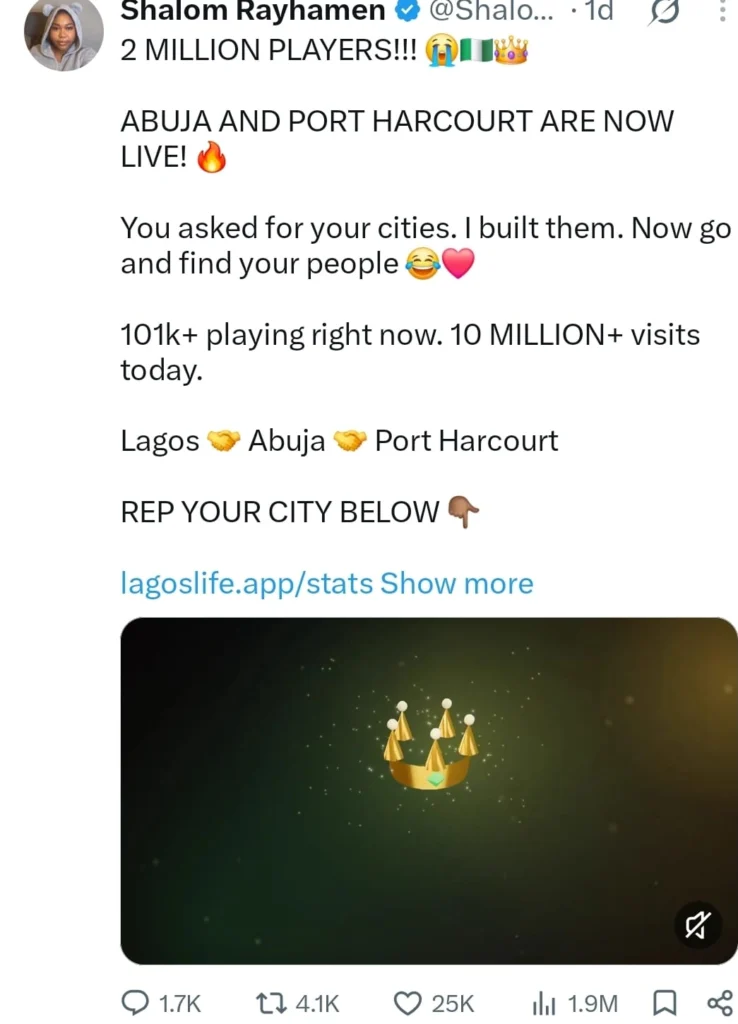
She built what people asked for. Players outside Lagos wanted their own cities, so Abuja and Port Harcourt went live around the two-million mark.
She was just as public when things went wrong. The game went down briefly on its second day, and she credited every player ₦100,000 in game money as an apology. When an exploit hit the in-game economy, she announced it herself and fixed it in front of everyone.
She has also said that AI played a large part in getting from idea to launch so quickly. I am glad that is on the record, because many people are building this way and letting the public assume otherwise.
The result was enormous. X’s trend pages logged more than 145,000 posts under one Lagos Life topic and more than 114,000 under another. I have seen funded campaigns achieve far less.
Everybody wants to be a trillionaire
I went in aiming for one billion naira and thought I was being ambitious. I reached it in five hours, and I did not earn a kobo of it at the bank. Two ladies I met in the city simply sent it to me. That is how I learned that one billion is small change in there, and why my target is now a trillion.
The game she designed is a hustle. You arrive as “Nepo”, with money and connections, or as “Lapo”, named after a microfinance lender, with a loan on your neck. Shifts run on the real clock, so if you miss yours you earn nothing. The power goes out, as it does in real Lagos, and you save for a generator or an inverter. Buy cheap land and omo-onile, the local land touts, may arrive for their share.
The pay scale will make any Lagosian laugh. Carrying loads at Balogun Market earns ₦900 for two hours. A POS stand, the street-corner cash point that is the first business most players can afford, costs ₦500,000. According to player guides, the top bank job pays ₦72,000 a shift. The best-paid shift in the city is Afrobeats Giant at the New Afrika Shrine, at ₦99,000. As a bank employee I took that personally. As a Nigerian I could not argue with it.
Then some players found a way to create money, and accounts appeared holding trillions. I expected anger. They threw a party.
Players began “crediting” strangers with billions and then trillions, usually in return for a follow on X. One posted that “1 billion naira is like 1 naira here”. Another said the game had opened his eyes: he had been giving out millions since the previous day and was still not broke, so our real billionaires must simply be stingy. A third offered ₦100,000 of real money to anyone who would send him a trillion in the game.
I have thought about those three posts more than I expected to.
Nobody was celebrating a paid rent. People jumped over millionaire and billionaire and landed on trillionaire. In naira, only a handful of Nigerians hold that title. In dollars, no human being does.
Look at what they did with the money, too. They gave it away, loudly, and the respect went to whoever sprayed the most. Anyone who has attended a Nigerian wedding knows that instinct.
The post about stingy billionaires stayed with me. It took one day of pretend wealth for a young man to pass judgement on every rich person in the country, and I suspect he had held that opinion for years.
The developer cleared the hacked balances, restored what people had earned properly and introduced income tax. Players replied, mostly with jokes, that they had not come to a game to suffer the way they suffer in real life.
I do not read any of this as greed. The naira has lost most of its value in ten years, and salaries have not kept pace. If you have watched your savings shrink while you were looking at them, you stop dreaming about a decent salary. You start dreaming about a figure so large that no devaluation can finish it.
My populist theory: start every Nigerian on ₦1 million
The game has put an idea in my head, and I know it will annoy economists. What if, after the 2027 elections, whoever wins started every Nigerian on ₦1 million, about $750?
That is roughly how Lagos Life treats its citizens. Nobody enters the city with nothing. You arrive with an account, a way to earn and a list of things to pay for. When the system failed, everyone was compensated. I am trying to remember the last time a Nigerian government compensated the whole country for a failure. I am still trying.
Players used their starting money sensibly. They rented rooms, took jobs, saved for a POS stand, and bought land when they could. Give a real Lagosian ₦1 million and you would see the same: a small business, a sewing machine, a year of rent, school fees, a deposit on a keke. My taxi driver could tell you in ten seconds what he would do with his.
It would also be the most popular promise in the history of Nigerian campaigning, and unlike the usual election-season generosity it would be written in a manifesto and paid to everybody, including those who voted for the other candidate.
The arithmetic is the obstacle. Nigeria has about 230 million people. One million naira each comes to about ₦230 trillion, more than four times the 2025 federal budget of ₦54.99 trillion. Pay adults only and the bill is still above ₦100 trillion. A government would have to print it, and the hack week showed what printed money is worth once everybody has it.
So the theory fails as economics, and I am keeping it as a question for 2027. A developer working alone gave two million people a starting point, a job market that pays for skill and an apology when the system failed. I would like each candidate to tell us what their starting point is, and what it costs.
Crime is not so bad
The biggest week a Nigerian game has ever had was helped along by a robbery, and hardly anybody was upset.
Some of the crime is built in. If your character misbehaves you can land at Eko Police Division, where you wait or pay bail. There are police raids. Bail sits next to rent and property among the things in-game naira pays for.
The rest the players brought with them. The people who created money out of nothing were treated like philanthropists. “Lagos big boys” announced giveaways and collected followers. One developer said openly on X that he had been able to award himself any balance he wanted, and nobody called for his arrest. The money went out as gifts to thousands of players who had done nothing wrong, and they thanked God for it.
Then there is politics, and here I am an eyewitness. Lagos Life elects a governor every week. It costs ₦50,000 to contest, and the winner’s policy applies to every player. This week’s governor is a player called @Franka, who won 9,543 votes on the slogan “Good Lagos ahead”. Her policy is Steady light, which makes power cuts shorter and rarer. She has commissioners for Finance, Works, Health and Transport, and her term ends on Sunday at 8 p.m.
I opened the Lagos State House this morning to see who wants to replace her. These slogans are copied exactly from the ballot.
- “VOTE AND DM FOR 100B”
- “DM FOR PAY AFTER VOTING”
- “100 million each for who votes”
- “Emilokan. 100M per votes”
The offer is the slogan. Two of these candidates have appointed campaign managers. One borrowed “Emilokan”, Yoruba for “it is my turn”, from Nigeria’s 2023 presidential campaign. The developer did not program vote-buying into the game. People arrived knowing what a campaign looks like.
What surprised me is who is winning. The leader had about 15,000 votes and 25% when I checked. Second was a candidate running as “The Squad Party” with 13,678 votes and 23%. The candidate offering 100 billion was on 4%, and the two promising 100 million a vote were on 1% each. The loudest cash-for-votes offers were trailing badly. I did not expect a browser game to make me hopeful about elections.
Put Nigerians in a Lagos with no consequences and many of them will play the big man, the plug, the politician with a war chest, or the person who receives a credit alert and asks no questions. I would push back on anyone who reads that as admiration for criminals. Grand Theft Auto has sold hundreds of millions of copies to people who have never stolen a car. Games are where you do what you would never do outside.
Much of it is satire as well. The campaign giveaway is funny because every Nigerian has seen one. Those players understand exactly how vote-buying works, and they are mocking it by doing it.
The explanation I believe most concerns where we draw the line. Many of us were raised to judge wrongdoing by who gets hurt. Armed robbery is evil. Finding a loophole in a system that was never designed with you in mind is being sharp. The exploit injured nobody and emptied no real bank account, so people filed it under sharp. When official rules have failed people for decades, they measure right and wrong by the victim, and in Lagos Life there was none.
So I stand by my headline. In a city with pretend money and police who take bail, Nigerians treated crime as comedy, and the candidates shouting loudest about paying for votes were still at the bottom of the ballot.
People are monetising skills
In under a week this went from one woman’s side project to something other people earn from, inside the game and outside it.
Inside, skills decide how far you go. With Coding at level two you can take freelance gigs at a Yaba tech hub. With Photography at level three you can edit and sell photos from your room, provided you own a camera and the power is on. A skill called Hustle raises what you earn from a WhatsApp business or an Instagram shop. Player guides say a level-five job pays between eleven and twenty-five times what level one pays. Nobody gives you a motivational talk. The game shows you that the people who escape Lapo are the ones who learn something another person will pay for.
Outside, developers are turning one night’s work into a product. The danfo game was a side project by a Nigerian engineer in Berlin. Within days of these two games there was a London bus version, a Port Harcourt life game whose announcement passed 500,000 views, and a game about moving to Lagos to chase a music career. A few years ago each would have needed a studio and a year. Today a developer with a good idea and AI tools can ship by morning.
Musicians and small businesses are buying attention directly. Upcoming artists are using the game’s clubs and billboards to push new songs. A furniture marketplace, a music distributor, a payroll company and a lifestyle fair were among the first advertisers.
A service economy has formed around the game as well. I counted at least nine unofficial guide and wiki sites for a game that was six days old, several with pay tables pulled from the game’s own code. Those are writers and search specialists collecting traffic. Content creators grew their followings with in-game giveaways. One X account promised a $5,000 referral fee to whoever could introduce a buyer to the developer.
A practical note for new players: in-game naira cannot be cashed out, so buy it only through the game’s own wallet.
I find this the most encouraging part of the story. One person used her skill to open a market in a week, and coders, designers, musicians, writers and people with audiences all found something to sell into it. No government programme arranged that and no accelerator funded it.
Dating life
From what I see on my timeline and inside the city, people are going on more dates in Lagos Life than they have ever managed in real life.
The game is built for it. You can date another player, throw a wedding and invite your friends, and have a baby together that you feed, play with and watch grow. You can add other players as your sibling, cousin or aunty.
A date in real Lagos means fuel or a ride fare, traffic, a restaurant bill and the question of who is paying it. A date in Lagos Life costs game naira, and you can be home in one tap if it goes badly. Shy people who would never approach anyone at a lounge can type hello.
I tested this personally. I finally made it to i-Fitness in the game, which I have not managed in real life for six months. The first thing I announced to the room was, “Newbie here. Need to lose my stomach. Just started out on Mounjaro.” I would never say that to strangers in an actual gym. In there I typed it without thinking, which tells you something about why two million people have moved in. You get to be the Lagosian you keep postponing.
The gym also reminded me that even in the app, Nigerian women are still Nigerian women. I said hi to two girls and neither replied. I have been aired in real life and made my peace with it, but being aired by two avatars was new. Before I could recover, an account with “sexy” at the end of its name slid into my DM and tried to take our business outside the app. Anyone who has stood in a Lagos lounge on a Friday night will recognise the pattern.
I owe the women of Lagos Life a correction, and I am happy to make it. A few hours after two of them ignored me at the gym, two others made me a billionaire. They sent the money as a gift and asked for nothing. So yes, Nigerian women are still Nigerian women in the app. Some will air you, and some will change your life in an afternoon.
The drama has followed people in too. One man wrote on X that two ladies both ended things with him after one saw a notification and went into the other’s DM to fight her, calling her a boyfriend snatcher. He was laughing about it.
Which leaves me with a question for next year. These are real adults talking to each other for hours every day. Will we see Lagos Life weddings in real life? Should the hospitals expect something around July, nine months from now? I am joking, mostly. If somebody names a child Shalom next year, remember where you read it first.
The engineering scramble
Building the game in one night was impressive. Keeping it running while a million people arrived was the harder job, and she has described it in an interview with an engineering publication this week.
By her account the first week involved an overnight build, two database migrations and a game economy with far too much money in it. She began on a lightweight serverless database, the kind you choose for a prototype at 2 a.m. when you expect fifty users. A multiplayer city is a different animal, because every action by every player has to be saved and everyone is touching the same world at once. She moved to a larger host, and when that strained she moved again to one of the big cloud providers. All of this happened in a week when tens of thousands of people were logged in at any moment.
The economy needed a different kind of repair. A browser game runs on the player’s own device, so anything the game trusts the browser to report can be altered by someone who knows the tools. The durable answer is to calculate everything involving money on the server. Large global apps have been caught by the same weakness, and she dealt with hers in public within days.
I would take her position over that of a careful developer who is launching next year.
The money
She has reported earning $46,900 in the first four days, about ₦62 million.
People in Nigerian tech have said for years that games cannot make money here. In 2016 the founder of one of the country’s pioneering studios argued that advertising could not sustain a Nigerian game because advertisers pay less to reach Nigerians. “You cannot successfully monetise mobile games in Nigeria without telco involvement,” he said.
She has no telco partner and no app store taking a cut. She sells two things, and she sells them herself.
The first is space in the city. This was her opening rate card in the first days of October.
| Placement | Price |
| Roadside billboard, one of 38 | ₦5,000 a week (about $3.77) |
| 6×6 plot on the lagoon | ₦18,000 a week |
| Slot on the statistics page, 3 Oct | ₦50,000 for 30 days |
| Slot on the statistics page, 5 Oct | ₦100,000 for 7 days |
Those prices did not last. When I looked inside the app this week, billboard advertising was listed at ₦1.5 million, about $1,130. I have not seen a rate card climb like that.
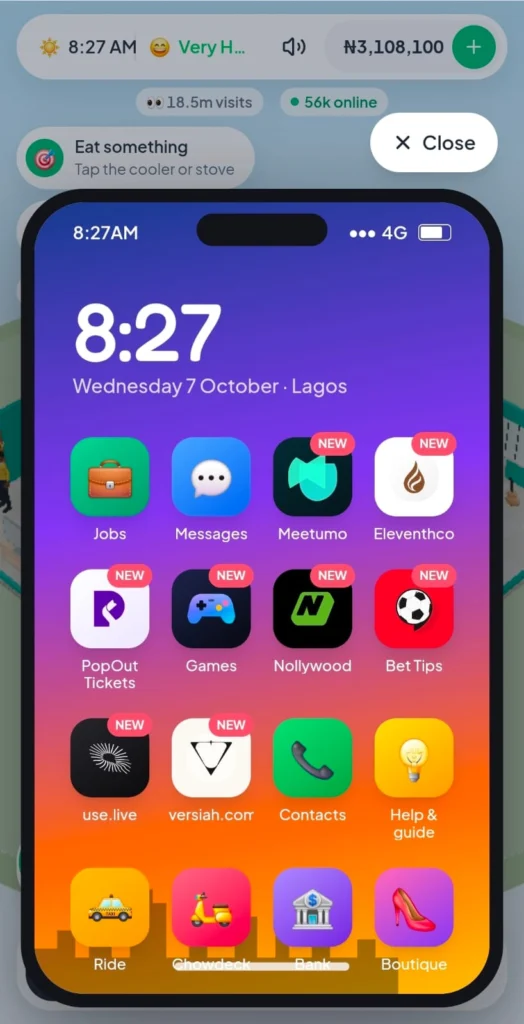
The first buyers were a payroll platform, a lifestyle fair, a furniture marketplace, a music distributor and a long line of small businesses and independent artists. The premium positions have since gone to bigger names. Chowdeck, the food delivery company, and Surebets have taken prime spots on the game menu. Chowdeck also appears as an app on the phone your character carries, so you see it whenever you order food in the game.
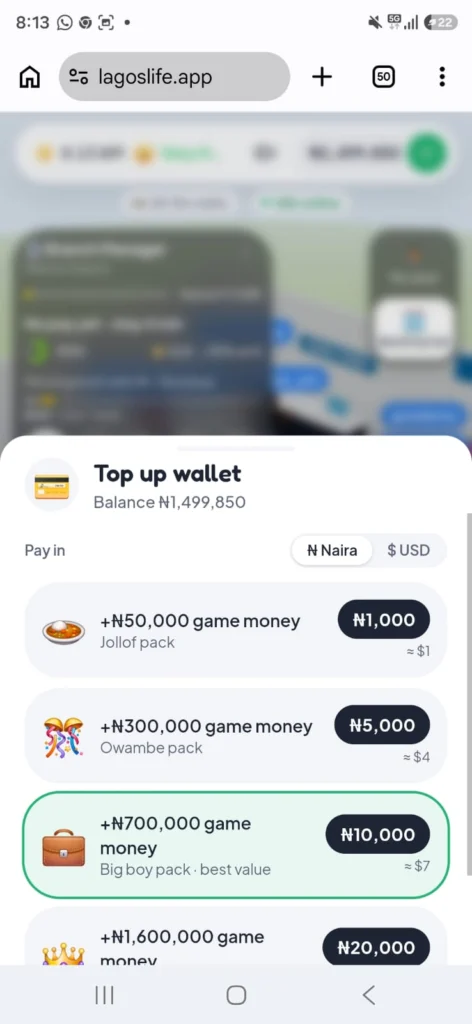
The second thing she sells is naira. You pay real money and receive game money. I paid because I wanted my one billion and I am not a patient man. As it turned out, generosity got me there faster than my ₦20,000 did. In a game where everyone is showing off and giving money away, many people will still make the same purchase.
You can work out where the revenue comes from. All 38 roadside billboards at the opening price would bring in ₦190,000 a week, around $143. The rest of that $46,900 has to be premium placements, sponsorships and players like me topping up.
This is why one offer was laughed off the timeline. An X account announced that an investor would pay $100,000 for the game. People replied that she had earned almost half of that in four days. At close to $12,000 a day, the offer was worth about nine days of her revenue.
She has said she is now building a gaming company around it.
I am running for CBN Governor
The game now has an inflation problem, and it has decided to deal with it the way a country would. The official Lagos Life account has advertised for a central bank governor. Anyone can post policies for fighting inflation under the hashtag #LagosLifeCBN. The five best proposals go to an election, and the winner takes the job.
I have put my name forward. At age 10 I wanted to be President of the World Bank. I hold a First Class Honours degree in Economics, I have lived in Dubai, where the dirham has been pegged to the dollar since 1997, and I have worked in the UK, where the central bank must explain itself in public when it misses its 2% inflation target. This governorship feels like my turn.
My platform has six parts.
- One mint. Every naira is created on the server and logged, and the total money supply is published every week.
- A savings rate in the game’s Bank app, raised whenever prices rise, so that people are paid to hold naira instead of spending it.
- Lagos Life treasury bills that lock your naira for 7 or 30 days in return for interest.
- A levy on large giveaways. Five per cent goes to the treasury and is destroyed.
- A small weekly charge on idle trillions, so that hoarded money is spent or invested.
- Something worth buying for every naira that enters the city, whether land, businesses or licences, and a working relationship with the elected Governor, because tax and spending drive inflation as much as interest rates do.
I know how it looks for a man who became a billionaire by gift to campaign on a giveaway levy. Under my own policy, the transfers that made me rich would have been taxed. I am comfortable with that. A central banker should be willing to live under his own rules.
This is also the most interesting thing the game has done so far. It created an inflation crisis by accident, and it is now asking its players to argue about monetary policy in public and then vote on it. I studied economics for years and never saw a classroom make the subject this popular.
What I am watching next
The viral week is over, and the more interesting period begins now. Four things will tell us how large this becomes.
The first is the number of people online each day. The weekly election, rent day and the family features were all designed to bring players back, and 78,000 people online on a working morning suggests they are doing their job.
The second is the team. One person built this, scaled it, sold the advertising and handled the communications. The hires she makes in the next month will shape the company.
The third is the next set of cities. Abuja and Port Harcourt arrived within days. Accra, Nairobi and Johannesburg have young, online populations with their own slang and their own landlords, and London has a large Nigerian community that already plays.
The fourth is who follows her. Nigerian developers have now watched a game go from an idea to two million players and real revenue in a week. I expect a wave of new games this quarter, and the best of them will come from people who know their own cities as well as she knows Lagos.
What Lagos Life proves
Nigerian culture sells as it is. She did not translate The Sims into pidgin. She took rent day, power cuts, microfinance loans, land touts and amala and made them the rules of the game. Nobody needed a tutorial, because we have been living this game for years.
A capable person with AI tools can now build a multiplayer world overnight. That should excite every developer in Africa. What cannot be produced overnight is taste, knowledge of the culture, and an audience that watched you build and trusts you.
Openness is a growth strategy. I work with founders, and many of them guard every metric like a state secret. I will be sending them her timeline.
Nigerian attention can be sold without a middleman, at prices set in Nigeria.
Young Nigerians want far more than survival. Offered a simulation of getting by, they went straight for trillions and shared them out. Any brand, bank or politician trying to reach them should keep that in mind.
Shalom Rayhamen wanted to know what the Sims would do in a world like ours. About two million of us have shown her. We hustled, showed off, shared, cut corners, voted, flirted, complained about the government, and logged in again the next morning.
As for me, I started the day as a Nepo baby at the bank with ₦2,453,150 in my account. I am ending it as a billionaire, a candidate for central bank governor and a man with a trillion to chase. If you see Ifeanyiabraham in the city, you know what I am there for.