
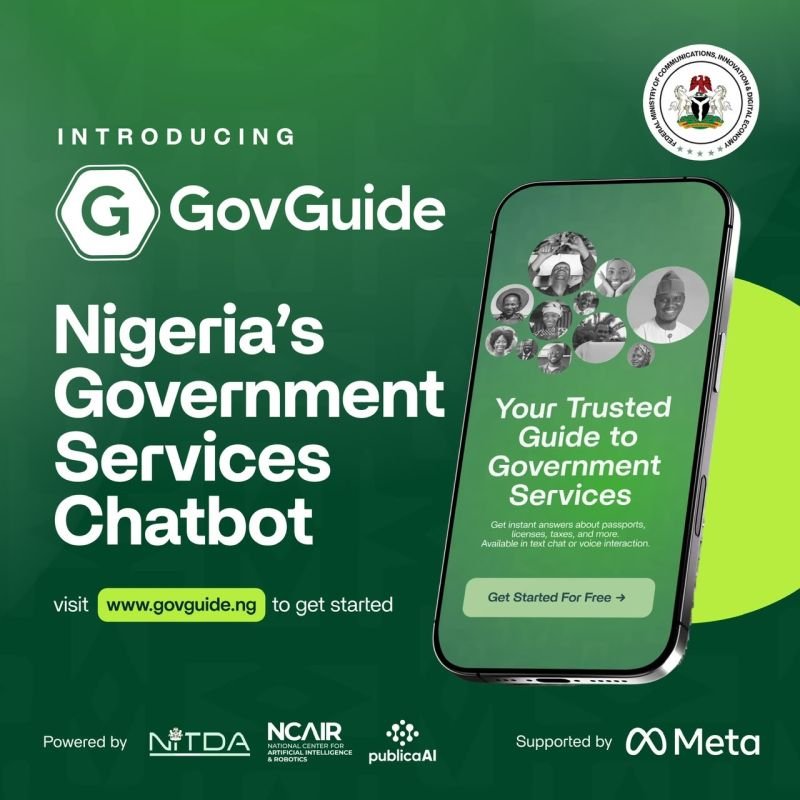
Nigeria has launched GovGuide Nigeria, a new AI service that helps people find government information through chat and voice on the web and WhatsApp. The platform supports English, Hausa, Igbo, and Yoruba. It also pulls information from more than 35 federal ministries and over 60 government agencies. The platform works as a voice and text assistant.
This launch solves a simple problem that millions of people face every day. Government information often sits across many portals, agencies, and office channels. That makes basic tasks harder than they should be. GovGuide Nigeria tries to give people one clear entry point instead of asking them to hunt through scattered websites and office processes.
Local languages make it more useful
GovGuide Nigeria works in English, Hausa, Igbo, and Yoruba. A government service guide only works well when people can ask questions in the language they use every day. Bosun Tijani said the platform aims to bridge language and information gaps, especially for underserved and low-literacy communities. Meta and Publica AI also said the service was built for broad access, including rural users and people who need simpler entry points into public information.
Nigeria has already spent the last two years building a stronger base for local language AI. The Ministry of Communications, Innovation & Digital Economy earlier launched N-ATLAS, an open-source multilingual language model built to reflect Nigeria’s linguistic diversity. In that context, GovGuide looks less like a one-off chatbot and more like a public service layer built on a local AI agenda. That is a smarter path than copying foreign tools without adapting them to Nigerian realities.
RELATED:
Nigeria Launches N-ATLAS V1: Open-Source Multilingual AI Fluent in 4 Languages
Nigeria is building around AI
The country’s National AI Strategy places strong emphasis on responsible AI, inclusion, fairness, accountability, and better service delivery. It also says AI should reflect Nigeria’s social context and cultural diversity. GovGuide matches that language closely because it focuses on public access, local languages, and everyday government use.
Nigeria’s 3MTT programme is also building a large pipeline of technical talent across fields such as AI and machine learning, cloud, data, cybersecurity, and software development. Public digital products need local builders, not just foreign vendors. When a country grows both policy and talent at the same time, it gives projects like GovGuide a better chance to improve and stay relevant.
The choice of open models also fits the direction of the market. Governments like open models because they offer more control over deployment, storage, and cost. The US General Services Administration made a similar case when it expanded federal access to Llama for agency use. Nigeria is not copying that playbook exactly, but it is moving in the same direction by testing open AI in a practical service environment.
READ ALSO:
How to Maximize the 3MTT NextGen Fellowship: A Guide to Launching Your Tech Career in 2026
Trust will decide the outcome
A public service chatbot needs fresh data, clear rules, and strong oversight. If agency information goes stale, the answers lose value fast. If the bot gives wrong or vague guidance, trust drops just as fast. Research on AI chatbots in public services warns about false answers, bias, weak transparency, and poor data practices. It also stresses the need for clear disclosure, limited data collection, strong accountability, and visible human oversight.
That is where GovGuide will face its real test. Long term success depends on how well the team keeps information updated across dozens of agencies, explains privacy standards, and routes complex issues to real people when needed. If the builders do that well, GovGuide Nigeria can become one of the smartest examples of practical AI in African public service today.
GovGuide Nigeria points in a better direction. It takes AI out of the lab, gives it a public job, and puts it in a format ordinary people can actually use. It shows a more grounded idea of what useful AI looks like in 2026 and beyond.