

I’ve spent the past year covering funding rounds, startup launches, and digital expansion across Africa.
This week, while reviewing projections that Africa’s digital economy could reach $1.5 trillion by 2030, I was also reading about another shutdown.
At some point, you have to ask whether we are serious.
The Popular Belief
Africa is on an unstoppable digital rise.
At the Mastercard Africa Edge Summit, executives projected the continent’s digital economy will hit $1.5 trillion by 2030. Startups raised $3.24 billion in 2025. Mobile penetration continues climbing. Fintech adoption is reshaping payments. E-commerce platforms are expanding into secondary cities.
The narrative is smooth. Africa is leapfrogging. Infrastructure gaps are narrowing. Youth demographics are powering the next tech frontier.
It feels inevitable.
Why That Belief Is Incomplete
Now put that optimism beside the shutdown record.
According to the Top10VPN Global Cost of Internet Shutdowns Report, Sub-Saharan Africa lost $1.11 billion in 2025 alone due to internet shutdowns. That came from 24,276 hours of disruption affecting 116.1 million users.
Tanzania’s blackout cost $889.8 million over 5,448 hours.
DR Congo and Sudan incurred losses of $67.2 million and $66.6 million respectively due to conflict and unrest.
Sub-Saharan Africa lost $1.11 billion
Tanzania’s blackout cost $889.8 million
DR Congo incurred a loss of $67.2 million
Sudan lost $66.6 million
Source: Top10VPN Global Cost of Internet Shutdowns Report 2025
These are not symbolic losses. They are economic events.
Nigeria has seen shutdowns during protests. Uganda during elections. Ethiopia and Sudan amid conflict. Now Gabon.
Each time, the network goes dark. Payments freeze. Businesses stall. E-commerce halts. International partners watch.
Then the signal returns, and the growth narrative resumes.
The Real Contradiction
Capital does not invest in ambition alone. It invests in stability.
A trillion-dollar digital economy requires trust in infrastructure. It requires that payment rails remain operational. It requires that cloud services remain reachable. It requires that founders can build without wondering whether connectivity will vanish during political tension.
Shutdowns do more than interrupt communication. They broadcast unpredictability.
And unpredictability gets priced in.
The $3.24 billion raised in 2025 is not immune. Venture capital already accounts for currency instability and regulatory uncertainty. Add infrastructure volatility and the cost of capital rises.
Shutdowns do not just pause economic activity. They quietly increase risk premiums for the future.
Why This Actually Matters
It is tempting to treat shutdowns as political moments.
They are economic shocks.
When connectivity drops:
-
Payment systems fail
-
E-commerce transactions collapse
-
Logistics coordination suffers
-
Remote work contracts freeze
-
International clients reconsider exposure
The data shows $1.11 billion lost in one year across Sub-Saharan Africa. That is leakage.
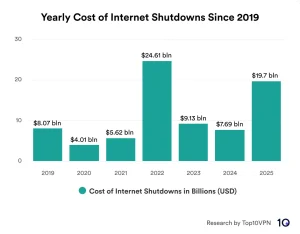
And while governments pitch trillion-dollar projections, that leakage compounds.
You cannot market digital reliability while practising digital interruption.
The Climax: Gabon
The latest example is Gabon.
While policy conversations focus on cloud infrastructure and fintech growth, Gabon pulled the plug during unrest. We previously detailed the report of this shutdown here.
What makes Gabon different is timing.
These shutdowns are now happening in an era when Africa is actively branding itself as the next digital growth engine. The contradiction is visible.
You cannot present a $1.5 trillion opportunity while demonstrating that the network can be switched off without warning.
That tension sits at the centre of Africa’s digital story right now.
The Better Approach
If Africa wants a $1.5 trillion digital economy, digital infrastructure must be treated as critical infrastructure.
That means:
-
Ring-fencing internet access from reflexive political response
-
Establishing transparent legal thresholds for restrictions
-
Ensuring independent oversight
-
Communicating clearly with markets when disruptions occur
Digital transformation is not just about apps and platforms. It is about protecting the pipes that carry them.
Common Objections
“Shutdowns are about national security.”
Security concerns are real. But mature digital economies design proportional responses. Blanket shutdowns resemble emergency brakes, not calibrated tools.
“They are temporary.”
Temporary disruptions can still cause permanent damage. Tanzania’s 2025 blackout cost nearly $890 million.
“The ecosystem is resilient.”
African founders are resilient. But resilience is not structural stability. Investors price certainty higher than grit.
The Uncomfortable Reality
Covering African tech now means holding two truths at once.
On one hand, we report billion-dollar projections, AI expansion, and digital acceleration. On the other, we document thousands of hours of digital darkness.
Both are real.
But they cannot comfortably coexist forever.
The talent exists. The demand exists. The innovation is visible.
The question is whether policy will align with ambition.
Because you cannot build a $1.5 trillion digital economy with an off switch.
Are shutdowns justified safeguards or economic self-sabotage?
Reply to this piece or join the conversation on X. The future of Africa’s digital economy deserves more than optimism. It deserves stability.