

This analysis is based on BCG’s report published in March 2026.
Burna Boy sold out the O2 Arena. Wizkid filled Madison Square Garden. Rema’s Calm Down became one of the most streamed songs on the planet. Nollywood produces more films annually than Hollywood. African fashion weeks are drawing global press. By every cultural measure, Africa’s creative output is having a moment that looks less like a moment and more like a permanent shift.
And yet, according to a recent report by Boston Consulting Group, all of that cultural power adds up to less than 3% of the global creative economy.
Let’s talk about it.
What The Numbers Actually Say
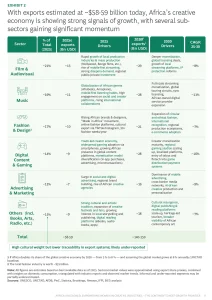
BCG’s report, titled “Africa’s Next Growth Frontier: Empowering Women in the Creative Industries,” puts the continent’s creative economy; spanning fashion, music, film, design and digital content, at around $59 billion, representing less than 3% of the $2 trillion global creative market.
To be clear, $59 billion is not a small number. It represents millions of jobs, thousands of businesses, and a cultural output that is reshaping global taste. But against the backdrop of what Africa’s creative industries actually produce, it is a significant undervaluation.
BCG projects that doubling Africa’s share of the global creative market from 3% to 6% by 2030 could lift creative exports to between $150 billion and $160 billion. The ingredients for that doubling already exist. What is missing is the infrastructure to convert cultural output into captured economic value.
The Infrastructure Gap Nobody Talks About
Here is the uncomfortable truth behind the numbers. African creators are producing content that the world wants. The problem is that the systems built to monetise that content — streaming platforms, payment rails, distribution networks, intellectual property frameworks — were not built with African creators in mind.
Nollywood earns an estimated $590 million annually, making it one of the fastest-growing film industries in the world. But a significant portion of that value leaks through piracy, informal distribution, and licensing deals that route revenue through Western intermediaries before any of it reaches Nigerian filmmakers.
Afrobeats artists routinely sign deals with major Western labels that capture the majority of streaming revenue. The music is African. The audience is global. The money flows to London and New York.
Creative industries currently attract less than 1% of venture capital in Africa. That is the structural problem in one number. The output is enormous. The investment is almost nonexistent.
Where The Opportunity Lives For Tech
This is where the story becomes directly relevant to anyone building in African tech.
The $150 billion opportunity BCG identifies is not just for musicians and filmmakers. It is for the developers, fintech founders, platform builders and product managers who will build the infrastructure that makes that number possible.
Africa needs streaming platforms designed for African content consumption patterns and payment methods. It needs intellectual property registration systems that are accessible and affordable for informal creative businesses. It needs cross-border payment infrastructure that allows a Ghanaian designer to sell to a customer in Nigeria without losing 15% to conversion fees. It needs data tools that help African creators understand their audiences without depending on algorithms built for Western markets.
Rapid smartphone adoption and improved broadband access have already enabled between 300 and 400 million Africans to actively engage with social media, giving creators direct access to global audiences. The demand infrastructure is being built by the platforms. The supply infrastructure, the tools that help African creators capture value from that demand, is largely still missing.
Women Are Running This Economy
The BCG report carries a specific focus that sharpens the investment argument further. Women make up more than 60% of Africa’s fashion workforce, and in countries such as Kenya and Madagascar this figure rises above 80%.
The fashion and design sector alone is valued at $31 billion and spans the full value chain from cotton production to finished garments. Women are not peripheral to this industry. They are running it. And they are doing so while receiving a fraction of the formal investment and institutional support directed at other sectors.
BCG’s Lisa Ivers put the argument for investment directly: “Investing in women in the creative economy is a high-return, data-backed business opportunity.” That is not a corporate social responsibility talking point. It is an observation about where value is being created and where capital is not following.
What This Means Right Now
Africa’s creative economy does not need to be built from scratch. It already exists and it is already global. What it needs is for the next generation of African founders and investors to stop treating it as a cultural story and start treating it as an infrastructure problem.
The $150 billion projection is not inevitable. It requires payment systems that work across African borders, IP frameworks that protect local creators, platforms built for African content, and investors willing to back the people building all of the above.
The culture is already there. The infrastructure is the opportunity.
Sources: BCG — Africa’s Next Growth Frontier, Brookings Institution