
Techsoma Africa
Latest Startups FinTech AI Tech Global Apps Opinions African
Policy & Regulations Artificial Intelligence Reports About Contact Advertise African Startup Ecosystem FinTech & Digital Money Artificial Intelligence Technology Global News Apps, Gadgets, Tools & Softwares Opinions & Perspectives African Telecommunications
Techsoma Africa
No Result
View All Result
Techsoma Africa
No Result
View All Result
Techsoma Africa
No Result
View All Result
Home Apps, Gadgets, Tools & Softwares

Adobe’s Quiet Entry Into Ghana And Nigeria: Creators Finally Get Direct Access

by Onyinye Moyosore
October 13, 2025
in Apps, Gadgets, Tools & Softwares, Technology
Reading Time: 5 mins read
Adobe full

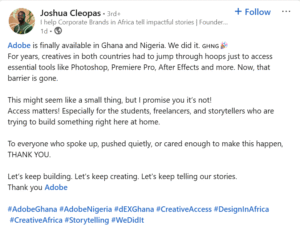
On 13 October 2025, Ghanaian brand consultant Joshua Cleopas posted a short but striking update on LinkedIn: “Adobe is finally available in Ghana and Nigeria. We did it.” The post, tagged #AdobeGhana and #AdobeNigeria, spread quickly among West African creatives celebrating a long-awaited breakthrough. In the screenshot shared by Techsoma, Cleopas thanked “everyone who spoke up, pushed quietly, or cared enough to make this happen,” describing it as a win for students, freelancers, and storytellers “trying to build something right here at home.”
Screenshot 2025 10 13 154044

The post didn’t come from Adobe itself, yet it carried the kind of authority only lived experience gives. Within hours, creative communities across X and WhatsApp groups in Accra and Lagos were celebrating a shift that felt both technical and symbolic.

The question then followed: was this simply a viral moment, or the first visible sign of Adobe’s quiet entry into West Africa?

From Workarounds To Direct Access

Evidence suggests Cleopas’s excitement wasn’t misplaced. Adobe’s Nigeria site now lists Creative Cloud plans in naira (₦), offering monthly subscriptions through the official portal for the first time. Ghana also appears in Adobe’s own Creative Cloud availability matrix, confirming access for individual users. These quiet changes remove long-standing hurdles that forced many creatives to buy in USD or depend on shared logins.

Until recently, most professionals across Ghana and Nigeria had to buy licences through South Africa or rely on shared agency bundles. The hurdles weren’t just financial. Currency conversion fees, limited card acceptance, and authentication issues often kept freelancers locked out of legitimate tools they needed for paid work.

Adobe hasn’t released a statement about this rollout, but its updated pricing pages and documentation, paired with Cleopas’s announcement, clearly show a gradual rollout focused on access first, publicity later. The move mirrors how platforms like Canva and Figma entered African markets by enabling local payments quietly before promoting it widely.

For many creatives, that discretion hardly matters. The change itself, finally being able to pay locally and log in without workarounds, represents years of advocacy finding a real result.

A Shift For Creators And The Market

For designers, videographers, and digital artists across West Africa, this change isn’t just another product update. It’s a quiet levelling of the playing field. The ability to pay for tools like Photoshop or Illustrator in naira or cedis removes one of the biggest barriers for creative professionals who have long operated outside the official Adobe ecosystem.

Freelancers and agencies can now build legitimate workflows that scale, without depending on shared or foreign accounts. For students, especially those in design and media schools, the implications are immediate. It makes professional-grade software accessible for learning and practice.

Still, the rollout is not without limits. Adobe’s Teams and Enterprise plans remain billed in USD through regional resellers or its South Africa office. Customer support and business partnerships are also routed through existing EMEA networks. In other words, users in Ghana and Nigeria now have the doorway, but not yet the full house.

Even so, Adobe’s inclusion of West Africa in its consumer pricing ecosystem is a clear signal. It recognises the region’s growing creative economy, one fuelled by storytelling, design, and digital entrepreneurship. Initiatives like dEX Ghana, Design Week Lagos, and Africa Creative Market have already built a foundation of tech-driven creativity. Adobe’s new accessibility simply puts global tools in the same hands driving those movements.

Quiet Steps, Big Implications

Adobe’s new visibility in Ghana and Nigeria didn’t arrive with press conferences or launch banners. It came through a LinkedIn post, quiet pricing updates, and the ripple of excitement among creators who had been waiting for years. That silence might be deliberate. Companies increasingly test new markets by turning on access first and watching how local users respond before making a full announcement.

What matters most is what comes next. With direct billing now active, creatives can build legitimate portfolios, pay fairly for tools, and compete globally. For Adobe, this may just be the beginning, but for Africa’s creative community, it already feels like a door finally opened.


Related Techsoma coverage

  • Five Apps Making Mental Health Support Easier to Reach
  • WhatsApp Experiments with Usernames to Replace Phone Numbers
  • Google Offers Free Access to Its Most Advanced AI Tools for African University Students
Onyinye Moyosore

Onyinye Moyosore

Onyinye Moyosore is a tech writer at Techsoma, where she covers startups, digital infrastructure, and how technology reshapes everyday life...

Recommended For You

Facebook Marketplace seller app interface showing listing management dashboard
Apps, Gadgets, Tools & Softwares

Facebook launches Marketplace Seller App and free verification

by Faith Amonimo
July 29, 2026

Facebook just launched a dedicated Seller app and free verification for Marketplace. These updates make selling easier, build trust between buyers and sellers, and put pressure on rivals like eBay.

Read moreDetails
Spotify rolls out now playing

Snapchat Launches Now Playing: Real-Time Spotify Sharing on Snap Map

July 28, 2026
A Samsung Z Fold8 device

Samsung Z Fold8 Now Available For Pre-Order In Nigeria

July 24, 2026

X Ships Full Android App Rebuild, Promises Faster Speed and Room for New Features

July 21, 2026

The US and Morocco Partners to Build Drone Academy in Tan-Tan to Fight Terrorism

July 16, 2026
Next Post
1x 1 (1)

SPAR Expands Uber Eats Partnership to Over 800 Stores Across South Africa

800x450 vertiv pelzer

Vertiv Expands Footprint in Africa with Multi-Year Airtel Nxtra Data Centre Deal

Please login to join discussion

Browse by Category

  • African Startup Ecosystem
  • African Telecommunications
  • Apps, Gadgets, Tools & Softwares
  • Artificial Intelligence
  • Business & Markets
  • Creator Economy
  • Cybersecurity
  • Digital Work-Life Series
  • E-Commerce
  • Event Radar Africa
  • Exclusive Interviews
  • Explainers
  • Features/Spotlights
  • FinTech & Digital Money
  • Funding news
  • GenZ Desk!
  • Global News
  • Logistics & Mobility Tech
  • Media & Entertainment
  • News
  • Opinions & Perspectives
  • Opportunities, Careers & Learning
  • Partner
  • Policy & Regulations
  • Reports
  • Reviews
  • Tech Insights for Creators
  • Technology
  • Thought Leadership
  • Uncategorized
  • About Us
  • Advertise on Techsoma
  • Contact
  • Corrections Policy
  • Editorial Standards
  • Ownership and Funding
  • Privacy Policy
  • Publish Your Articles
  • Techsoma Africa
  • Terms of Service

Copyright 2026 Techsoma Africa. All rights reserved.

Welcome Back!

Login to your account below

Forgotten Password?

Retrieve your password

Please enter your username or email address to reset your password.

Log In
Techsoma Africa

© 2026 Techsoma Africa Media.

Company

Policy AI Reports About Contact Advertise

Legal

Terms Privacy RSS

Latest

Founder Dependency: Why Your Startup Needs to Survive Without You Founder dependency happens when your startup cannot function without you. This guide explains how to spot the signs, build decision-making frameworks, delegate authority, and create a business that outlasts its founder. Chief Diana Chen Is Building the Technology Stack for Nigeria’s Mobility Future Nigeria’s transition to electric, connected and technology-enabled transportation will require far more than the introduction of new vehicles.... Kenya AI Policy: New Rules Put People and Local Business First Kenya just released a draft AI policy that shifts focus from foreign dependence to local innovation. The policy proposes a Sovereign Cloud Strategy, worker protections for content moderators, and an AI Innovation Fund to support homegrown startups. Public comments are open until August 4.
Techsoma Network Techsoma Network Techsoma Africa Techsoma Middle East Techsoma Canada
Transparency About Editorial Standards Corrections Ownership & Funding Privacy Terms Contact
No Result
View All Result
  • About Us
  • Advertise on Techsoma
  • Contact
  • Corrections Policy
  • Editorial Standards
  • Ownership and Funding
  • Privacy Policy
  • Publish Your Articles
  • Techsoma Africa
  • Terms of Service

Copyright 2026 Techsoma Africa. All rights reserved.