
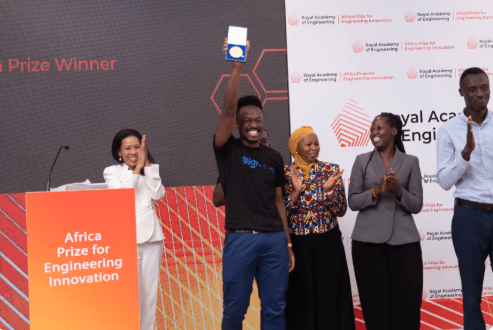
A young Kenyan inventor just proved that Africa’s brightest minds can solve global problems with local solutions. Elly Savatia, 24, walked away with the continent’s biggest engineering award and $67,000 after creating an app that makes sign language accessible to millions.
His creation, Terp 360, uses artificial intelligence to turn spoken words into sign language through realistic 3D avatars. The breakthrough technology addresses a massive gap: only one interpreter was available for over 300 deaf students at a conference Savatia attended in 2019.
Terp 360 Breaks Down Communication Barriers
Terp 360 works like Google Translate but for sign language. Users speak into the app, and a lifelike 3D avatar immediately signs back in Kenyan Sign Language. The system processes speech and text in real-time, creating smooth, natural signing movements that mirror human interpreters.
The app solves a critical problem across Kenya, where approximately 600,000 people are deaf or hard of hearing. Most rely on Kenyan Sign Language, but finding qualified interpreters remains nearly impossible in schools, hospitals, and workplaces.
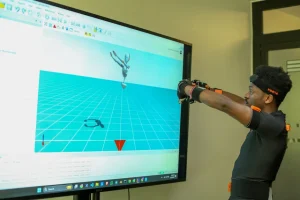
Savatia’s team at Signvrse partnered directly with Kenya’s deaf community to build the app’s foundation. They captured over 2,300 signs using motion-capture technology, recording native signers to ensure the avatars move naturally and express emotions accurately.
Companies cannot afford interpreters. We see ourselves as enablers, providing sign language at scale. The deaf community has been left behind, and we’re changing that,” Savatia explained.
Young Engineer Wins Africa’s Top Innovation Prize
The Royal Academy of Engineering awarded Savatia the 2025 Africa Prize for Engineering Innovation, the continent’s most prestigious engineering award. The competition drew 16 shortlisted innovators from across Africa, with Savatia emerging as the clear winner after an eight-month intensive business program.
The £50,000 prize ($67,000) recognizes innovations that address real African challenges while creating scalable business solutions. Since launching in 2014, the Africa Prize has supported 165 businesses from 22 countries, helping turn promising ideas into thriving companies.
“I’m totally grateful for this and it is a testament to the innovative assistive technology work that is coming from Africa,” Savatia said after receiving the award in Dakar, Senegal.
Rebecca Enonchong, chair of the judging panel, praised Savatia’s approach: “Elly’s solution demonstrates that Africans can leverage advanced technology to solve real-world problems not just on the continent but globally.”
Kenyan Sign Language Technology Reaches Global Scale
Signvrse, Savatia’s startup founded in 2023, now holds Africa’s largest dataset of Kenyan Sign Language. The company has built partnerships with UNICEF, USAID, and the Kenya National Innovation Agency to expand access across education and healthcare systems.
The technology addresses interpreter shortages that plague institutions across Kenya. Schools struggle to provide deaf students equal access to education, while hospitals often rely on family members for basic communication with deaf patients.
Savatia’s solution scales what human interpreters cannot. The app works 24/7, costs a fraction of human interpreters, and provides consistent quality across different locations. Educational institutions can integrate the technology into classrooms, while healthcare facilities can use it for patient consultations.
The startup plans to expand beyond Kenya by 2027, adding support for additional African and international sign languages. A new motion-capture studio in Nairobi will accelerate this growth, capable of recording up to 1,000 new words daily.
From Childhood Curiosity to Social Impact Innovation
Savatia’s path to innovation started early in western Kenya, where he dismantled electronics as a child to understand their inner workings. By age 12, he had built a wind-tracking windmill. At 13, he designed a robotic staircase that converted into a wheelchair ramp after watching a classmate struggle with mobility.
His formal innovation journey began at Upper Hill School in Nairobi, where he developed the Stair Ramp project and co-founded the Climate Action Club. After graduating in 2019, he launched Innovate 4 SDGs, a nonprofit mobilizing youth around the UN Sustainable Development Goals.
The defining moment came at a 2019 conference in northeastern Kenya. Watching a single interpreter serve over 300 deaf students sparked the question that would drive his career: how to bridge communication barriers for deaf communities.
Terp 360 is Savatia’s third major venture. His previous startup, Veezaviz, focused on assistive communication technologies but closed in 2022 due to internal challenges. Rather than give up, Savatia used those lessons to build Signvrse with stronger foundations and a clearer focus.
AI Avatar Technology Creates Natural Sign Language Experience
The technical breakthrough behind Terp 360 lies in its motion-capture foundation. Unlike basic animation systems that produce robotic movements, Savatia’s team recorded real deaf signers in detail, capturing subtle hand movements, facial expressions, and body language that make sign language natural and expressive.
The AI system processes this motion data to generate fluid signing that matches human interpreters. Users report that the avatars feel more relatable and easier to understand than previous digital signing attempts, which often appeared mechanical and emotionless.
Signvrse has also joined Google’s prestigious Accelerator program for Generative AI, gaining access to advanced AI tools and mentorship to further improve the avatar technology.
The platform handles complex grammar structures unique to Kenyan Sign Language, including regional variations and cultural expressions that distinguish it from American Sign Language or British Sign Language systems commonly used in existing apps.
Recognition Spans Global Innovation Networks
Savatia’s work has earned recognition far beyond the Africa Prize. He received the 2024 Mandela Washington Fellowship, became a Commonwealth Secretary-General’s Innovation Award recipient, and won UNICEF’s Generation Unlimited Innovation Challenge.
Additional honors include selection as a Global Teen Leader by the We Are Family Foundation, recognition as the youngest World Bank African Drone Youth Scholar in 2020, and victory in Kenya’s Drone Business Competition in 2022.
These awards reflect not just technical achievement but social impact potential. Each recognition has opened doors to partnerships, funding, and networks that help scale Terp 360’s reach across Kenya and beyond.
As a One Young World ambassador and Youthtopia Circle member, Savatia actively promotes youth leadership while building his technology company. This dual focus on innovation and advocacy positions him as a role model for Africa’s next generation of tech entrepreneurs.
Deaf Community Collaboration Drives Product Development
Terp 360’s success stems from deep collaboration with Kenya’s deaf community throughout the development process. Rather than building in isolation, Savatia’s team worked directly with deaf users to understand their communication needs and preferences.
This community-centered approach revealed that previous digital signing tools failed because they looked too artificial. Deaf users needed avatars that signed with the same fluidity, emotion, and cultural context as human interpreters.
The motion-capture process involved deaf community members demonstrating thousands of signs while sensors recorded every movement detail. This data became the foundation for AI algorithms that generate natural signing patterns rather than rigid, computer-generated movements.
Kenya’s deaf community faces significant challenges accessing education, healthcare, and employment due to communication barriers. Research indicates that approximately 2.75 million Kenyans are deaf or hard of hearing, but interpreter shortages mean most never receive adequate communication support.
African Innovation Leads Global Technology Trends
Savatia’s victory highlights Africa’s emerging role as a global innovation hub rather than just a technology consumer market. Young African entrepreneurs are creating solutions that address local challenges while competing internationally.
The Africa Prize competition showcases this trend, supporting innovations from solar-powered systems to agricultural sensors and medical devices. Winners consistently demonstrate that African problems require African solutions, built by people who understand local contexts and constraints.
This approach often produces more effective results than importing foreign technologies that don’t account for local languages, cultures, or economic realities. Terp 360 succeeds precisely because it was built for Kenyan Sign Language users, not adapted from systems designed elsewhere.
The startup plans to expand this model across Africa, working with deaf communities in other countries to build localized versions that respect regional sign language variations and cultural differences.