

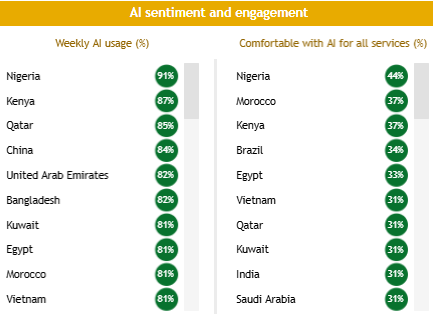
Nigeria ranks first in the world for weekly artificial intelligence usage. Ninety-one percent of Nigerians surveyed use AI at least once a week, according to Boston Consulting Group’s latest Digital Government Citizen Survey. Eighty percent of Nigerians describe themselves as AI proficient, compared with 63 percent globally.
Nigerians use AI tools built and owned almost entirely by foreign companies. Every subscription, every query, and every piece of training data strengthens systems that Nigeria does not control. The country is sprinting ahead on adoption while falling behind on ownership.
Nigerians Use AI More Than Anyone Else on Earth
The adoption data is remarkable by any measure. Google and Ipsos found that 88 percent of Nigerian adults have used an AI chatbot, an 18-point jump from 2024. Ninety-three percent of Nigerians use AI to understand complex topics, compared with 74 percent globally. Ninety-one percent of the workforce uses AI for professional tasks.
The World Bank reports that AI adoption among Nigerian formal firms jumped from less than 5 percent in 2022 to about 40 percent in 2025. That puts Nigerian businesses on par with American firms in adoption rates. Even 21 percent of Nigerian firms that still rely on handwritten records have adopted AI, mostly through mobile chatbots.
This is not a small elite experimenting with new technology. It is a broad, economy-wide shift. Business owners use AI to write proposals. Students use it to study. Farmers use it for crop advice. The tools have become part of daily life for millions of people.
The Tools Nigerians Use Were Built Somewhere Else
A report titled “Adoption of Artificial Intelligence in Nigeria” warns that Nigeria remains largely a consumer of technologies developed abroad. The report, authored by Debola Ibiyode and conducted by OLGNova alongside AI in Action Now, found that Nigerians rely on foreign-built AI models, cloud infrastructure, and software platforms.
The financial leak is measurable. Nigerian companies spend about $850 million annually on foreign cloud services. That money flows to Amazon Web Services, Microsoft Azure, and Google Cloud. The report notes that this dependency exposes local institutions to risks from changing licensing policies, service disruptions, and external control of critical digital infrastructure.
Every time a Nigerian business uses a foreign AI tool, two things happen. Revenue leaves the country. Nigerian data enters a foreign model and improves it. The business gets a useful service. The foreign company gets a better product and a new paying customer. The cycle repeats.
A Local AI Industry Exists, but It Operates on Tiny Budgets
Nigeria does have AI builders. TechCabal spent a year mapping the ecosystem and found companies working at every layer of the stack. Tonative curates African language datasets. Spitch builds speech recognition for Yoruba, Hausa, and Igbo. Intron Health created a speech model covering more than 20 African languages for use in hospitals and courts. Cencori and Yamify provide compute access and deployment infrastructure.
These companies solve problems that global tools were not designed to handle. A skincare AI trained without African skin data performs worse for African users. A speech recognition tool built for hospitals in Europe does not work well in a Lagos clinic. The local builders understand these gaps because they have lived them. That same principle applies to founders building across the continent, which is why building for the market you are actually in matters more than importing a model that worked elsewhere.
The challenge is scale. TechCabal Insight found that less than 5 percent of African AI talent has access to the GPU power needed to build seriously. Local AI companies operate on budgets that global competitors spend on a single marketing campaign. They are building the foundation for African AI while foreign platforms capture the mass market.
Nigerian AI Talent Earns More Working for Foreign Companies
The salary gap explains why local AI companies struggle to retain talent. A mid-level developer at a Nigerian company earns between N150,000 and N800,000 per month. The same developer doing equivalent work remotely for a foreign company earns $2,500 to $5,000 per month. At mid-2025 exchange rates, that is an income multiplier of five to fifteen times.
The result is a steady drain of the most capable AI professionals. Many stay physically in Nigeria while working for companies in San Francisco, Amsterdam, and London. Their expertise builds foreign models, foreign products, and foreign institutions. The African Leadership Magazine noted that remote work allows income to flow into local economies, but it does not strengthen African technology firms or domestic innovation ecosystems. This pattern has become so entrenched that remote work now functions as one of the most powerful forces pulling Nigerian talent into foreign payrolls.
This is not a new problem. It is an old problem with a new face. Global demand for AI expertise has made the pull stronger than ever. Local companies train workers who then leave for higher pay. The country invests in skills and foreign companies collect the returns.
Foreign AI Models Do Not Understand Nigerian Languages
Most leading AI models are trained predominantly on English language datasets. The report warns that this limits their ability to accurately interpret Hausa, Yoruba, Igbo, and other Nigerian languages. A business owner using a foreign AI tool to communicate with customers who speak primarily in Nigerian languages uses a tool that performs less well in that conversation.
The gap is not only about who profits. It is about whether the technology actually works for the people it is supposed to serve. A customer service chatbot that cannot understand a complaint in Yoruba is not solving a problem. It is creating a new one.
Local companies like Spitch and Intron Health are building the language models that global platforms ignore. Their work matters because language is not a niche feature. It is the foundation of how people access services, information, and economic opportunity. Without local language AI, millions of Nigerians remain outside the digital economy even as they use digital tools. The technical foundations these companies build on depend on skills that every Nigerian professional now needs to develop to stay relevant in this market.
The Jobs Nigerians Hold Today Face Automation Without Local Replacements
A Nigeria-focused economic review projects that automation could put about nine million routine jobs at risk by 2030. The most exposed sectors include banking, clerical services, public administration, customer service, and media. The same review suggests that Nigeria could create about 11 million technology-enabled jobs if it invests sufficiently in skills and reskilling.
The net number looks positive. The transition does not. Experts describe the current phase as quiet displacement. Companies automate tasks first and make headcount decisions later. The first person displaced may not be the person whose job disappears. It may be the person who was going to be hired next.
Entry-level jobs have traditionally been the first rung on the professional ladder. A junior accountant reconciles records. A young banker reviews documents. A junior journalist conducts basic research. AI can now handle many of these tasks. If companies need fewer junior employees, the ladder loses its bottom rungs. Young Nigerians face a labour market that demands experience for jobs that no longer exist. The same shift is forcing workers everywhere to build new skills, which is why the ability to work with AI rather than against it has become one of the most valuable things a professional can develop.
The jobs AI creates and the jobs it displaces do not sit in the same places or require the same skills. The growing AI jobs boom and the ongoing brain drain are two sides of the same story, one creating opportunity that the other pulls offshore.
Huawei’s Local Cloud Is One Answer, but One Company Cannot Fix the Gap
Huawei launched its Agentic AI Cloud in Nigeria in September 2026, allowing businesses and government agencies to develop and deploy AI agents on local infrastructure. The company operates a hyperscale local cloud with storage and compute capacity physically installed in the country.
Roc Bai, Managing Director of Huawei Cloud Nigeria, said the platform supports local data residency by ensuring data is hosted, processed, and governed within Nigeria. He described the approach as “Data stays home. Value stays home”. NITDA’s Director-General stressed that digital sovereignty should not be confused with technological isolation and that attracting international partners remains vital for building domestic capacity.
Huawei’s investment shows that local infrastructure is possible. The company has operated in Nigeria for 27 years and cites a talent base of over one million developers. But one company cannot build the entire stack. Power supply, connectivity, cybersecurity, and local technical skills all need investment. A single local cloud provider does not solve the structural gap between AI consumption and AI creation.
Nigeria’s Laws Are Starting to Price the Value of Nigerian Data
The Digital Sovereignty and Fair Data Compensation Bill would require foreign digital companies to store Nigerian user data locally and obtain NITDA approval for cross-border transfers. It would create a Nigeria AI Development Fund funded by a 2 percent contribution of Nigerian revenue from foreign companies. The bill also mandates that at least 30 percent of AI research and development using Nigerian data be conducted locally.
These measures treat Nigerian data as an asset with economic value. They say that companies profiting from Nigerian users should contribute to Nigerian AI capacity. The approach mirrors what other countries have done to capture more value from their digital economies.
The bill faces implementation challenges. Foreign companies may resist the revenue contribution. Enforcement requires tracking revenue generated from Nigerian users. Local infrastructure must be capable enough to handle the data that foreign companies currently process abroad. The law sets a direction, but the infrastructure to deliver it remains uneven.
What Nigeria Must Do to Keep the Value It Creates
Closing the gap requires action on several fronts.
Nigeria needs more compute capacity. Local data centres have expanded, with Kasi Cloud unveiling a 100MW facility expected to retain some of the $850 million annual foreign cloud spend. But capacity remains far below what the market demands.
Nigeria needs to keep more of its AI talent. Remote work creates income for individuals but not capacity for local institutions. Policies that encourage local AI companies to compete on salary, equity, and mission could slow the drain. The Nigeria AI Talent Factory Initiative aims to train 500,000 young Nigerians for AI roles by 2030, but training without local opportunities just feeds the export pipeline.
Nigeria needs government procurement to favour local AI solutions. The Federal Government targets $1 billion in annual public sector IT spending for local cloud infrastructure. If that spending flows to Nigerian AI companies, it builds the market that local startups need to scale.
Nigeria needs to invest in local language datasets and models. The builders exist. Tonative, Spitch, and Intron Health have proven the demand. What they need is capital, compute, and customers who value tools that work in Nigerian languages.
Adoption Without Ownership Is a Trap
The BCG survey found that 61 percent of Nigerians believe the benefits of AI outweigh its risks. That optimism is understandable. AI helps people learn, work, and start businesses. It solves real problems in a country where public services often fall short.
But optimism without ownership carries a cost. The country that consumes technology sends money to the country that builds it. The consumer gets more efficient until the pricing changes or the provider changes the terms. Then the consumer discovers that it depends on something it does not control and cannot replace quickly.
Nigeria has the users. It has the talent. It has the data. What it lacks is the infrastructure and the institutions to turn those advantages into lasting economic value. The window to build that value is open now. It will not stay open forever.