

While Western nations debate universal AI regulations, three African countries lead with practical, agile governance models that could reshape global AI policy
The global AI governance race has an unexpected frontrunner. When it comes to AI governance, Africa is no longer playing catch-up. It’s setting the pace to shape the direction of the debate.
While Brussels wrestles with the EU AI Act and Washington debates regulatory frameworks, three African nations quietly pioneer innovative approaches that put practical experimentation over theoretical restrictions. Rwanda’s AI sandbox model, Nigeria’s adaptive data protection framework, and Egypt’s comprehensive AI strategy offer fresh perspectives on governing artificial intelligence.
These aren’t small-scale experiments. They represent fundamental shifts in how governments approach emerging technology regulation.

1. Rwanda’s Revolutionary AI Sandbox: Testing Tomorrow’s Rules Today
Rwanda transforms regulatory thinking with its AI sandbox initiative. The country hosts Africa’s first comprehensive AI sandbox co-creation lab, bringing together 17 stakeholders from government, private sector, and civil society.
The Datasphere Initiative’s AI Sandboxes Co-Creation Lab in Kigali demonstrates Rwanda’s commitment to agile governance. Unlike Western regulatory approaches that impose rules first and adapt later, Rwanda creates controlled environments where innovation meets responsibility.
The Sandbox Advantage
Rwanda’s approach tackles three critical challenges:
Data Governance and Digital Sovereignty: The sandbox allows testing of new data collection, management, and governance frameworks before codifying them into law. This prevents premature regulation that might stifle innovation.
Infrastructure and Contextual Solutions: Rwanda creates safe spaces for testing technologies like edge AI that address local infrastructure realities. The sandbox approach builds sustainable business models beyond one-off pilots.
Skills and Capacity Development: The initiative serves as a practical learning environment, providing access to real datasets for research and training while building regulatory capacity.
The Rwanda model proves that regulatory innovation can accelerate rather than impede technological progress.
2. Nigeria’s NDPC: Adaptive Regulation Meets Cross-Border Innovation
Nigeria’s Data Protection Commission (NDPC) pioneers adaptive regulatory sandboxes that support AI integration while enabling cross-border innovation. The commission’s approach represents a significant departure from rigid compliance frameworks.
The NDPC’s recent workshop on AI sandboxes reveals sophisticated thinking about AI governance. Rather than viewing regulation as a barrier, Nigeria treats it as an innovation enabler.
Smart Regulatory Architecture
Nigeria’s approach addresses West Africa’s fragmented regulatory space.
Dr. Jimson Olufuye, Principal Consultant at Kontemporary Konsulting, emphasizes the need for “regulatory harmonization across African nations to facilitate easier data flows and AI integration.”
The NDPC framework operates within real-time legal and regulatory parameters while maintaining flexibility for emerging technologies. This creates competitive environments for AI developers while addressing Africa’s unique challenges.
Executive Vice Chairman of the Nigerian Communications Commission, Dr. Aminu Maida, highlights the collaborative nature:
“Sandboxes provide a controlled environment for innovators to test AI under regulatory supervision. This encourages collaborative learning, risk mitigation, and evidence-based policymaking.”
Nigeria’s model demonstrates how regulatory agencies can become innovation partners rather than gatekeepers.
3. Egypt’s Comprehensive AI Council: Strategic National Transformation
Egypt’s National Council for Artificial Intelligence represents the most comprehensive AI governance framework in Africa. The second edition of Egypt’s National AI Strategy (2025-2030) establishes ambitious goals backed by detailed implementation roadmaps.
Six-Pillar Strategic Framework
Egypt’s strategy builds on six interconnected pillars:
Governance: Establishing national regulatory frameworks and strengthening international collaboration on AI policies.
Technology: Developing national AI models for local challenges while expanding research and development resources.
Data: Creating comprehensive data governance frameworks and high-quality Arabic language datasets.
Infrastructure: Building national data centers and expanding AI cloud computing infrastructure.
Ecosystem: Creating secure investment environments and collaboration platforms between academia and private sector.
Skills: Developing AI talent through specialized training programs and international academic alliances.
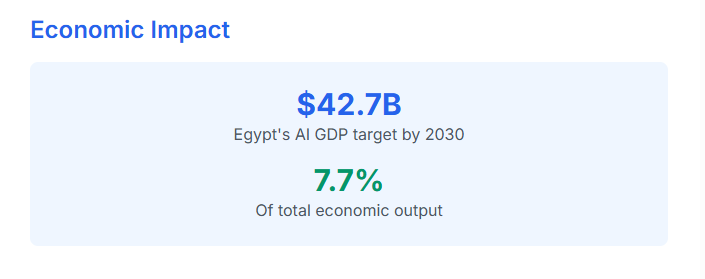
The strategy targets raising AI’s contribution to GDP to $42.7 billion by 2030, representing 7.7 percent of total economic output. This ambitious target reflects Egypt’s confidence in its governance model.
Why African Innovation Outpaces Western Approaches
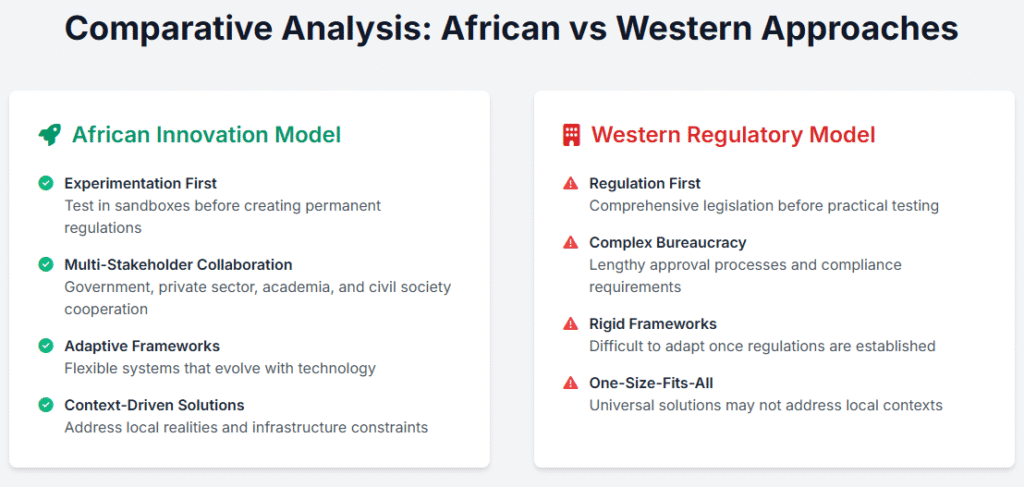
African AI governance succeeds where Western models struggle because it prioritizes practical experimentation over theoretical perfection. Three factors drive this advantage:
Agility Over Bureaucracy
African regulators embrace rapid iteration and learning. Rather than creating comprehensive regulations upfront, they test approaches in controlled environments and adapt based on results.
Stakeholder Collaboration
African initiatives consistently bring together government, private sector, academia, and civil society. This collaborative approach prevents regulatory capture while ensuring diverse perspectives inform policy development.
Context-Driven Solutions
African frameworks address local realities rather than importing solutions designed elsewhere. This creates more effective and sustainable governance models.
Lessons for Global AI Governance
The African experience offers valuable insights for global AI governance:
Sandbox First, Regulation comes Next: Testing approaches in controlled environments before creating permanent regulations reduces unintended consequences.
Collaborative Governance: Including all stakeholders in policy development creates more robust and accepted frameworks.
Adaptive Frameworks: Building flexibility into regulatory systems allows them to evolve with technology rather than constraining innovation.
Cross-Border Coordination: Regional approaches to AI governance create larger markets and more effective oversight.
The Future of AI Governance Is African
As Western nations debate comprehensive AI legislation, African countries demonstrate that effective governance emerges from experimentation, collaboration, and adaptation. Rwanda’s sandboxes, Nigeria’s adaptive frameworks, and Egypt’s comprehensive strategy provide blueprints for responsive AI governance.
These models don’t just regulate AI, but they enable it. African regulators show how governance can accelerate rather than impede technological progress, y creating environments where innovation and responsibility coexist.
The global AI governance conversation needs African voices at the center. The continent’s innovative approaches offer solutions to challenges that purely regulatory frameworks cannot address.
The future of AI governance isn’t being written in Brussels or Washington. It’s being tested, refined, and implemented across Africa.