

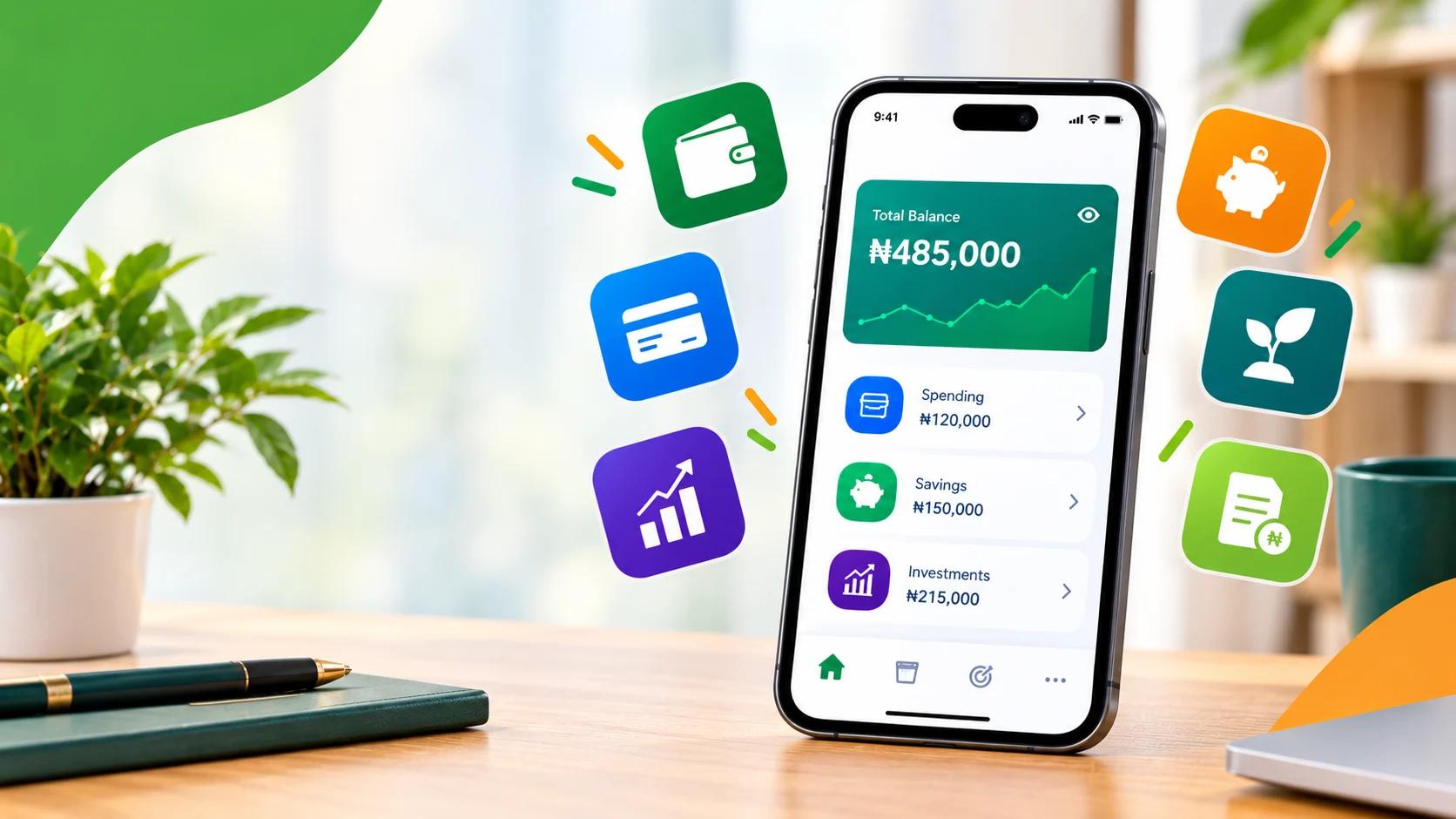
Managing money in Nigeria now involves more than checking your bank balance. You may have a salary account, another account for bills, a savings wallet, investment accounts and several small payments that are easy to forget.
The right app can help bring some structure to all of this. Some apps are better for everyday banking and spending, while others help you save towards specific goals or invest for the future.
Before choosing one, it also helps to understand the difference between a fintech and a traditional bank, since the two can look similar on your phone while operating under different licences and rules.
The important thing is to choose an app based on the financial problem you want to solve.
Here are five useful apps Nigerians can use to manage their money more deliberately.
1. Kuda helps with everyday spending and saving
Kuda is useful for people who want everyday banking and money management tools in one app.
Kuda lets users send money, pay bills, use a physical or virtual card and save automatically. Its Spend+Save feature allows users to set a percentage of their spending that the app moves into savings. Users can also create savings pockets and set regular savings goals.
Kuda also offers spending and budgeting features through its Premium programme. The company says Premium users can access budgeting and spending reports alongside other benefits.
This makes Kuda particularly useful for someone who wants to keep everyday transactions, spending and savings within one banking app.
Best for: Everyday banking, spending management and automated saving.
2. PiggyVest makes goal-based saving easier
PiggyVest is one of Nigeria’s better-known savings and investment platforms.
Its strength is helping users put money aside for specific goals. Target Savings allows users to create personal or group targets for things such as rent, travel, gadgets or starting a business. Users can set daily, weekly, monthly or manual contributions.
PiggyVest also offers SafeLock, which allows users to lock money for a selected period. Breaking a SafeLock before maturity means forfeiting the accrued interest, so users need to understand the conditions before committing money.
This makes the app useful for someone whose main financial challenge is saving consistently.
For example, someone preparing for annual rent can create a target and contribute towards it regularly instead of trying to find the full amount when the payment is due.
PiggyVest is not a detailed expense-tracking app, though. It is better suited to saving and investing than analysing every naira you spend.
Best for: Goal-based saving, savings discipline and investment products.
3. Cowrywise combines saving with investing
Cowrywise is another Nigerian platform that combines automated savings with investment products.
Users can create daily, weekly or monthly savings and investment plans. The platform also provides access to mutual funds, including dollar-denominated funds. Cowrywise says it is regulated by the Securities and Exchange Commission of Nigeria as a fund manager.
The distinction between saving and investing matters. A savings plan is usually built around a specific goal and timeline, while investments carry different risks and potential returns.
Cowrywise is therefore more useful for someone who has moved beyond simply trying to save money and wants to think about how some of that money can grow over time.
The platform can also work well for people who want to automate their contributions. Instead of remembering to move money every month, users can set up a recurring plan.
Best for: Automated saving, mutual fund investing and longer-term financial planning.
4. Risevest helps Nigerians invest beyond naira
Risevest is useful for Nigerians who want to add dollar and other foreign-currency investment exposure to their financial plans.
Risevest operates through a Nigerian company, RV Fund Management Limited, which its current terms identify as registered with the Securities and Exchange Commission of Nigeria as a fund and portfolio manager. The platform offers investment products rather than functioning as a conventional bank account.
The platform is particularly relevant for people who earn in foreign currency, have international financial goals or want part of their investment portfolio outside naira-denominated assets.
That does not mean dollar investments are automatically safer or more profitable. Investment products carry risks, fees and different withdrawal conditions. Users should understand what an investment holds, who manages it and how withdrawals work before committing money.
Risevest therefore fits a different part of personal finance from apps such as Kuda and PiggyVest. It is more about building and managing investments than tracking daily expenses.
The growth of investment apps also reflects a shift in how Nigerians participate in financial markets, with digital platforms making it easier for individuals to access stocks and other investment products.
Best for: Dollar investments, international exposure and long-term wealth building.
5. Auritrack focuses on budgeting and expense tracking
Auritrack takes a different approach from the savings and investment apps on this list.
Instead of holding or investing your money, it helps users track where it goes. The platform is designed for naira-based spending and allows users to record expenses through chat or upload bank statements for categorisation. It currently does not offer live bank synchronisation, so users need to import statements or enter transactions manually.
This distinction makes Auritrack useful for people who already have bank and savings accounts but struggle to understand their spending patterns.
For example, a person could use Kuda for daily banking, PiggyVest for a rent target and Auritrack to monitor how much goes towards food, transport, data, subscriptions and other monthly expenses.
That combination addresses a problem that savings apps alone do not solve. Saving money is important, but knowing where your money goes is the first step towards building a realistic budget.
Best for: Expense tracking, budgeting and understanding spending patterns.
The right finance app depends on what you need
These five apps are not direct replacements for one another.
Kuda is useful when you want everyday banking, spending management and automated saving in one place.
PiggyVest is stronger when your priority is setting money aside for specific goals and creating savings discipline.
Cowrywise makes more sense when you want to combine structured savings with mutual fund investments.
Risevest is designed for people who want investment exposure beyond traditional naira savings.
Auritrack is useful when your biggest problem is understanding where your money goes each month.
You also do not have to use only one app. Someone could use their bank app for daily transactions, PiggyVest for a specific savings goal and an expense tracker to monitor spending across accounts.
The goal is not to download five finance apps and create more work. It is to use the fewest tools necessary to understand your spending, save for important goals and make informed decisions about your money.
Check the terms before putting your money into an app
A finance app should not be judged only by its interest rate or number of features.
Before depositing or investing money, check who regulates the company and what protection applies to the specific product.
This is particularly useful when dealing with fintechs that now offer services that looks similar to traditional banking. Understanding what a microfinance bank licence allows a fintech to do can help you understand the financial service you are actually using.
A CBN-licensed bank, an SEC-regulated fund manager and an investment platform using regulated third parties do not necessarily offer the same type of protection.
Also check withdrawal rules, fees, investment risks and what happens if you need your money earlier than planned.
This is especially important with products that lock funds for a specific period. A high advertised return is less useful if you cannot access the money when you need it.
The best finance app is therefore not necessarily the one with the most features. It is the one that fits the job you need it to do and whose terms you understand.