


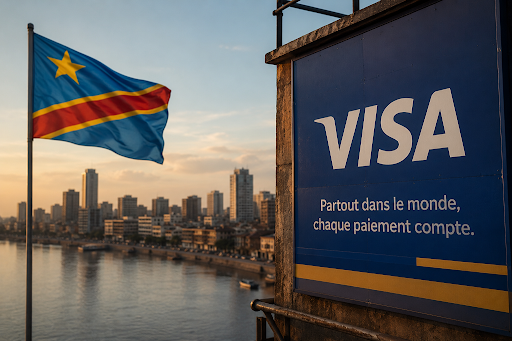
Visa, M-Pesa, and pan-African payments company Onafriq have started something quiet in the Democratic Republic of Congo, and it’s the kind of story that looks small until you notice who’s going to be unhappy about it.
The three companies have launched a pilot that settles cross-border mobile money transactions using stablecoins, digital currencies pegged to assets like the US dollar. On the surface, nothing changes for the person using the app. Top up your M-Pesa wallet from abroad, and the transaction still shows up the same way it always has. What’s different is what happens in the background, where a blockchain-based settlement layer now moves the actual value instead of the usual chain of correspondent banks.
Why the DRC, Specifically
This isn’t a random test market. The DRC has rapid mobile money growth and a huge share of adults still outside the formal banking system, roughly 30% of adults have access to formal financial services, compared with 84% in Kenya. That combination, fast-growing digital payments plus low banking penetration, makes it a useful lab for testing whether a new rail actually works before rolling it out somewhere with more scrutiny.
It also builds on groundwork Visa already laid. The company recently launched Visa Pay in the DRC, connecting M-Pesa, Airtel Money, and Orange Money wallets to its global network through Onafriq’s infrastructure. The stablecoin pilot slots into that existing plumbing rather than building something from scratch.
The Problem It’s Actually Solving
Cross-border remittances into Sub-Saharan Africa cost an average of nearly 8% of the amount sent, the most expensive remittance corridor in the world, according to the World Bank. That’s the friction this pilot is aimed at. A payment moving from, say, a diaspora sender in Europe to a family member’s mobile wallet in Kinshasa normally passes through multiple banks, each taking a cut and adding delay. Route that same value through a stablecoin instead, and in theory the transfer clears faster and cheaper, without the user ever touching a crypto wallet or managing a private key.
Visa’s Chris Newkirk described the mechanics plainly: as a user tops up their M-Pesa wallet, the transaction settles in stablecoins in the background, while the customer experience stays identical to what they already know.
Where the Politics Get Tricky
Here’s the part worth sitting with. The DRC’s central bank has spent years trying to reduce heavy dollarization in its economy and push adoption of the Congolese franc. A dollar-pegged stablecoin, even one operating invisibly behind a familiar mobile money interface, embeds more digital dollar exposure into the country’s payment rails, not less. That runs directly against the direction the central bank has been steering.
Visa, for its part, is treating this as infrastructure experimentation rather than a pivot into crypto. The company has previously partnered with African exchange Yellow Card to explore stablecoins for treasury operations and cross-border settlement, and this pilot extends that same cautious, behind-the-scenes approach. But cautious framing doesn’t make the underlying tension disappear. If the pilot works and Visa wants to scale it to other African corridors where Onafriq operates, it will keep running into the same question: does a payments company get to quietly expand dollar circulation in a country whose regulator is actively working against that.
A Test Case for the Rest of the Continent
Africa’s mobile money market processed $1.4 trillion in transactions in 2025, up 26% year on year, and the continent still accounts for the bulk of global mobile money volume and value. Cross-border payments remain the weakest link in that system, slow, expensive, and dependent on intermediaries most users never see. If Visa can prove stablecoins solve that without disrupting the user experience or triggering a regulatory fight, the model travels easily to other markets with the same problem.
If it doesn’t, and the DRC’s central bank or others push back hard on the dollarization question, this becomes a cautionary story instead. Either way, what’s being tested here isn’t just a technology. It’s whether global payment networks can route around a country’s monetary policy quietly enough that nobody notices until the numbers get big enough to matter.