How a former infantry officer used broadband, fintech and a flurry of policy experiments to push Nigeria toward a new kind of commodity: code.
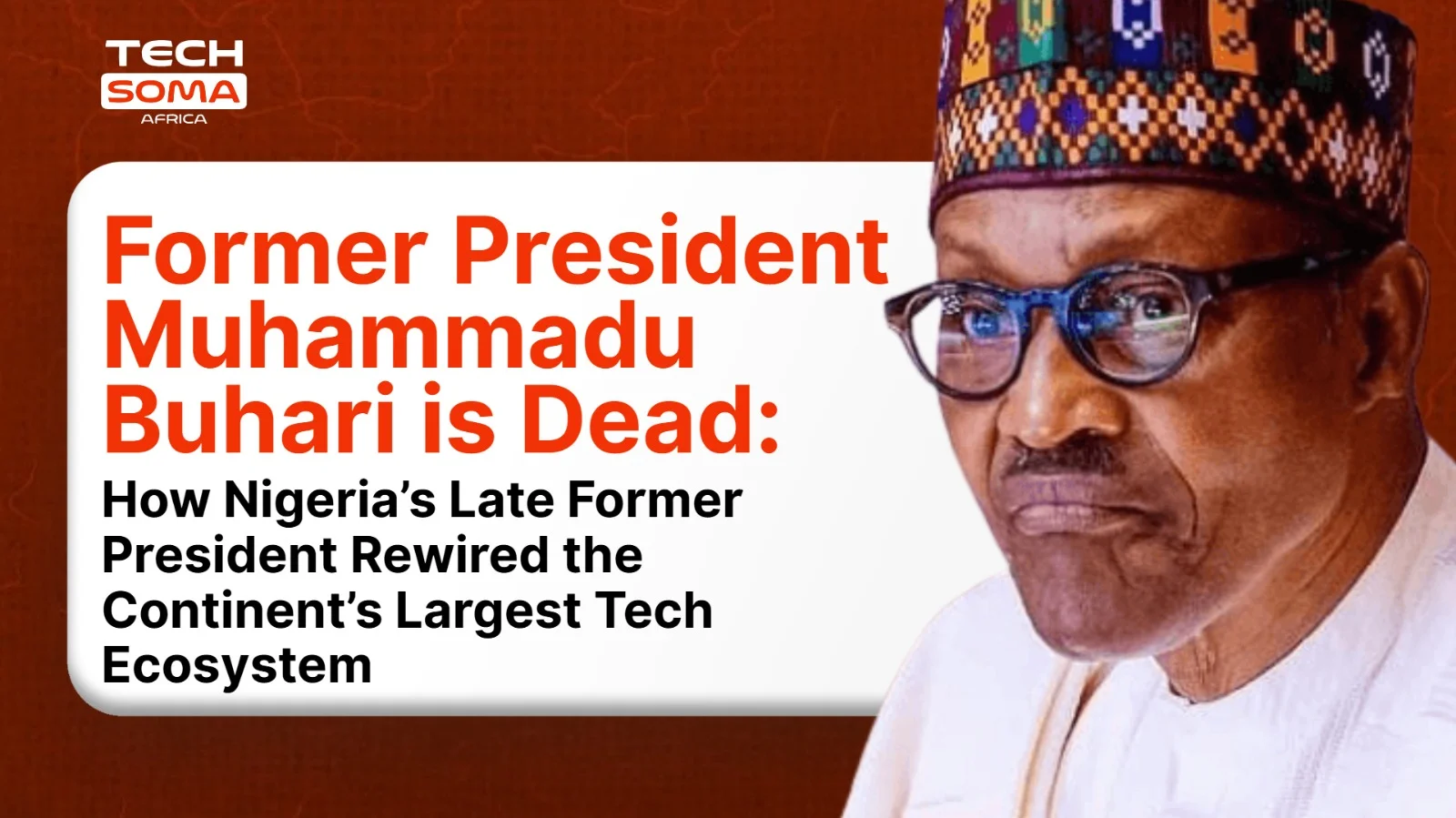
Muhammadu Buhari died in London on 13 July 2025, aged 82, closing the chapter on a career that stretched from the battlefields of the Biafran War to the ballot boxes of Africa’s largest democracy. His economic scorecard will be argued for years, yet on technology he leaves a record that even critics acknowledge is the most consequential since independence. His eight-year presidency coincided with the moment Silicon Valley’s cheque books and Nigeria’s own founders began treating Lagos as Africa’s default launchpad, turning software into a headline export alongside crude.
Between 2015 and 2023 his State House embraced broadband as infrastructure, courted venture capital, experimented with a central-bank digital currency and wrote the continent’s only full-scale Startup Act. Nigeria, long defined by hydrocarbons, emerged from his tenure with a second growth story centred on software talent and digital rails. This essay unpacks the achievements, the contradictions and the unfinished business of Buhari’s digital agenda.
1. From Petroleum to Platforms
Early in 2019 Buhari approved a rename of the Communications Ministry, adding “Digital Economy” and giving it cabinet-level clout. The change embedded hard targets in the national growth plan and forced every ministry to produce quarterly tech scorecards that landed on the President’s desk.
2. Wiring the Nation
The National Broadband Plan 2020 to 2025 set a minimum download speed of 25 Mbps in cities and 10 Mbps in rural districts, with a goal of 70 percent population coverage by 2025. Private-sector tower companies responded with fresh capital, though insecurity in the north-east still slows fibre roll-out.
3. Fintech Firsts: the eNaira
On 25 October 2021 Buhari launched the eNaira, Africa’s first central-bank digital currency. By March 2025 wallet creation had climbed to 13 million, yet the IMF rates real-world usage as negligible. Even so, the project signalled official willingness to test new rails for payments at continental scale.

4. The Startup Act and Capital Clinics
Buhari signed the Nigeria Startup Act in 2022 after rare co-drafting sessions with founders. The law created a one stop secretariat, tax holidays of up to 5 years and a fintech sandbox. Hundreds of companies have already secured the coveted “startup label”, unlocking pioneer status incentives.
5. Data Privacy and Consumer Trust
Ahead of a full Data Protection Bill reaching the Senate, Buhari’s team issued the Nigeria Data Protection Regulation in 2019. Banks and telcos must now file annual audits and face fines that recently crossed the ₦500 million mark for single offences.
6. Electronic Government and Doing Business
Corporate registration, passport renewals and customs filings moved online under a presidential digital-economy council. Nigeria rose 39 places in the World Bank ease-of-doing-business ranking between 2016 and 2021, its best run on record.
7. Dark Spots on the Canvas
The same presidency that courted Silicon Valley also blocked Twitter for 222 days after the platform deleted a Buhari tweet in 2021. Internet shutdowns appeared during regional protests, and journalists faced cyber-crime charges. Investors learned that policy certainty could vanish overnight.

8. Human-Capital Surge
Government programmes such as N-Power Tech and Digital Skills Nigeria claim 5 million certificates issued, while Google pledged to train 500 000 developers. Yet graduate unemployment stayed near 30 percent, fuelling the “japa” talent exodus.
9. Venture Outcomes and Global Optics
African startups attracted more than $20 billion in VC between 2015 and 2024, with Nigerian firms securing roughly one quarter. Paystack sold to Stripe for $200 million in 2020, Flutterwave topped $3 billion in valuation and Andela exported coders worldwide. Buhari’s defenders cite these deals as evidence that supportive policy unlocks capital even in stormy macro cycles.
10. Verdict
Buhari was no digital messiah but neither was he a Luddite. He treated code as a sovereign asset yet sometimes smothered the internet in the name of security. He leaves behind laws, councils and unfinished fibre trenches that can either power an inclusive renaissance or decay into monuments of lost momentum. The choice now rests with his successors, investors and a restless generation of builders who grew up under his digital decade.
Five Numbers that Tell the Story
- 70 percent targeted broadband coverage by 2025.
- 13 million eNaira wallets created by March 2025.
- ₦555.8 million data-privacy fine levied on a single bank in 2024.
- 222 days of Twitter suspension between 2021 and 2022.
- 39-place climb in the World Bank business ranking 2016 to 2021.