
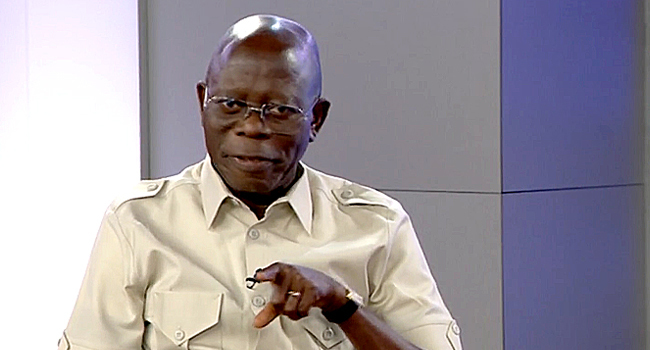
Senator Adams Oshiomhole has called on the Nigerian Senate and the Federal Government to nationalise MTN Nigeria and revoke the operating licences of South African companies in the country, framing economic retaliation as the most effective response to escalating xenophobic attacks against Nigerians in South Africa.
The senator representing Edo North made the remarks during Senate plenary in Abuja on Tuesday, while contributing to a motion on xenophobia sponsored by Senator Aniekan Bassey and co-sponsored by Senator Osita Izunaso. The motion, titled “A Call for Urgent National Diplomatic and Humanitarian Action to Defend the Dignity, Safety and Honour of Nigerian Citizens,” was debated under matters of urgent public importance.
The Case for Economic Retaliation
Oshiomhole invoked the principle of reciprocity in international relations, arguing that Nigeria had extended goodwill to South Africa during the apartheid era and was now watching its citizens being targeted, killed, and driven from their livelihoods.
“I don’t want this Senate to be shedding tears, to sympathise with those who have died. We didn’t come here to share tears,” he said. “If you hit me, I’ll hit you. It’s an economic struggle.”
He proposed that Nigeria nationalise MTN and withdraw its licence, so that “a Nigerian company can take over the MTN business and recruit more people,” adding that South Africans who claim Nigerians are taking their jobs would then find good employment in the company that replaces MTN.
Beyond MTN, Oshiomhole also called for similar action against MultiChoice, the operator of DStv, accusing the company of economic exploitation and advocating increased indigenous participation in key sectors.
What’s Driving the Attacks
The attacks that prompted his remarks have been escalating since late March. Foreign-owned properties have been set ablaze, immigrants have been barred from receiving hospital care, and many have been driven from their livelihoods. Oshiomhole linked the recurring violence to domestic political dynamics in South Africa, where anti-immigrant rhetoric has increasingly influenced public opinion and been directed at Nigerians and other African nationals.
Nigeria’s Foreign Affairs Minister, Bianca Odumegwu-Ojukwu, confirmed that 130 Nigerians had already registered for evacuation, with the number expected to rise. President Bola Tinubu separately condemned the attacks, describing them as xenophobic rhetoric and incendiary anti-migrant statements.
Senate Declines, Chooses Diplomacy
Despite the passion behind his proposal, Oshiomhole’s call to revoke the operational licences of MTN and DStv was ultimately declined on procedural grounds, with Senate President Godswill Akpabio emphasising diplomatic engagement as the preferred path and stating that economic retaliation against businesses would not be the preferred course of action.
Akpabio, however, condemned the attacks in strong terms, describing the situation as “barbaric” and “unheard of,” and announced that the National Assembly would send a joint team to meet with the South African parliament on the matter.
The Broader Legislative Response
The House of Representatives strongly condemned the attacks and mandated its Committee on Foreign Affairs to work with the Nigerian High Commission in Pretoria to establish a 24-hour emergency response desk and a legal aid fund for affected citizens.
The Senate also urged the Federal Government to initiate high-level diplomatic dialogue with South Africa and Ghana to secure protection for Nigerians and obtain enforceable assurances against future attacks, and called for a full, transparent, and independent investigation into all reported incidents.
Whether Nigeria moves beyond condemnation and diplomatic letters will depend on how Abuja reads the pressure, and how much longer South African authorities remain passive.