

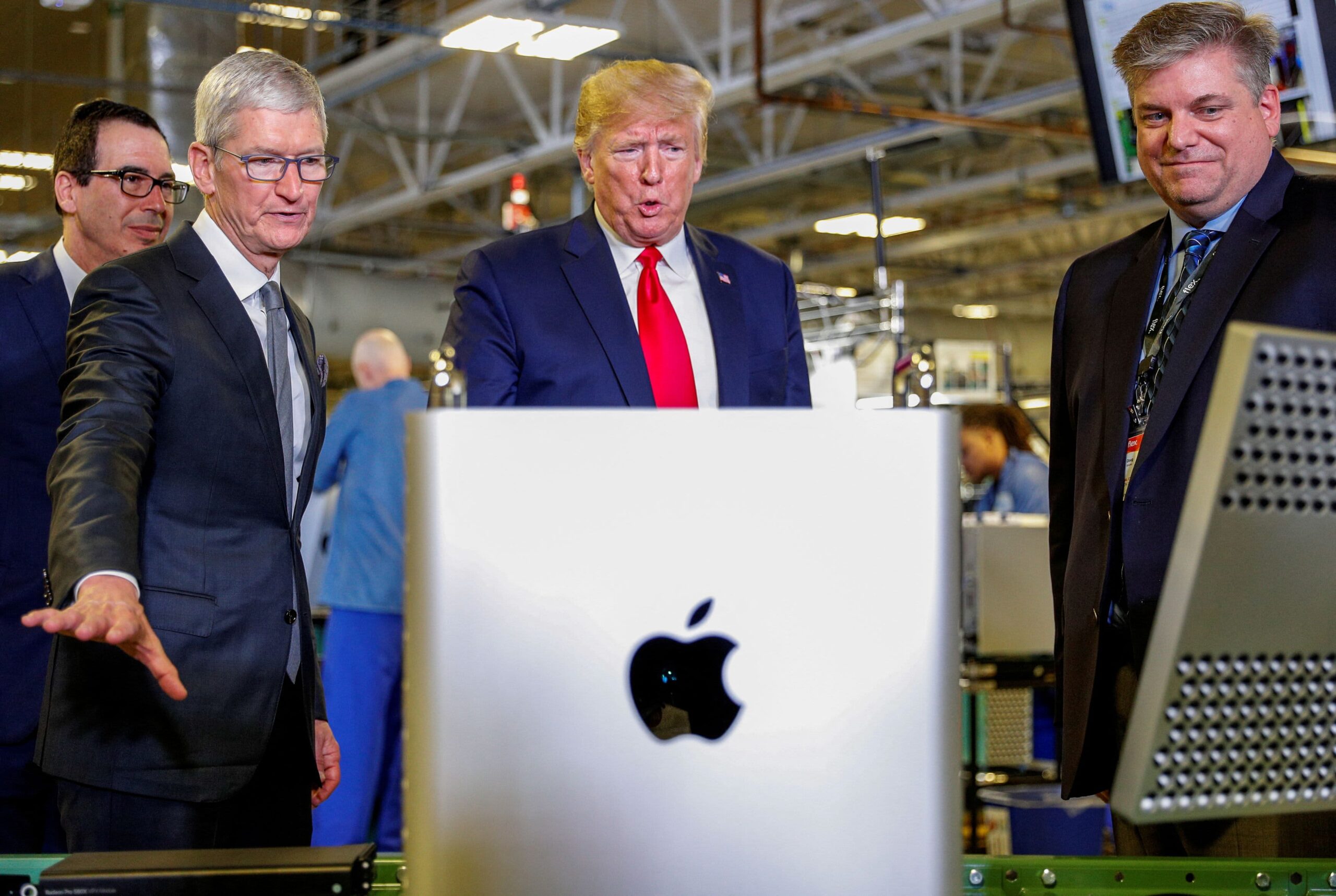
President Donald Trump issued a direct challenge to Apple CEO Tim Cook in May 2025, demanding the tech giant manufacture iPhones for American customers on U.S. soil. His message carried serious financial consequences: comply or pay hefty tariffs.
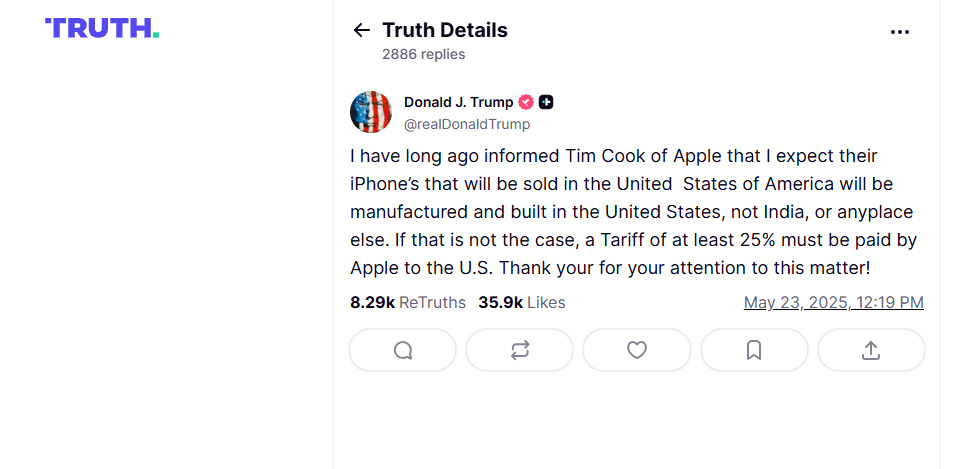
The ultimatum came through Trump’s Truth Social platform, where he wrote: “I have long ago informed Tim Cook of Apple that I expect their iPhones that will be sold in the United States of America will be manufactured and built in the United States, not India, or anyplace else.”
Trump left no room for interpretation. “If that is not the case, a Tariff of at least 25% must be paid by Apple to the U.S.,” he declared.
Apple’s India Strategy Triggers Trump’s Response
The confrontation stems from Apple’s recent shift in manufacturing strategy. During the company’s May earnings call, CEO Tim Cook revealed that “the majority of iPhones sold in the U.S. will have India as their country of origin.” This move was designed to dodge high tariffs on Chinese-made products.
The company has been working with manufacturing partners like Foxconn, which invested $1.5 billion in expanding its Indian facilities, according to Financial Times reporting.
But Trump saw Apple’s India expansion as circumventing his vision for American manufacturing dominance.
The High Cost of American iPhone Production
Industry experts paint a stark picture of what U.S.-based iPhone manufacturing would actually mean for consumers. Dan Ives from Wedbush Securities estimates that moving iPhone production to America would push the price of a U.S.-made iPhone to approximately $3,500 – more than triple the current iPhone 16 Pro’s $1,000 price tag.
Bank of America analysts calculate that U.S. labor costs alone would increase iPhone prices by 25%, excluding additional expenses like factory construction and supply chain restructuring.
“Price points would move up so dramatically it’s hard to comprehend,” Ives said, calling the concept of U.S.-made iPhones a “nonstarter.”
The complexity extends beyond simple assembly. Apple’s supply chain spans continents, with components sourced from dozens of countries. Moving this intricate network to American soil would require massive infrastructure investments and take years to implement.
Apple’s $500 Billion Counter-Strategy
Rather than commit to iPhone manufacturing in America, Apple announced a different approach. In February 2025, the company unveiled plans to spend more than $500 billion in the U.S. over four years – but focused on research, development, and specialized manufacturing rather than consumer device assembly.
The investment package includes:
- A new server manufacturing facility in Houston for Apple Intelligence infrastructure
- Doubling the U.S. Advanced Manufacturing Fund from $5 billion to $10 billion
- Plans to hire approximately 20,000 new employees, mostly in R&D roles
- Opening an Apple Manufacturing Academy in Detroit to train American workers
This strategy allows Apple to demonstrate significant U.S. investment without the massive costs and logistical challenges of moving iPhone assembly stateside.
Trump’s Broader Manufacturing Push
Trump’s Apple ultimatum fits into his wider campaign to return manufacturing jobs to America. The president has wielded tariff threats against multiple industries and countries, using economic pressure to encourage domestic production.
During a May press conference, Trump expanded his threat beyond Apple: “I had an understanding with Tim that he wouldn’t be doing this. He said he’s going to India to build plants. I said that’s okay to go to India, but you’re not going to sell into here without tariffs.”
The president made clear that similar penalties would apply to other smartphone manufacturers, including Samsung, with implementation scheduled for late June 2025.
Market Impact and Industry Response
Apple’s stock price dropped 3% following Trump’s tariff announcement, reflecting investor concerns about potential cost increases and supply chain disruptions.
The broader tech industry watched nervously as Trump’s pressure on Apple signaled potential challenges for other companies with overseas manufacturing operations.
Treasury Secretary Scott Bessent framed the Apple situation as part of the administration’s push to strengthen America’s “precision manufacturing” capabilities, particularly in semiconductors.
The Reality of Global Manufacturing
Despite Trump’s demands, experts remain skeptical about large-scale iPhone production returning to America. Avi Greengart from Techsponential told ABC News that while “anything is possible,” relocating Apple’s supply chain would require “many years, possibly decades” and would severely impact profitability.
Ben Bajarin from Creative Strategies noted that even with significant price increases, only a small portion of consumers would buy premium-priced American-made iPhones, while the “vast majority” would choose cheaper alternatives.
The fundamental challenge remains: American manufacturing wages are significantly higher than those in Asia, making consumer electronics production economically unviable without substantial price increases that could price out most buyers.
Current Status and Future Implications
As of August 2025, Apple continues manufacturing most iPhones in China and India while expanding its U.S. investments in other areas. The company has successfully navigated Trump’s tariff threats before, maintaining strong relationships with the administration while pursuing its global manufacturing strategy.
The ongoing tension between Trump’s manufacturing demands and Apple’s economic realities represents a broader challenge facing American tech companies which is balancing political pressure for domestic production with the economic necessities of global competition.
Trump’s ultimatum to Apple highlights the complex intersection of trade policy, manufacturing economics, and political objectives in modern American business. While the president’s pressure has generated headlines and market volatility, the practical challenges of reshoring iPhone production remain formidable.