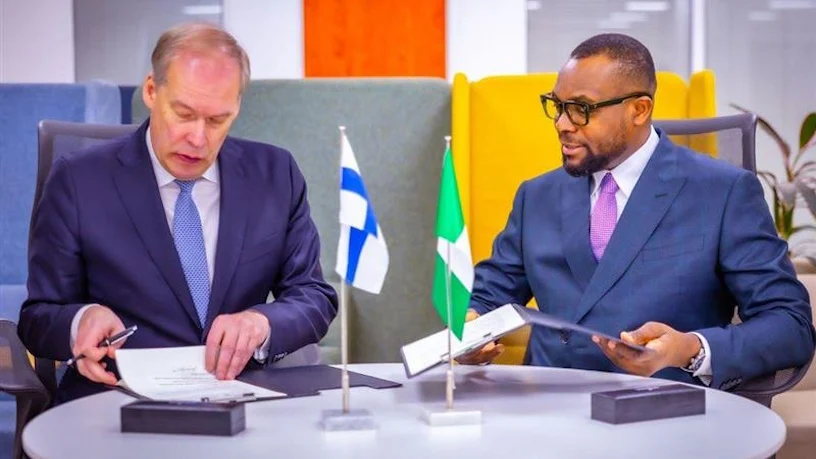
Nigeria and Finland have signed a Memorandum of Understanding on Digitalisation and Innovation, opening a new chapter in bilateral cooperation that puts cybersecurity, digital infrastructure, and technology capacity squarely at the centre of the two countries’ relationship.

What Was Signed and Who Signed It
The MoU was signed in Abuja by Dr Bosun Tijani, Nigeria’s Minister of Communications, Innovation and Digital Economy, and Jarno Syrjälä, Under-Secretary of State for International Trade at Finland’s Ministry for Foreign Affairs.
Under the agreement, both countries will collaborate across digital government, emerging technologies, cybersecurity, digital public infrastructure, innovation ecosystems, and capacity building. The pact is also expected to provide a framework for knowledge exchange, institutional cooperation, and private sector engagement.
Why This Deal Matters
The agreement is not happening in a vacuum. It builds on months of diplomatic groundwork. Dr Tijani described the signing as a significant next step following his engagements in Helsinki in February 2026, where discussions centred on digital infrastructure, the Data Exchange Platform, and potential Finnish involvement in Nigeria’s broader digital transformation agenda.
For Finland, the motivation is equally strategic. Syrjälä stated that Nigeria is a key partner for Finland in Africa, and that the MoU provides a strong basis for concrete cooperation between governments, institutions, and private sectors, with a goal of advancing digital solutions that are interoperable, future-fit, and mutually beneficial.
The €23 Million EU Programme Behind It
The MoU does not stand alone. It is backed by a significant funding commitment from Europe. Finland is leading a €23 million EU-backed initiative aimed at strengthening Nigeria’s digital public services and expanding inclusive digital skills across the country.
The initiative is designed to deepen Nigeria’s digital capacity by improving access to secure, interoperable, and citizen-focused public services, while also building a skilled workforce to drive the country’s digital economy.
Critically for Nigeria’s domestic agenda, the project will also support the rollout of the 3 Million Technical Talent (3MTT) programme, a key federal initiative designed to build a robust digital workforce. The programme is being implemented by Finland’s development agency HAUS in consortium with Estonia’s development agency ESTDEV, and aligns with Nigeria’s National Digital Economy Policy and Strategy.
Cybersecurity as a Core Pillar
While the MoU covers several areas, cybersecurity is one of its most prominent focus points, and also one where Finland brings genuine expertise. Finnish Ambassador Sanna Selin noted that the collaboration will strengthen cybersecurity and data protection practices, build institutional capacity, and expand inclusive digital access for both citizens and businesses.
Earlier diplomatic engagements between the two countries had already flagged cybersecurity, digital public infrastructure, and internal security technology as key areas of strategic cooperation. The MoU effectively formalises that direction.
Nigeria’s Wider Digital Push
The development comes amid Nigeria’s aggressive push to position itself as Africa’s digital powerhouse, with ongoing reforms in digital public infrastructure, cybersecurity, and innovation-driven growth. The Finland deal adds to a string of international partnerships the Tinubu administration has pursued through the Ministry of Communications under Tijani’s leadership.
Finland’s interest, meanwhile, extends beyond diplomacy. The Finnish Ambassador briefed Nigeria’s Ministry of Foreign Affairs on Finland’s plan to establish a Trade Office in Lagos in an initiative expected to enhance economic ties and expand commercial opportunities.
Takeaway
This MoU signals that Nigeria’s digital diplomacy is maturing. Rather than one-off agreements, the country is building layered partnerships with partners who bring specific technical credibility. Finland, consistently ranked among the world’s top digital governments, is a meaningful counterpart for that ambition.