

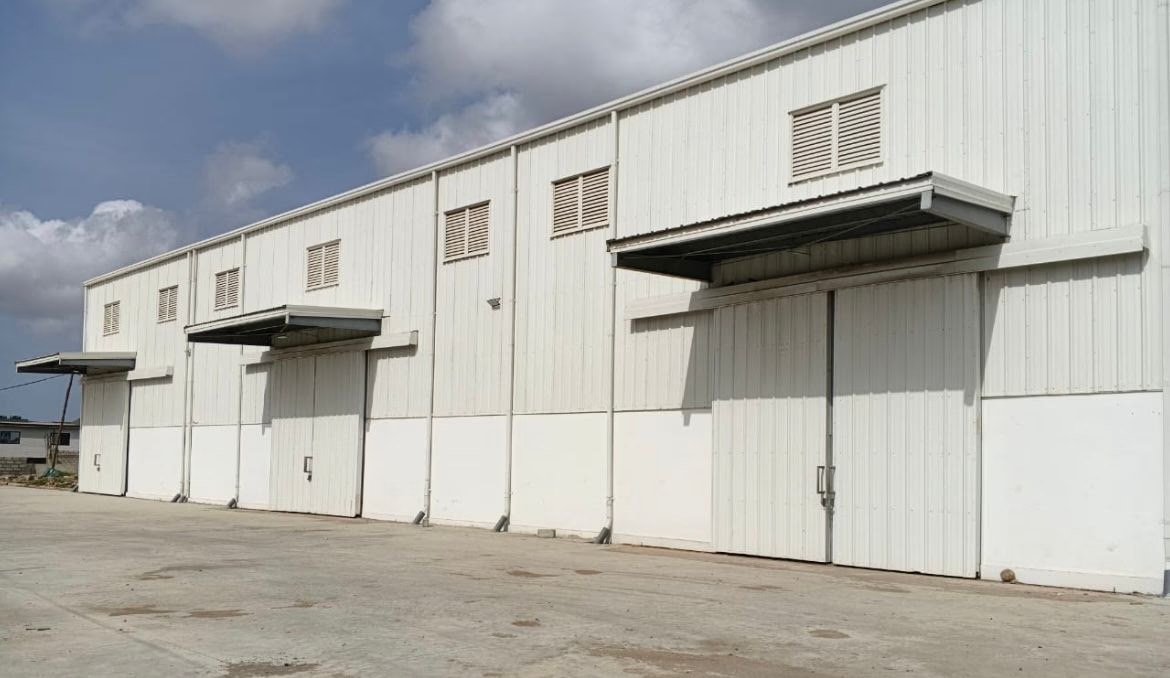
African tech has spent a decade obsessing over fintech and software. Now, the new Terra Industries Ghana facility is forcing a hard pivot to heavy hardware. Following a recent $34 million raise, the defense tech startup is building “Pax-2” in Accra, a 34,000-square-foot facility set to become the continent’s largest drone manufacturing hub by June 2026.
This isn’t about consumer delivery drones; it is the foundation of a sovereign military-industrial base.
The Geographic Hedge: Why Accra?
Terra already operates its Pax-1 flagship in Abuja, which serves Nigeria’s massive internal security market. The expansion to create Terra Industries Ghana is a calculated regional export play.
Accra offers a politically stable, highly predictable manufacturing environment crucial for a facility aiming to output 50,000 autonomous units annually by 2028. To build at that scale, Terra needs a government willing to aggressively fast-track aerospace regulations, airspace testing, and defense export licenses. They found that regulatory runway in Ghana. By establishing a dual-country footprint, Terra mitigates operational risks and positions Ghana as a vital hub within the ECOWAS region for defense hardware logistics.
The Kama Interceptor and the Sahel Threat
The core of this expansion is the product-market fit of Terra’s newest hardware: the Kama drone.
Modern conflict in the Sahel has fundamentally shifted. Non-state actors are aggressively retrofitting cheap, commercial fiber-optic drones into attack systems, and traditional militaries are struggling to counter this asymmetric warfare with heavy, legacy equipment.
Terra’s Kama isn’t built for passive surveillance; it is a 300 km/h kinetic interceptor engineered for high-volume defense. Instead of relying purely on electronic jamming (which adversaries quickly adapt to), Kama physically intercepts the threat. By manufacturing these interceptors at the Terra Industries Ghana plant, the company is building a scalable, localized immune system to protect allied African infrastructure, border zones, and maritime assets.
Rewiring the Talent Pipeline
Pax-2 will immediately create 120 specialized engineering roles. For the local ecosystem, this breaks the monopoly of B2B SaaS and consumer apps.
It introduces high-stakes aerospace, mechatronics, fluid dynamics, and embedded systems opportunities. Historically, top-tier African hardware talent has bled out to foreign defense contractors like Anduril or DJI due to a lack of local opportunities. This facility reverses that brain drain. These engineers will be tasked with integrating physical airframes—like the Archer VTOL and the rapid-deployment Iroko UAV—directly with ArtemisOS, Terra’s unified software platform.
The Economic and VC Ripple Effect
Beyond the immediate hardware, a factory of this scale stimulates secondary supply chains. To sustain a 50,000-unit annual production rate, Terra will inevitably need to source local materials, stimulating advanced manufacturing and precision machining sectors in West Africa.
Furthermore, it signals a massive shift to global venture capital. The $34 million round backing this expansion proves that deep tech and defense hardware are now viable, high-ROI sectors in Africa. Investors are realizing that the next billion-dollar African startups might not just be moving money—they might be securing borders.
The Bottom Line: CEO Nathan Nwachuku’s vision of “Pax Africana” relies on a simple premise: imported security architecture has failed to stabilize the continent. With the launch of Terra Industries Ghana, the startup proves African nations can build their own defense tech. Ghana isn’t just hosting a factory; it is positioning itself as the primary supply chain hub for the African defense prime.