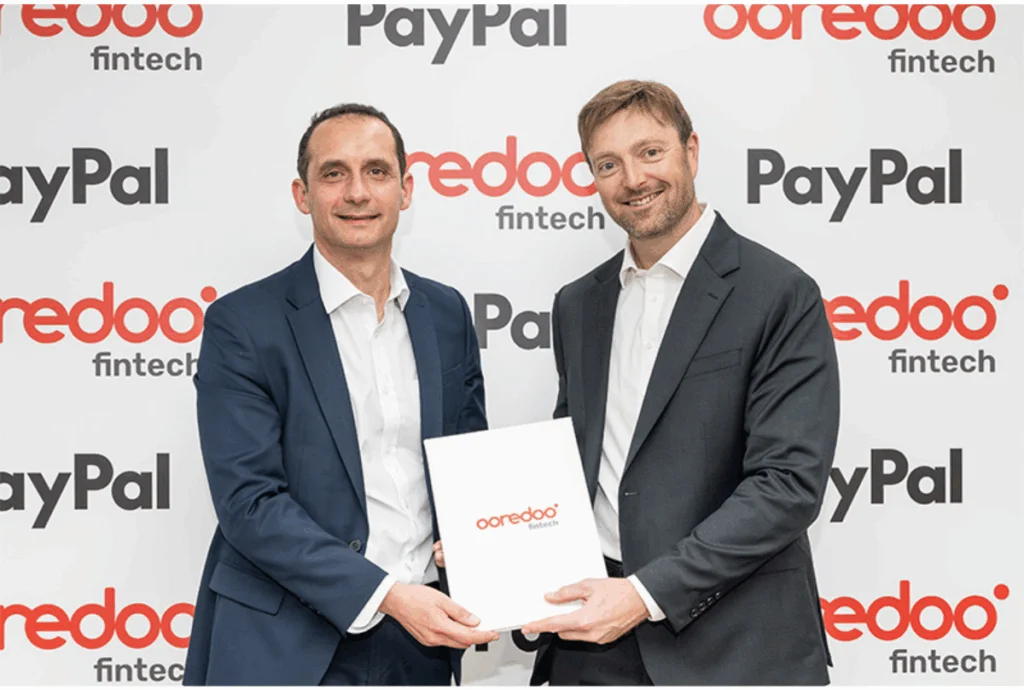
Ooredoo Fintech, the digital payments arm of Ooredoo Group, will join PayPal World, a global platform that connects payment systems and digital wallets across borders. Announced on 1 October 2025, the partnership will allow Ooredoo Wallet users in Qatar, Oman, and the Maldives to spend and transfer money internationally through PayPal’s merchant network.

According to PayPal, the collaboration will link Ooredoo’s regional wallet directly to millions of merchants worldwide. Users will be able to pay in multiple currencies, shop online, and make in-store transactions without switching apps or cards.
For Ooredoo Fintech, this move expands its reach beyond the Gulf. The company already offers peer-to-peer transfers, merchant payments, and utility bill services across its footprint. But cross-border payments have remained costly and complex. Integration with PayPal World promises to change that by connecting Ooredoo’s growing customer base to a truly global payment ecosystem.
Mirko Giacco, CEO of Ooredoo Fintech, said the deal supports the company’s goal of “enabling borderless payments through local wallets.” For PayPal, it advances the mission of building a unified, interoperable payments network capable of connecting billions of users worldwide.
Bridging Local To Global
PayPal World is the company’s latest attempt to simplify global commerce by linking multiple wallets and payment systems under one network. For users, it means access to new merchants without needing a PayPal account. For regional providers like Ooredoo Fintech, it removes the technical and regulatory friction that often limits cross-border transactions.
The platform allows local wallets to connect to PayPal’s existing infrastructure, enabling smoother currency conversion, global merchant acceptance, and improved fraud protection. For Ooredoo, joining the network gives its customers access to millions of global merchants, while merchants gain automatic access to Ooredoo Wallet users across its operating markets.
PayPal CEO Alex Chriss described PayPal World as a “first-of-its-kind ecosystem” designed to bring the world’s payment systems closer together. By adding Ooredoo Fintech, PayPal expands its footprint in the Middle East and strengthens its position as a bridge between global e-commerce and local financial services.
For users, the integration means one thing: fewer boundaries. Whether paying for a subscription, shopping online, or sending money abroad, transactions that once required multiple steps can now happen through a single wallet.
Access, Choice, Competition
For users, the partnership promises convenience and access. Ooredoo Wallet holders will be able to pay for international subscriptions, shop online, or send funds abroad without relying on cards or third-party apps. For many in the Gulf and South Asia, where card penetration remains limited, this kind of wallet interoperability makes digital payments more practical than ever.
Merchants also stand to gain. Joining PayPal World automatically connects them to Ooredoo’s regional customer base without extra integration work. Local SMEs in Qatar, Oman, or the Maldives could start accepting payments from foreign customers through a familiar, secure interface. That could widen their reach in markets where cross-border e-commerce has long been constrained by payment barriers.
But there’s also a competitive undertone. Regional fintechs such as STC Pay, e& Money, and Vodafone Cash have been racing to expand their international capabilities. PayPal’s partnership with Ooredoo raises the stakes. It sets a new benchmark for interoperability, forcing others to consider global partnerships rather than building closed systems.
Regulation, Cost, And Integration
While the partnership opens new opportunities, it also brings real challenges. Cross-border payments are among the most regulated areas of finance, and each of Ooredoo’s markets, from Qatar to the Maldives, operates under different licensing and data rules. Ensuring compliance across jurisdictions will test how quickly the integration can move from announcement to real-world use.
Currency conversion and settlement costs are another concern. While PayPal World promises lower friction, fees on small-value transactions can still add up for users and merchants alike. Managing foreign exchange rates, chargebacks, and transaction disputes across regions will require careful coordination between both companies.
Integration is the third hurdle. Merging Ooredoo’s wallet infrastructure with PayPal’s vast network means aligning systems built under different standards. Any delays or technical inconsistencies could undermine user trust at the very stage when confidence is most critical.
Still, both companies have the scale and infrastructure to manage these challenges. If executed well, the collaboration could become a case study in how regional fintechs link into the global digital economy without losing local control.
Local Wallets, Global Ambitions
Ooredoo Fintech’s move into PayPal World is more than a partnership. It signals how regional fintechs are stepping into the global arena by integrating into the same networks that shape global commerce.
For users, it’s a simple promise: more access, fewer barriers. For regulators, it’s a test of how far local frameworks can stretch to accommodate borderless payments. And for the wider fintech ecosystem, it shows that collaboration, not isolation, will define the next phase of digital finance.
If the rollout succeeds, it could mark a new standard for Gulf fintech. Local wallets will no longer be limited by geography. They’ll become gateways into a shared payments ecosystem, where a user in Doha can pay for a product in New York as easily as in Muscat.
In an increasingly connected financial world, Ooredoo’s partnership with PayPal shows that the future of fintech isn’t just about who builds the platform, but who connects to it first.